


 Shkruar nga Bulent Mumay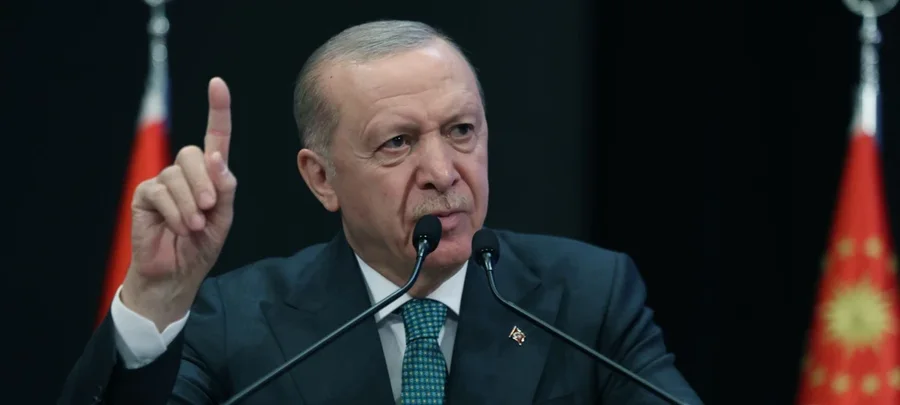
Turkish president uses war with Iran to maintain power while suppressing opposition and media
Wars, regional crises, and international upheavals undoubtedly have a negative impact on the world. Democracies regress and economies weaken. In Turkey, the consequences of these negative developments are felt particularly strongly. This is because Erdogan uses every crisis to govern more authoritarianly and increase pressure on society.
He compared the largest protest against his government, the Gezi Park uprising in 2013, to the wave of protests of the “Arab Spring,” describing it as an “outwardly incited uprising.” The protests were suppressed with excessive force. Erdogan also used the civil war in Syria, which escalated a little later, as a tool, especially against the West. He used the flow of refugees as a means of pressure and softened international criticism of his authoritarian steps. Erdogan often plays with the international balance of power; Russia’s war against Ukraine also served him well. He maintained relations with both sides while strengthening control at home.
Even the war with Iran, triggered by Israeli and US attacks, could turn into an opportunity for Erdogan, but a major risk for democracy in Turkey. The country's increased geopolitical importance could weaken criticism from the West, thus accelerating the weakening of democracy. Domestically, this war offers the government an opportunity to shift attention from the economy and domestic problems to security issues and the perception of an external threat. This could foster mobilization around the government and help the regime recover lost support.
However, Erdogan knows that these circumstances are not enough to guarantee victory in the upcoming elections. Currently, the regime is unable to create social consensus and therefore relies on repression and the use of the justice system to survive.
As is known, his strongest rival, Ekrem İmamoğlu, was arrested a year ago on corruption charges. The arrest came a day after his university degree, which he earned 31 years ago, was revoked, a condition for running for president. More than ten cases have been opened against him, and thousands of years in prison are being sought in total. Meanwhile, the largest opposition party faces the risk of being banned. The regime does not stop there; it uses the judiciary to crack down on all critics, be they students, artists, journalists or trade unionists.
A famous singer was investigated after declaring at a concert: “we will change this time for the better”, which was interpreted as an attack on the constitutional order. Meanwhile, sixteen students were investigated for decorating trees on the university campus before the New Year. Strikes, although guaranteed by law, have been banned for years on the grounds of “national security”. Recently, a union leader was also arrested after demanding accountability for a serious accident at work.
Critical journalists remain among the main victims of the justice system. They have been repeatedly arrested on charges of membership in terrorist organizations or insulting the president. The law against “disinformation,” passed four years ago, has been used to silence the media, despite promises that it would not affect journalistic activity. Since 2022, any reporting that does not please the government can be prosecuted as “spreading false information.” About a hundred journalists have faced court and several have been arrested.
The most recent case is that of journalist Ismail Arı from the opposition newspaper BirGun. He was imprisoned for reporting on foundations linked to Erdogan and his family. Arı had uncovered major scandals, including the sale of tents to earthquake victims and cases of abuse in religious sects. He had received death threats and was under police protection, but was nevertheless arrested by the authorities.
Meanwhile, the government-affiliated media does not face consequences under the disinformation law. After İmamoğlu's arrest, it published a series of false news stories, which were later denied. However, no legal action was taken against the authors of these reports.
These developments show a selective use of the law and a continued attempt to control the public narrative in Turkey. /Adapted from FAZ /


Erdogani është politikisht i mbaruar. Fizikisht ai ka pak kohë për të ecur. E përgatit të birin, por djali i tij nuk ishte në gjendje të fshihte dollarët në kutitë e këpucëve! Opozita do të "ngulë gozhdën e fundit në arkivol" në zgjedhjet e vitit 2027. Dhe turqit do të kthehen në klubin e demokracisë së BE-së. Për çfarë autokracie po flisni?