


 Shkruar nga Diplomatico | Pamfleti.net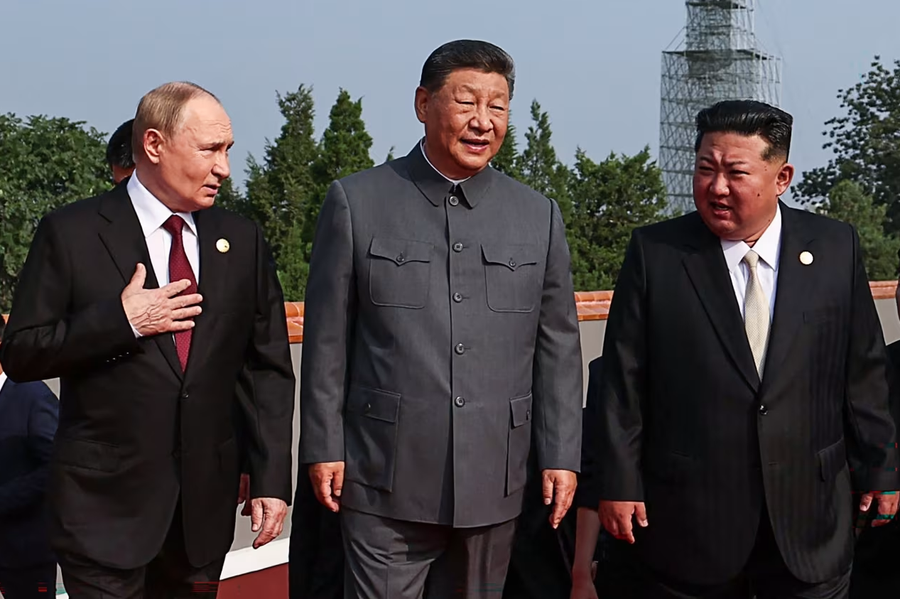
The giant parade in Tiananmen turns into a show of force and geopolitical message, with Xi Jinping, Vladimir Putin and Kim Jong-Un on the same rostrum against the Western order...
On September 3, 2025, Tiananmen Square in Beijing became the scene of the largest military demonstration China has ever staged. On the occasion of the 80th anniversary of the end of World War II, President Xi Jinping unveiled a powerful technological and political spectacle to the world, turning the ceremony into a blunt message to international rivals and an instrument for consolidating domestic power.
Sophisticated missile systems, autonomous drones, laser air defense artillery, as well as elements of the nuclear triad: DF-5C intercontinental missiles, the DF-61 road version, and naval platforms that confirm Beijing's ambition to be a global superpower with full destructive capacity, paraded along the main boulevard of the Chinese capital.
The technology spectacle was not just a demonstration of the military's capabilities, but a clear message to the US and Western allies that China has no intention of bowing to strategic pressures.
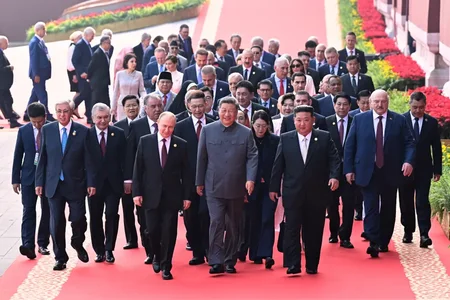
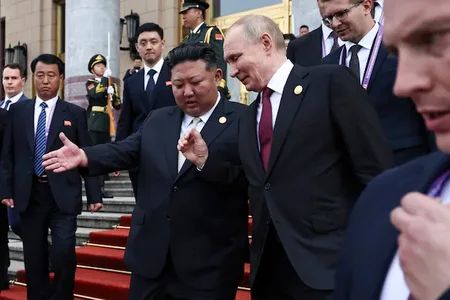
The political symbolism was even more significant. On the central tribune, alongside Xi Jinping, stood Vladimir Putin and Kim Jong-Un, creating the image of an “axis of unrest” openly challenging the Western-led order.
This joint appearance by the three leaders, known for their rivalry with Washington, was read as a warning of closer cooperation between Beijing, Moscow and Pyongyang.
Putin's participation gave the parade a strong geopolitical dimension, signaling that Russian-Chinese ties are entering a new strategic phase, while Kim Jong-Un's presence openly underscored the increasingly visible ties between Beijing and the North Korean regime.
Xi used his speech not only to commemorate the past but also to warn of the future. He declared that “China will not be afraid of anyone” and that the world today faces a clear choice: peace or conflict.
His message was twofold; on the one hand a challenge to the US, which continues to support Taiwan and reinforce its military presence in Asia, and on the other hand a domestic promise to the Chinese people that the Communist Party is ready to defend the country under any circumstances.
In the West, reactions were not long in coming. US President Donald Trump immediately denounced the parade as a “propaganda theater” and a conspiracy against the US, warning of new measures to strengthen alliances in the Indo-Pacific. Meanwhile, Japan and Taiwan expressed open concern about China’s increasing military aggressiveness, seeing the parade as a signal of preparation for confrontation.
But beyond its external dimension, the parade also served as a tool for internal mobilization. By honoring World War II veterans and positioning the Communist Party as the heir to historical glory, Xi consolidated his message of national unity and his absolute authority.
The spectacle at Tiananmen was a combination of historical memory, nationalist pride, and the ambition to present himself as the undisputed leader of a rising world power.
Overall, the 80th anniversary parade was not just a festive manifestation; it was a deliberate provocation, an open message that China is entering a new era of power projection. On the one hand, Beijing showed the West that it possesses the full military capacity to face any challenge. On the other hand, Xi used the Tiananmen scene to showcase a new political bloc, where China, Russia, and North Korea are positioned as the main challengers to the current international order.
In this sense, the parade was not just for China, but for the entire world: a message that the global balance of power is changing, and Beijing seeks to be at the center of this change./ Pamphlet



Lini një Përgjigje