


 Shkruar nga Diplomatico | Pamfleti.net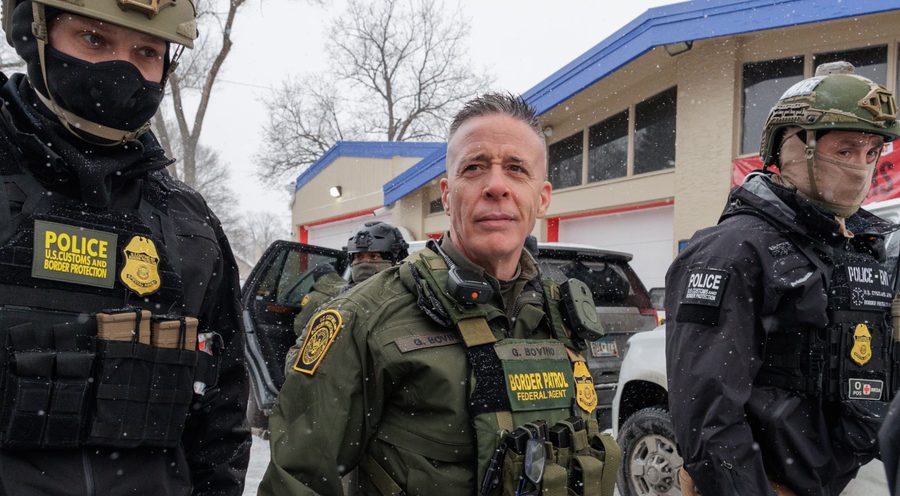
The federal immigration operation collapses under public pressure: Commander Bovino is fired, agents are reduced, and the White House acknowledges the limits of force...
Minneapolis has become the clearest proof that federal force policy has real limits, especially when it clashes with politically mobilized cities, resistant local institutions, and a public opinion sensitive to civil rights violations.
The Donald Trump administration, built on “law and order” rhetoric and a relentless crackdown on immigration, has been forced to partially withdraw from an operation that was intended to demonstrate federal authority but ended up exposing the political and institutional fragility of that approach. The removal of the operation’s leading figure and the reduction of the federal agent presence in Minneapolis constitute a silent but significant setback.
At the center of this crisis is Gregory Bovino, the head of the US Border Patrol and the most prominent figure in the Trump administration’s immigration offensive in Minneapolis. Bovino has been removed or retired from his role in the city and will return to a previous post in California, where he is expected to retire. The departure, although officially packaged as an “administrative reassignment,” is widely read as a solution to the crisis after the intense controversy that erupted over federal law enforcement operations in Minnesota and, above all, after the deaths of two civilians during interventions involving federal agents. In American politics, such moves are rarely neutral: they are signals.
The federal operation, conceived as part of a broader strategy to extend the powers of border and immigration forces to urban centers, was perceived by local authorities and communities as a direct provocation. Aggressive arrests, an armed presence in multi-ethnic neighborhoods, and an official language that ignored the social reality of the city sparked immediate reactions. Protests, the refusal of cooperation from the city council, and political clashes transformed Minneapolis into a symbolic battleground between federal power and local autonomy. The fatal incidents shifted the debate from immigration to state violence, reviving the collective trauma that the city has been holding on to for years.
What forced the Trump administration to withdraw was not only the pressure of the road, but also the growing political cost. Criticism came not only from traditional opponents, but also from Republican lawmakers, who demanded investigations and transparency. In this context, continuing the offensive would mean open confrontation with a symbolic city, endangering public order and further deteriorating the presidential image. The solution came through a familiar formula: the removal of the commander, lowering the profile of the operation and a careful official silence on the word “withdrawal”.
Minneapolis, in this sense, did not politically overthrow Donald Trump, but it did set a clear limit for him. It showed that the use of federal force in polarized urban environments does not necessarily produce order, but often resistance; it does not build authority, but erodes it. Beyond the US, this episode also has an international significance: it signals that even the most confrontational administrations face social and moral limitations that cannot be overcome with uniforms and orders.
In the end, Trump's Minneapolis defeat remains an important precedent. A city that resisted, a commander who walked away, and an administration that, without openly admitting it, changed course. In politics, especially for leaders who build their power on the image of strength, these are the moments when reality speaks louder than rhetoric. /Pamphlet


Si nuk pashe nja afrikan nga keta por vetem te bardhe. Luan dicka fashiste me duket.