


 Shkruar nga Gilles Gressani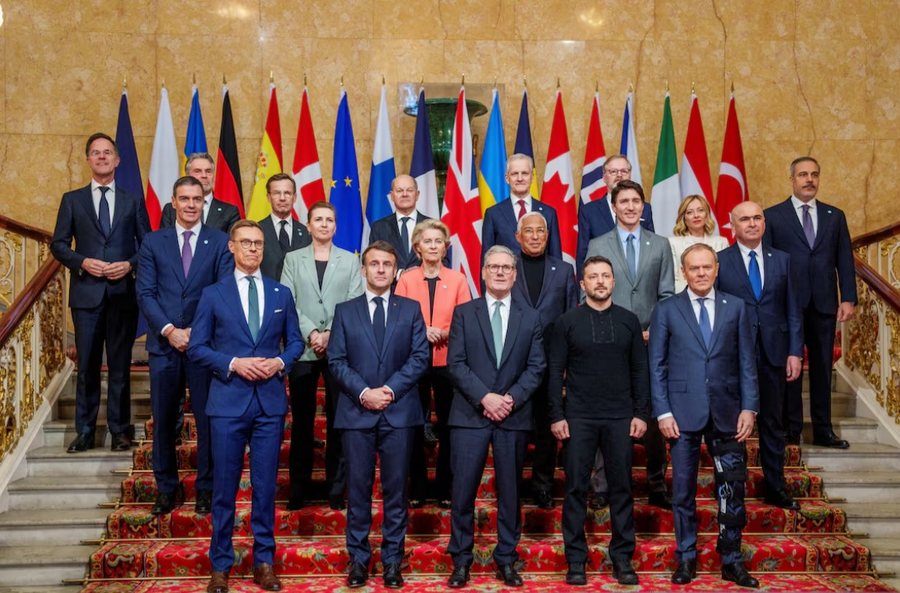
There is a name for the discrepancy between the strength of Trump's radical political agenda and the inadequacy of the European response to it: "heureuse vassalization," a kind of willing submission.
The trade agreement between the US and the EU announced at the end of July has dealt a significant blow to the global position of the bloc and its member states.
This obstacle is the result of the world’s largest trading power willingly submitting to outright extortion, with President Donald Trump exploiting the EU’s structural weaknesses. What once seemed like a strategic trilemma, between market, democracy and climate, has now hardened into a systemic trap.
First, Trump has undermined what was once considered the EU’s main strength, the single market, revealing this economic giant to be a political dwarf, unwilling and unable to engage in a power struggle to defend its own interests or articulate a coherent set of strategic priorities. Europe, which seems to believe that the deal was a necessary step to maintain US support for Ukraine, could face a harsh surprise at the Trump-Putin summit in Alaska.
Second, by demanding increased European investment in American liquefied natural gas, Trump showed how easily what was supposed to be a core EU objective, the climate agenda, could be ignored.
Third, Trump has exposed the inability of the EU and its member states to mount a democratic defense of the legitimacy of their institutions. There is a name for the discrepancy between the strength of Trump’s radical political agenda and the inadequacy of the European response to it: “vassalization heureuse,” a kind of willing submission.
The White House’s goal seems to be not just to influence the Western order, but to reshape it entirely in a vast geopolitical space in which no real sovereignty can exist outside Washington’s orbit. If this radical vision is fully realized, the result could resemble a digital-age version of the Warsaw Pact: states will still exist, but they will be forced to align or submit.
We are not there yet, and the EU’s actions (or inactions) may yet affect the outcome. But the beginnings of such a system are already emerging, whether in attacks on autonomous governance of the digital public sphere, climate policy, or the territorial integrity of allies like Denmark.
The basic goal remains the same: to test the limits and achieve a strategic retreat. Although capitulation has been reimagined as pragmatism, there is nothing “happy” about Europe’s subjugation. It amounts to the rejection of any substantial autonomy in exchange for protection.
The supposed benefits of this arrangement lie primarily in avoiding too harsh or unexpected punishment. As such, it is more of a defensive ruse than a long-term insurance policy. In a period of rapid upheaval and institutional dislocation, this solution gives directionless political systems a vague illusion of stability. It is a dynamic captured in the tense smiles on the faces of European Commission members standing next to a triumphant Trump at the announcement of the trade deal with the US.
But temporary relief always comes at a cost. It feeds defeatism and atrophies the political imagination. Believing in the inevitability of Trump's project is the first step toward accepting his terms. The constant refrains; "we have no other choice," "we need more time," "the risks are too great," hide a deeper problem: if the world's most developed countries are powerless, who, then, is left to act?
The irony is that since returning to the White House, Trump has consistently taken only what was given to him. Countries and institutions continue to surrender, offering no resistance and telling each other that resistance is futile.
Yet resistance exists. Polls show that Europeans are increasingly hostile to Trump. Unfortunately, our institutions and political elites seem unwilling or unable to harness this extraordinary energy. This paralysis is no coincidence. To establish his new regime, Trump must overcome major external obstacles, including the EU. His strategy is to make Europeans doubt their power.
It is a narrative that fits perfectly with a system that is already convinced of its own collapse. The EU seems incapable of responding and has surrendered to the “slow agony” denounced by Mario Draghi, as long as the collapse is mild enough to allow one last generation to prolong the illusion of security inherited from the long European peace.
This is an existential threat to Europe, although nothing about it is inevitable. Yes, Trump is building an imperial project, but grand plans often collide with unexpected realities, especially when they encounter determined opposition. / Adapted from “Pamphlet” from “Financial Times”




Lini një Përgjigje