


 Shkruar nga Gjergj Zefi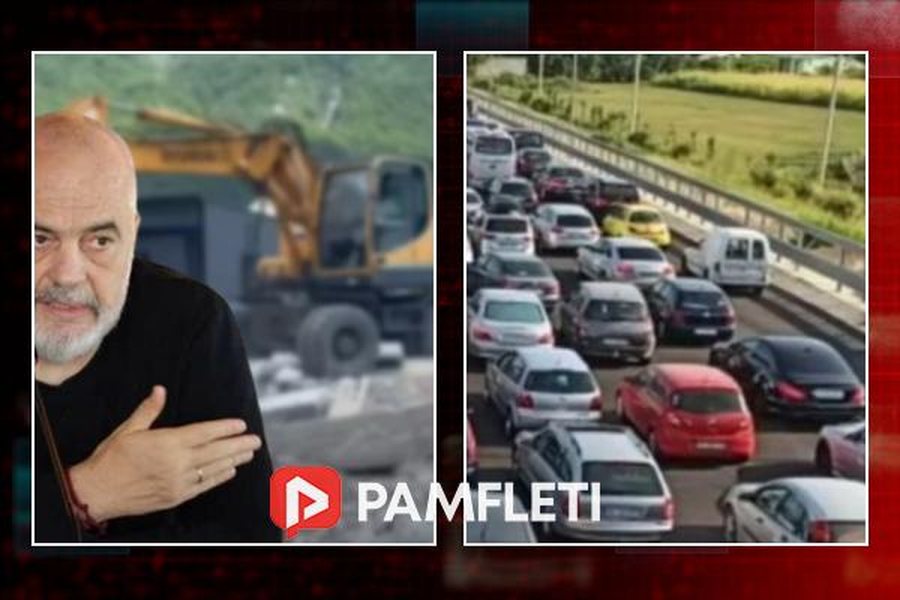
While the wooden kiosks on top of Theth disrupt the aesthetic symmetry of the government, the Tirana-Shkodra road meticulously preserves chaos as a national value. In the absence of a road, we take care of geopolitical balances...
The genius of planning and the 11 deputies of structured dumbness
Welcome to the wonderland of Albania, where to travel 99 kilometers from Tirana to Shkodra, you need three hours, two bottles of water, a Valium and a lifetime spent in traffic. We are talking about the only land route connecting you to Europe, which for years has been a trap for cars, mules and human patience.
At the head of this urban miracle we have Edi Rama, who has focused all his national concern on... the wooden kiosks in Theth. There, on top of the mountain, in the middle of the alpine tranquility, an aesthetic regime has been established that demolishes umbrellas, sacks, onion bags and national dresses, because, as our tall man says: "they are not up to standard".
Meanwhile, the Tirana-Shkodra road appears to have been designed according to the standards of the medieval crusades, where the journey was sacred, long, and arduous.
What happens to the 11 MPs representing this district?
Nothing! They are there to get paid, to vote "for" whatever comes to them from the Prime Minister's Office, and to take a selfie with some secondary road inauguration. This is their constitutional function: programmed silence and approval of everything that increases the shopping in the center of Tirana.
And while every hour of waiting in traffic can be compared to a spiritual experience in Dante's hell, our prime minister sees beyond. He sees aesthetics, he sees drones, he sees satellites, he sees reborn balconies. But he has no eye for the road that connects Albania to civilization. Because he is busy with "strategic axes" that do not pass through Shkodra. According to him, history, culture, or economy do not pass there, only "a handful of 'maloks' who do not know how to build beautifully."
In a normal country, Edi Rama should be accused of violating the Constitution, of unfair budget redistribution, of blatant regional discrimination, of misusing national priorities. But in the Albania of aesthetics over dignity, he continues to play the role of the worried artist, who wants to remove every beer tent on the coast, but is not bothered by the kilometer-long convoys dying from the heat on one-and-a-half lane roads.
This is no longer just an infrastructural problem. It is a political act of contempt, a symbolic punishment for the entire north of the country, a daily slap in the face of every citizen who believes that this state exists for them too.
But you are wrong. Edi Rama's state is not for everyone. It is for some. For those who build roads to connect to their villas on the South coast, not for those who go to Shkodra to work, live or breathe without being stuck in a traffic that never ends.
After all, why invest in Shkodra? There are no resorts. There are no towers. There are no large banknotes trampling on freshly poured concrete. There are only people. But people don't bring money, only problems.
And so, the road that leads to Europe remains the only one that takes you back to the Middle Ages. This is modern Albania, where we are all European citizens on Instagram, but abandoned medievalists in the street reality of Shkodra.
He ends the journey with a reflection: whoever has time for 3 hours of travel and 30 years of deception, surely has time for everything. Even to forgive this shame./ Pamphlet





Lini një Përgjigje