


 Shkruar nga Pamfleti
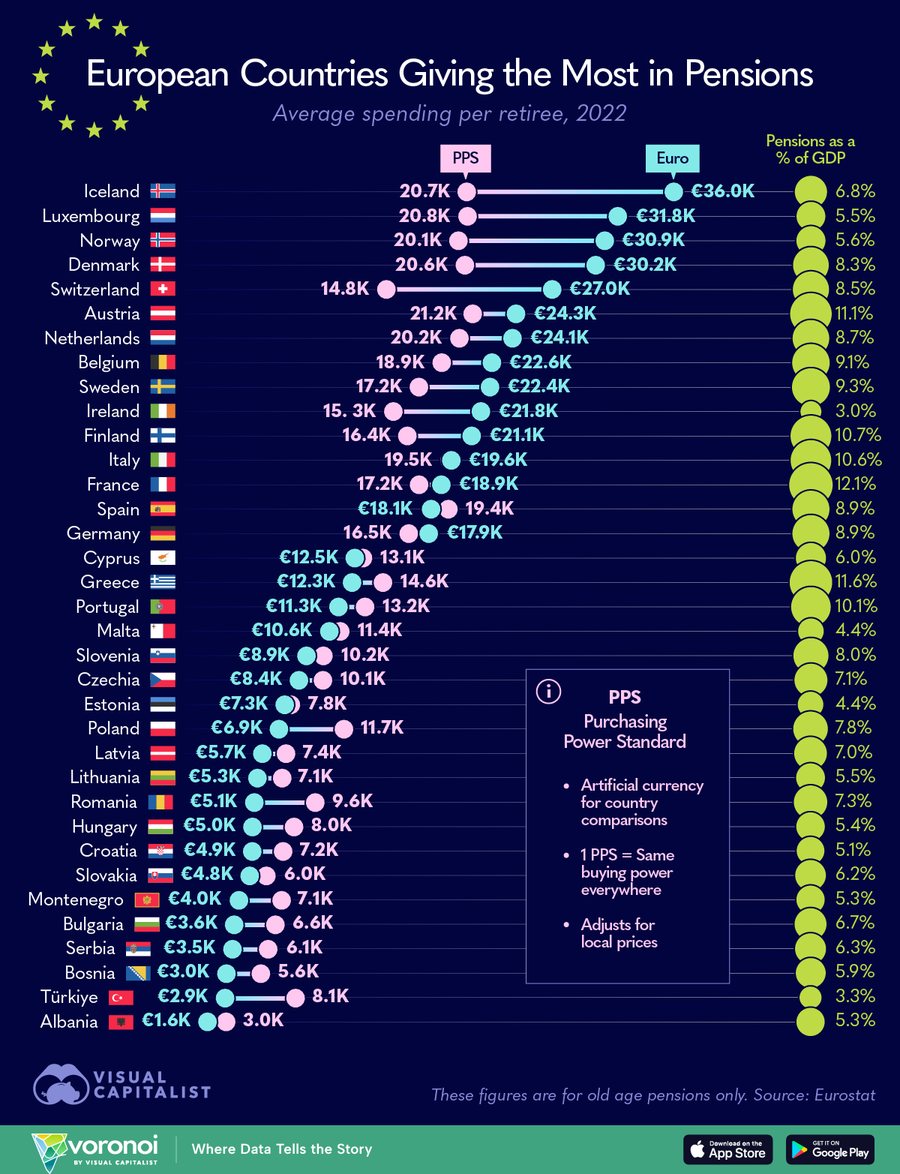
Albania ranks last among 35 European countries in terms of pension spending per capita, according to data for 2022.
With only 1,600 euros per pensioner per year, the country remains far from the European Union average, which amounts to 16,100 euros.
Even when purchasing power is taken into account, the difference remains significant.
In relation to Gross Domestic Product, Albania spends only 5.3% on pensions, compared to the 9.3% that the EU spends on average — a clear indicator of the structural challenges facing the country's pension system.
Meanwhile, Montenegro, despite having the same percentage of GDP as Albania (5.3%), manages to provide 4,000 euros per pensioner per year, more than double Albania's. Serbia, on the other hand, spends 3,500 euros per pensioner and 6.3% of GDP on pensions, reflecting higher financial support for the elderly.
europe
More and more young generations are saying they will never retire from work, due to financial insecurities. But how do today's retirees manage? How do they cover their monthly expenses and what do pensions in Europe really look like today?
The chart below presents the latest data on annual public spending on pensions per beneficiary in 35 European economies, as well as the share of old-age benefits in each country's national output.
The data are taken from two different Eurostat databases and include:
Total public pension spending for 2022, divided by the number of beneficiaries
Values expressed in both euros and purchasing power standards (PPS)
Percentage of GDP dedicated to pensions, according to data from the first base
These data provide a clear picture of the gap between countries in spending on elderly care, highlighting the challenges facing pensioners in Europe — especially those in low-income countries.
Iceland, Luxembourg and Norway top the rankings, with annual pension payments of over 30,000 euros per beneficiary.
High wages, stable fiscal revenues from energy or the financial sector, and mandatory pension savings systems give these small, wealthy economies the opportunity to offer generous benefits to the elderly.
Denmark and Switzerland complete the top five, each combining universal basic pensions with mandatory occupational pension schemes.
In the top five countries, benefits still consume less than 9% of GDP – well below the EU average (12.2% of GDP) – thanks to higher tax bases.
Eastern Europe's low payments reflect weak tax bases
In countries like Poland and Hungary, pensions absorb a similar share of GDP as the Nordic countries, but annual payments remain below 7,000 euros per beneficiary.
Low productivity limits the flow of contributions, while emigration in recent decades has further reduced the labor force.
When calculated according to purchasing power standards (PPS), the gap narrows — Polish pensioners receive about 11,700 PPS units — but real incomes remain modest.
Increasing wages, higher participation of older people in the labor market, and additional voluntary savings schemes can improve sustainability and meet needs, without burdening public budgets./ Monitor




Lini një Përgjigje