


 Shkruar nga Craig Turp-Balazs*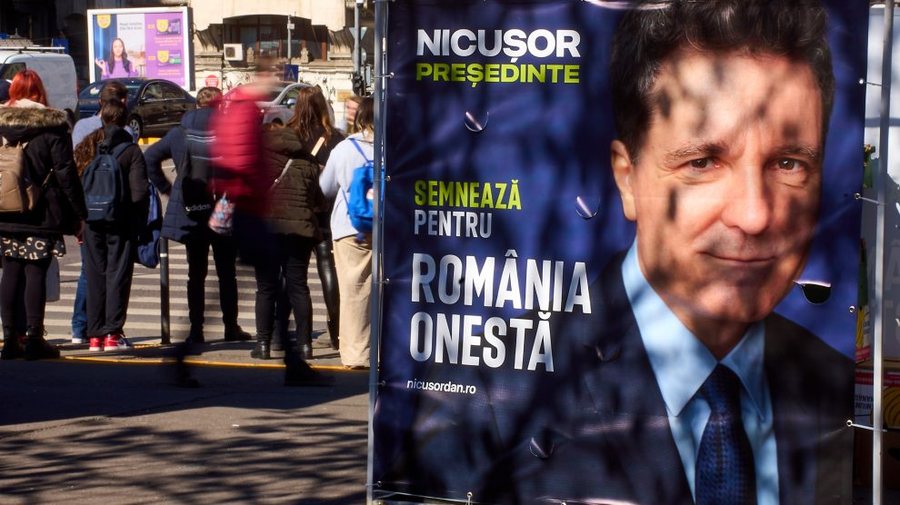
In 1989, Romanians paid with their lives to escape dictatorship. Now they risk walking blindly towards isolation...
Romania has been living in a state of suspense for the past six months. The shock victory of a hitherto unknown ultranationalist, Calin Georgescu, in the first round of the presidential election in November triggered a constitutional crisis. The country's highest court annulled the election, citing Russian interference as the reason.
Now, in their second attempt to elect a new president, Romanians face a choice that could change the fate of their country and the stability of NATO’s eastern border. On May 18, voters must decide between Georgescu’s successor, George Simion, a 38-year-old radical who leads the far-right Alliance for the Unity of Romanians (AUR), and Nicușor Dan, the pro-European mayor of Bucharest.
Simion's 41 percent of the vote in Sunday's first round - far higher than polls and analysts had predicted - makes him the clear favorite. Dan, who secured 21 percent of the vote as an independent, faces an uphill battle to narrow the gap.
The stakes are high. Romania risks turning its back on its comfortable role as a reliable ally of the West, and this because of a populist revolt against the liberal order. A victory for Simion would not only represent a political change, but would also cause
an economic crisis and a strategic realignment, which could seriously hinder support for Ukraine's war against Russia. Let's start with the economy.
Simion's program is a mix of populist and nationalist promises. He promises to "take back control" from Brussels, negotiate Romania's contributions to the EU budget, and prioritize "Romania First" policies. His advisers openly talk about pursuing the "Hungarian model" of "illiberal" democracy.
Foreign investors, worried after the November election turmoil, could flee. The national currency, the lei, could fall sharply. Borrowing costs would rise as markets assess the risk of a sovereign debt crisis.
In contrast to the gradual departure from liberal norms seen in Hungary and Poland, a Simeon presidency would bring a dramatic break. Any chance of restoring economic growth, which not long ago was at the highest levels in the EU, would disappear.
The flow of European structural funds, worth 80 billion euros over seven years, would drop sharply as Brussels would activate its rule of law mechanism. Migration, which has driven 4 million Romanians from the country since joining the bloc in 2007, would accelerate further.
Local businesses, especially in technology and manufacturing, would relocate to more stable locations. But the geopolitical consequences would be far greater than the economic ones. Romania shares a 650-kilometer border with Ukraine - the longest among EU countries.
Its Black Sea port of Constanta handles millions of tons of Ukrainian grain exports. Romania is home to NATO's largest land base on the alliance's eastern flank and has hosted over 100,000 Ukrainian refugees. Simion, meanwhile, has vowed to end Romania's support for Ukraine.
Although he has avoided the open praise of his disqualified predecessor for Vladimir Putin, he has called for “neutrality” and described Ukraine’s territorial integrity as “negotiable.” His vision for Romania includes reclaiming lost territories in Moldova and Ukraine, echoing the irredentism that destabilized Europe in the 1930s.
For Ukraine, the consequences would be immediate and severe. Romania provides the main logistical backbone for Western military aid flowing through the Black Sea corridor. It serves as a major alternative route for grain exports when Russia blocks Ukrainian ports.
A Simion government would likely restrict both, potentially collapsing Ukraine's agricultural economy, and cutting off NATO supply lines. The domino effects would destabilize the entire region. Moldova, already facing separatist threats and an energy crisis, would lose its key EU ally.
Hungary's Viktor Orbán would gain a powerful partner in his campaign to change the EU from within. Putin would find his Black Sea strategy suddenly transformed, with a friendly power controlling the western coast. But the most worrying aspect may be Simion's support from disaffected voters.
His success in the first round reflects a major distancing from the Romanian political class, which many blame for failing to close the development gap with Western Europe. Despite EU membership bringing unprecedented prosperity, inequality remains pronounced.
While Bucharest boasts shopping malls and tech hubs, much of rural Romania lacks basic infrastructure. Simion exploits this discontent with a populist approach. He denounces Romania’s leaders as “puppets of Brussels,” questions NATO’s demands for military spending, and denounces the “betrayal” of traditional values.
His rallies are accompanied by calls for Romania to withdraw from EU migration quotas, and threats to challenge Romania's borders with Ukraine and Moldova. Dan, on the other hand, represents everything Simion opposes: technocratic governance, European integration, and civic activism.
As mayor of Bucharest, he has fought corruption and modernized the city's crumbling infrastructure. His Sorbonne doctorate in mathematics symbolizes his belief in evidence-based policymaking, a stark contrast to Simion's emotional nationalism.
But rationality may not be enough. Simion has masterfully exploited social media to bypass traditional media outlets. His TikTok videos, which mix nationalist symbolism with populist charm, are watched by millions of Romanians. He has tapped into the same anti-elite sentiment that led Trump to victory and Brexit to success.
The final two weeks of the campaign will determine whether Romania's democratic institutions - and NATO's eastern border - can withstand this populist onslaught. Dan must convince the 50 percent of eligible voters who stayed home in the first round that their apathy could cost their country its European future.
He must articulate a compelling reformist vision that addresses legitimate grievances without abandoning liberal democracy. For Europe, Romania’s election represents a crucial test. Having faced populist challenges in France, Germany and the Netherlands, the EU cannot afford to lose control of another border state.
Romania's strategic position - guarding the alliance's Black Sea flank, housing critical infrastructure and serving as Ukraine's lifeline - makes its orientation existential for the West's post-Cold War order.
As Romanians prepare to cast their votes in the second and final round, they face a question that extends beyond their borders: whether the benefits of liberal democracy and European integration outweigh the easy lure of nationalist isolationism.
Their response will dictate not only the trajectory of their country, but also the future of European security in an increasingly turbulent world. The path they choose will be Romania's alone, but its consequences will reverberate from Bucharest to Brussels, and from Kiev to the corridors of the Kremlin. / Prepared by: Pamphlet


Lini një Përgjigje