


 Shkruar nga Daniel Bochsler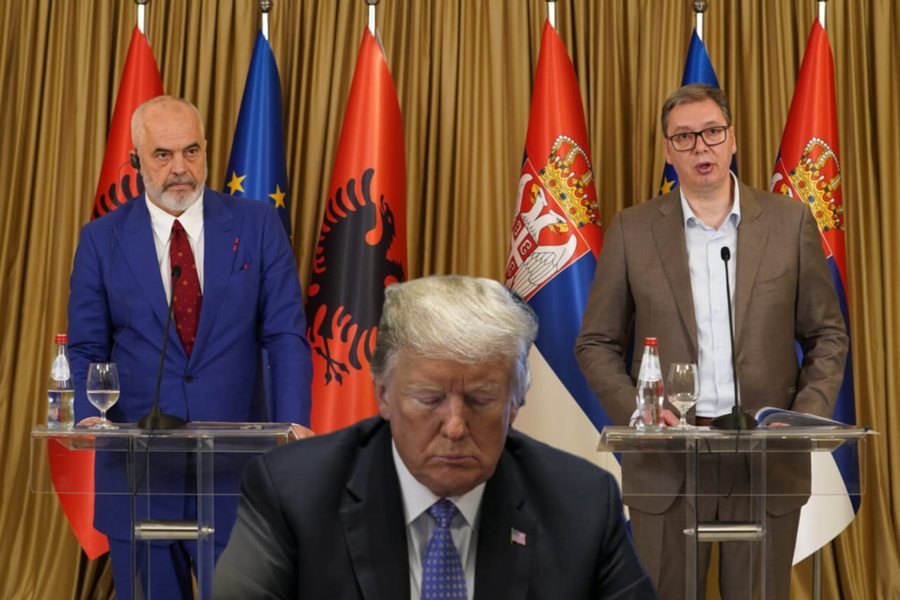
The efforts of Eastern European autocrats to woo Trump have proven futile. Serbian President Vučić and Albanian Prime Minister Rama lured the Trump family with projects to build hotels in protected areas, but without success...
The dismantling of the United States Agency for International Development (USAID) exceeded even the most pessimistic scenarios regarding Trump’s foreign policy. As the United States moves away from democratization as a foreign policy goal, it will have serious consequences around the world. It is no wonder that Eastern European autocrats, from Serbian nationalists to the Romanian far right, celebrated Trump’s election victory. The euphoria has since faded, as things are a little different in Eastern Europe.
The Trump administration's policy shift represents a historic reversal after five decades of pro-democracy foreign policy. The inclusion of human rights and democracy as goals of American foreign policy under the Carter administration in 1977 contributed significantly to the democratization of Latin America and later to the opening and democratization of the former communist countries of Eastern Europe.
While the public generally speaks of the failure to establish a new democratic regime through the wars in Iraq, Afghanistan, or Libya, these examples represent an exception. Far more important was the role of USAID, as one of the most important agencies in supporting governments and civil society around the world in building democracy. By dismantling USAID and similar foreign policy decisions, the Trump administration is sending a message to governments around the world that issues of democracy and human rights are now irrelevant compared to other priorities.
But 2025 is not 1977. Even before Trump took office, democracy was under pressure around the world. Authoritarian governments, for example in Belarus, Russia, and Central Asia, have stepped up repression. They feared that the outbreak of pro-democracy “color revolutions” of the 2000s across Eastern Europe, which culminated in the “Euromaidan” in Ukraine in 2014, could spread to their countries. Since the escalation of Russian aggression against Ukraine, an entirely different threat has been looming: will Russia try to impose a regime in Ukraine and, relying on US Vice President Vance’s European policy, create a new alliance of authoritarian states in Eastern Europe?
For a long time, however, the center of democracy promotion in Eastern Europe has not been Washington, but Brussels. At the Copenhagen summit in 1993, the European Union opened the prospect of enlargement to Eastern Europe and thus launched the most powerful engine of democratization in modern history. Such a “European deal” implies the four freedoms, economic prosperity and political participation, in exchange for democracy, the rule of law and the protection of human rights. In technical jargon, this is called a “conditionality mechanism”. The US followed and supported that policy. Since the 2010s, the European-American couple has disintegrated. Individual EU members have blocked the accession process due to neighborhood disputes motivated by nationalism or domestic political problems.
In other cases, key EU members or commissions have prioritized pragmatic deals with Western Balkan governments. Specifically, the EU turned a blind eye to Serbian President Aleksandar Vučić’s autocratic rule in exchange for his cooperation on the migrant crisis and access to a lithium mine. In doing so, it destroyed the EU’s engine of democratization.
On the other hand, the US plays a crucial role in the security sphere, especially in Southeastern Europe. The controversies surrounding US support for Ukraine demonstrate Europe’s dependence on its transatlantic partner, that is, its former partner. Security is a key issue in this region, as every country in which external actors are promoting or creating a fragile democracy at this time has recently faced war, or is located near war zones. Foreign troops are stationed from the South Caucasus to the Western Balkans to maintain stability. In the East there is Russia, while in the Western Balkans the US sets the tone for peacekeeping operations. In Bosnia and Herzegovina and Kosovo, NATO and the EU ensure peace.
So far, there are no signs that the US will withdraw from the regional security architecture. On the contrary, by unexpectedly holding a peace summit between Armenia and Azerbaijan, Trump is positioning himself in the South Caucasus.
Meanwhile, the efforts of Eastern European autocrats to woo Trump have proven futile. Serbian President Vučić and Albanian Prime Minister Rama wooed the Trump family with plans to build hotels in protected areas, but to no avail. Vučić returned from Mar-a-Lago in May empty-handed. Recall the media reports of how he was kicked out while trying to sneak into a donor meeting. At the same time, the Trump administration also betrayed Vučić’s close ally, the corrupt former Bosnian Serb politician Milorad Dodik.
Perhaps Eastern European countries are not economically important enough for Trump. By the way, the 35 percent tariff on imports from Serbia ranks among the highest in the world and represents the worst deal any Balkan country has.
Overall, Trump's second inauguration seems less important, both politically and militarily, than the other major event currently shaking Eastern Europe: Russia's attempted expansion of aggression against Ukraine in 2022. For three and a half years, the top of the European agenda has been the security and political prospects of the no-man's land between Russia and the EU. The answer to the Russian threat is European integration and military support.
The EU has started accession talks with Moldova and Ukraine, while Georgia has withdrawn from the process. In the Western Balkans, the EU urgently needs to restore credibility in European integration and clearly define the criteria for accession, because this process has not existed in reality for years. In other words, the answer to the gradual withdrawal of the US lies in a much more decisive European policy of democratization and security. / Adapted from "Pamphlet" by "Danas"
*Note: The author is a professor of political science at the University of Belgrade and the Central European University in Vienna. He directs the EU project 'Horizon Europe' for international support for democracy in Eastern Europe.
*Editorial title!


Lini një Përgjigje