


 Shkruar nga Ilir Çumani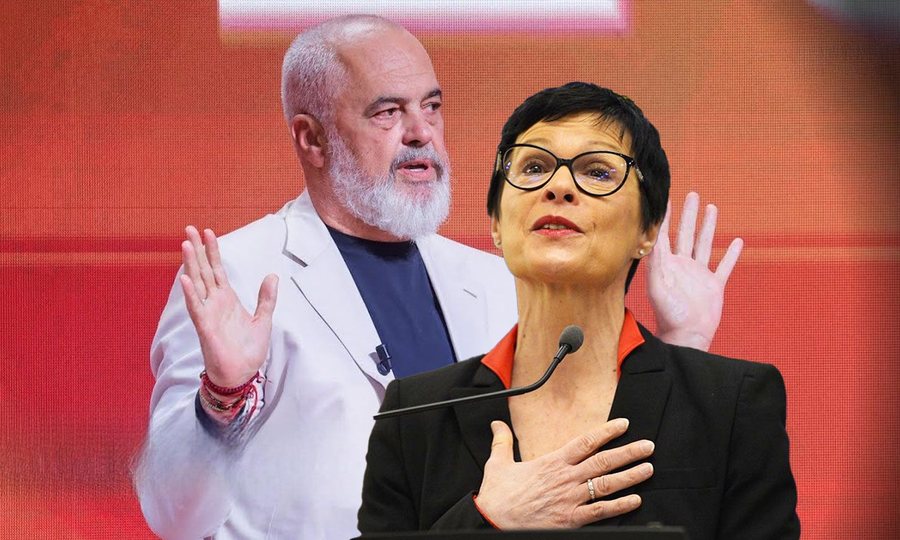
Brussels' stance, clearly articulated through the official Progress Report, serves as a return to a grounded state.
In the current Albanian political scene, the relationship with the European Union continues to be a mirror where each side tries to find the face that suits them best.
But sometimes, the mirror shows a truth that cannot be changed according to anyone's wishes. The case of Commissioner Marta Kos's statement, who in the presence of Prime Minister Edi Rama described the May 11 elections as "free and fair", and on the other hand the European Commission's immediate distancing from this statement, is the clearest example of this contrast that is striking to everyone.
This episode is not simply a diplomatic incident, but a classic symptom of a deeper political illness in the country that still persists, where the reality of facts often clashes with the reality of propaganda.
Brussels' stance, clearly articulated through the official Progress Report, serves as a return to a grounded state.
It is the document that measures standards, not press conferences, nor quick statements that sound good in the headlines, because they crumble as soon as they face verification scrutiny.
Here the essential question arises:
What does it mean when the institution that represents the voice of Europe distances itself from the voice of one of its representatives...!?
This shows that Europe is not willing to adopt narratives that do not match reality. The EU does not serve as an instrument for managing and curating the domestic political image.
Above all, integration is not a process that develops according to the pace of declarations, but according to the pace and real results of reforms, which are measurable and verifiable.
In Albania, elections have remained a highly debated issue and unresolved issue of democracy for years. International reports, OSCE/ODIHR observations, technical findings and repeated criticisms speak of the same problems that are endlessly recycled: misuse of public resources, administrative pressure, not fully transparent counting mechanisms and lack of strong guarantees for a clear separation between the state and the ruling party.
These are not political comments by the opposition, but findings of international institutions that measure standards according to the criteria of consolidated democracies.
It is precisely for this reason that the European Commission's distancing comes as a clear message: "Our assessment does not change just because someone in Tirana wants to change the narrative."
The progress report, the document on which Brussels places its true stamp of appreciation, is not political decor to be displayed at random. It is a road map towards Europe, where every deviation, every mistake, and every failure is accurately recorded.
The biggest paradox is this: while various officials may make quick statements for political consumption, the European Union, unlike Albanian politics, has institutional memory, standards, and procedures that do not waver according to the atmosphere of a conference room.
And this is why the Commission's official response leaves no room for interpretation: the position is the one written, fact-based and published in the Enlargement Report.
This episode should serve as a reminder to Albanian politics that integration is not a matter of management perception.
Political credentials cannot be gained through conferences, but only through functioning institutions, and this is not achieved through rhetoric, but through standards.
It is not built with an attempt to impose the desired version of reality, but with the will to change reality itself.
At the end of the day, Europe speaks with documents, while Albania must respond with reforms and not with applause in conference rooms.
The May 11 elections, like many other elections before them, have left behind more questions than answers.
And Brussels, as always, clearly expresses what Albanian politics often tries to paint in color: democracy is measured only by standards and not by declarations.
If Albania truly wants the path to the EU, then it must accept an essential truth: integration is not about convincing Brussels, but about convincing ourselves that we are ready to build a democracy where standards do not waver according to the next interest.


Edi Rama e genjeu me nje shishe vere dhe nje cope torte Kosin, atje ne Bruksel, kur Shqiperia apo paloqeveria "beri hatane" duke hapur te gjitha kapitujt.??!!!!!
Me Berishē e Ramē nuk ka demokraci..! "Hajdutēt me kollaro" tē ballafaqohen me krimin..!