


 Shkruar nga Sadri Ramabaja
A mountain of influential American and European media are calling for Kiev to freeze the situation on the ground, which is nothing more than consent to the loss of territory.
Followed by: Looking for compromise to stop the war in Ukraine
The lack of a geopolitical agenda of the West was reflected as early as 2014, when Russia invaded Crimea without encountering real resistance.
The transaction, which is currently being discussed, would mean that Ukraine would give up the territories currently occupied by the Russians, but with the guarantee that the remaining "western Ukraine" would immediately join NATO.
This scenario reminds analysts and researchers of the model of the division of Germany beginning after the Second World War into the part of West Germany that had joined NATO and the part of East Germany that would remain under the suzerainty of the USSR.
Let's remember that according to the Potsdam Agreement of August 2, 1945, the four victorious powers: the USA, the Soviet Union, Great Britain and France decided to divide Germany into four occupation zones. The three western zones would be restructured within the framework of liberal western democracies under some sort of US suzerainty.
On May 23, 1949, the Basic Law for the Federal Republic of Germany was announced, namely the constitution of Federal Germany that would serve for the three areas under the control of the Western powers. In the area administered by the Soviet Union, a dependent state of the USSR developed: the German Democratic Republic [which will exist from October 7, 1949 until the reunification of Germany on October 3, 1990.
Specifically, the plan is to hand over the occupied territories of Ukraine - Crimea and the four other regions that Russia has occupied in the last two years - to the Kremlin, to improve the bases on the borders and what is left of Ukraine to join NATO . A road reminiscent of the division of Germany after World War II.
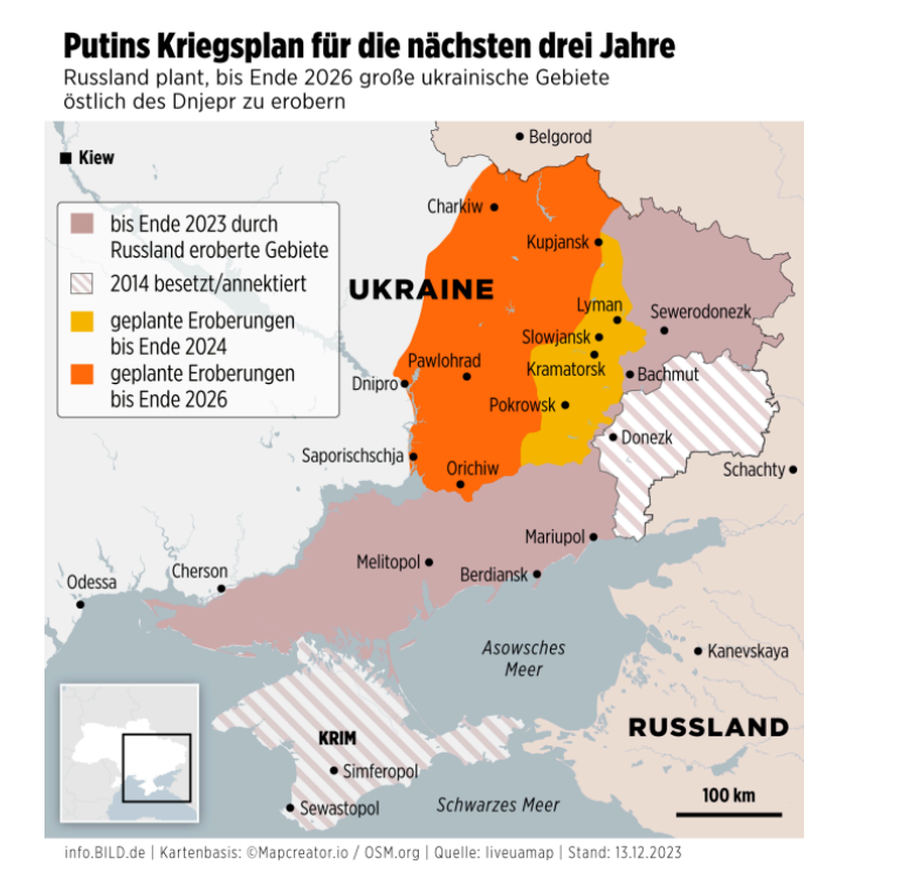
While the scenarios for the division of Ukraine are being discussed in the West and Germany's post-IDB model is being considered, Putin has put on paper the plan for the continuation of the war for the next three years. He has projected ideas for occupying large parts of Ukraine by the end of 2026, including territories on the eastern side of the Dnieper River.
Here is what Putin's plan for the war looks like over the next three years and its prosperity in a map published in BILD:
The turning point in Ukraine?
The report by the Italian daily 'La Republica' suggests that such a scenario would speed up aid shipments to Kiev, which are currently blocked in the US Congress - especially pending a possible return of Donald Trump to the House of Representatives. White.
Tutje në raport potencohet: edhe pse ky opsion nuk është një qëndrim zyrtar, ai duhet të diskutohet joformalisht dhe nuk duhet të jetë jorealist, veçanërisht duke pasur parasysh zgjedhjet e ardhshme në SHBA.
Lidhur me propozimin në fjalë qeveritë evropiane duket se janë skeptike dhe atë nga frika se ai mund të mbështetet nga Donald Trump, nëse ai rizgjidhet në nëntor. Trump ka theksuar vazhdimisht se ai do t'i jepte fund konfliktit në Ukrainë sapo të ishte në detyrë.
Një marrëveshje eventuale evropiane rreth këtij plani që pledon për ndarjen e Ukrainës do të mund të zhbllokonte ndihmën për Ukrainën, e cila do të mund të ishte qensore për sigurimin e kufijve në përputhje me interesat e sja jetike që ndërlidhen tani me mbijetesën e kombit ukrainas.
Nëse zgjidhja e ndarjes pranohet realisht, konkludohet në artikullin e La Republikës, "Ukraina (...) duhet të rimarrë sa më shumë nga territori i saj, dhe për të arritur këtë qëllim, ushtria e Zelenskit duhet të furnizohet me armë, municion dhe ndoshta edhe njerëz."
Një vit më parë filozofi i së drejtës dhe avokati i njohur për çështje penale, tashmë në pension, Reinhard Merkel (Universiteti i Hamburgut) e përshkroi detyrimin e Ukrainës për të qenë e hapur ndaj negociatave të paqes si një imperativ etik.
Tashmë është fakt noterial se interpretë të së drejtës ndërkombëtare, me theks të filozofisë ligjore, herë pas herë i referohen një lloj boshllëku të supozuar në teorinë e luftës së drejtë që filozofi Frankfurt Darrel Frank Moellendorf pati përpjekje për të kontribuar përmbylljes së tij [boshllëkut]. Paradigma e tij njihet tashmë në qarqet e specializuara si "ius ex bello". Sipas saj, "edhe gjatë dhunës, ka detyrime ligjore për të gjitha palët në konflikt që të kërkojnë mënyra ex bello për t'i dhënë fund luftës, edhe nëse kjo do ta pengonte. qëllimet e tyre ushtarake apo politike.
Në këtë rast një “ius ex bello” është vetëm një formulë në të drejtën ndërkombëtare që është e pakuptimtë për sa kohë që “ariu rus” është në tërbim dhe vazhdon të aneksojë pjesë ët një shteti të pavarur, siç është Ukraina. Prandaj Putini do të luajë lojën e negociatave për paqen për aq kohë sa do të përfitojë.
Por nëse politikanët europian duan vërtet ta shtyjnë Evropën drejt një lufte kontinentale me idenë se do ët ruajnë pushtetin, do të varet mbi të gjitha nga vet votuesit europin, të cilët do t'ua japin ose do t'ua heqin mandatin në zgjedhjet e ardhshme. Ndërkaq elitat politike ukrainase meqë kishin ndërtuar strategjinë mbrojtëse ekskluzivisht duke u bazuar tek besimi ndaj aleatëve perednimor, para së gjithash SHBA-ve, tani e kanë sjellë shtetin para alternativës midis vazhdimit të domosdoshëm e tejet tëi rrezikshëm të luftës për mbijetesë të zhveshur, dhe negociatave të dhimbshme me Moskën, në të cilat ajo [elita politike] do të duhej të hiqte dorë nga territoret e saj të pushtuara.
Një mal mediash amerikane dhe evropiane me ndikim po bëjnë thirrje që Kievi të ngrijë situatën në terren, që nuk është gjë tjetër veçse pëlqim për humbjen e territorit.
Duket se Vladimir Putini dhe Volodymyr Zelensky aktualisht nuk bien dakord vetëm për këtë çështje.
Për Zelensky-n, pranimi i humbjes së katër rajoneve të reja, përveç Krimesë, do të thotë vdekje politike, sepse ai mund të kishte fituar shumë më tepër përmes negociatave me Moskën, kështu që lufta do të dukej krejtësisht e kotë dhe katastrofike në pasojat e saj; Rusia ndoshta do të ishte e kënaqur me rezultatet e arritura ushtarake, por vetëm me kushtin e krijimit të një zone të gjerë tampon që ndoshta do të përfshinte Kharkivin, Odesën dhe të gjithë zonën deri në bregun lindor të Dnieper (natyrisht, pa Kiev dhe Sumy rajoni) i cili duhet të jetë nën një lloj kontrolli të tij, si dhe marrja e garancive strategjike të sigurisë nga Perëndimi, për të cilin Moska këmbëngul dhe për të cilën ajo filloi luftën.
Në këtë stad të luftimeve në terren, duke marrë parasysh ekuilibrin e fuqisë në trekëndëshin Perëndim-Rusi-Ukrainë, edhe laikët e kanë të qartë se humbësi i vërtetë, pavarësisht nëse arrihet një marrëveshje apo jo, në këtë betejë të ashpër gjeopolitike globale, do të jetë vetëm Ukraina.
Wars usually end when one side surrenders or both sides decide that continuing the war will no longer be beneficial. The pendulum of judgment now swings towards the second option, as both sides seem to be at the logical conclusion: the continuation of the war will not be beneficial for either side.
The worst case scenario would be that Ukraine is forced to capitulate and give in to Russian demands. This would have unpredictable consequences, because it would strengthen Putin's policies. This would also be dangerous for Russia's other neighbors, especially the Baltic countries, even if they are NATO members, because Putin might conclude that NATO would not fight a major war, nor would it risk a nuclear war because of these small countries.
In this line of thought, we could add that the capitulation of Ukraine will also seriously endanger the Western Balkans, imposing a complete revision of the political map.
Serbia's insistence to prevent at all costs the accession of Kosovo to the oldest pan-European organization, such as the Council of Europe, but also the non-signing of the Brussels Basic Agreement [February 27, 2023], is part of the strategy to push this issue further, making the impossibility of concluding this issue in the framework of the current world order, dominated by the [US-EU] Perednimi, an accomplished act. Serbia calculates that only through a multipolar world, it can return to Kosovo, respectively it can annex its north, which remains in the framework of the follow-up strategy in the process of creating the Serbian World. It seems that just like Slobodan Milosevic, who in his era had not properly read the messages brought by the fall of the Berlin Wall, Aleksandar Vučić also did not properly read the messages of the war in Ukraine.
Between Ukrainian victory and possible Russian capitulation are a series of compromise scenarios. But the compromise in the current situation would most likely not be a permanent solution; it would mark a kind of temporary suspension of the war, as an opportunity for both sides to regenerate forces for the start of a new war in a new political momentum.
However, this compromise for the current political class in Europe seems to have advantages compared to the so-called "Trump solution", which is simply conceived as a capitulation to Russian dominance./ Pamphlet


Lini një Përgjigje