


 Shkruar nga Aleksandër Çipa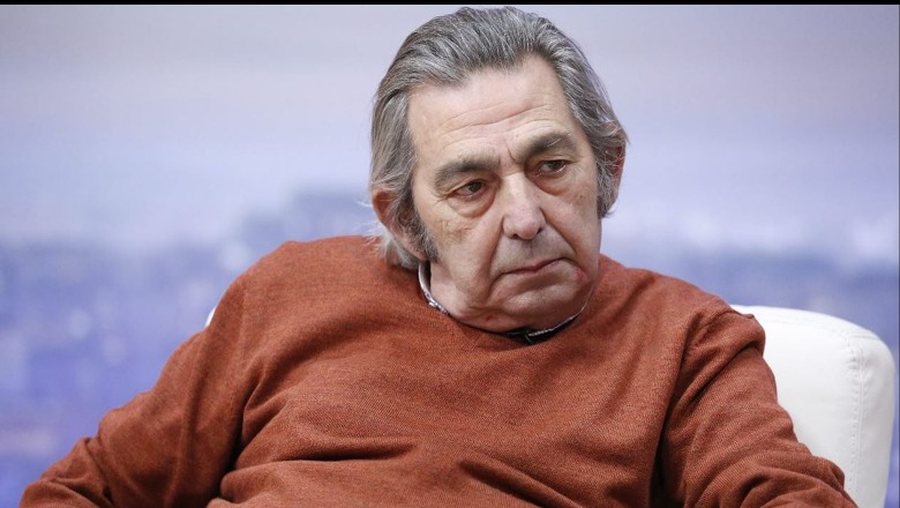
Papingji in various public appearances has reflected exactly this indomitable wisdom, as in the version of what Hygoi affirms that he "lives with what really interests him" - the word set to music or the text dressed with music.
The poet Jorgo Papingji gave the Albanian society, for more than five decades, poems for songs. He found from his early youth and kept in his passion, one of the most coveted forms of conveying one's own words to the public - poetry for songs. He chose to wear the poetic word with music, remaining faithful to what Ezra Pound said: "The poet who does not care about music is probably a weak poet." Papingji did not simply turn the relationship with music into an artistic interest, but built an atypical creative existence in this relationship.
He traveled through his artistic career embodying an alchemy between words and musical sounds, between poet and composer. In this long journey of artistic life, he became a model of the poet-co-author with the most prominent and most humble composers that Albanian music has in this last century and in general, in all our Albanian time. It was determined in this passion as a persistent with the special silence comparable to the monastic silence, but curtailed as in a wisdom and urat from the artist. It is one of the excellent reasons that he is now a beloved and respected artist by the community of countless artists and performers of Albanian light songs, civic songs, folk songs and in different characters and typologies. The poet of the Albanian song, Papingji, is the embodiment of a continuous search for the most prominent in these genres.
He does not stand out for strong poetic cadences, but stands out for innovations in Albanian song poetry that are mostly related to the communicative force, the internal tempos, the interior and the poetic fables of the creations. In his inimitable masterful way, he has managed to bring different genres of poetic texts for songs, from ballads, lyrical motifs, poems to social songs, fables for children and especially civic motifs and those of relationships between human generations. Family motifs, as a moral for inheritance and the cult of the family in our society, have been a preference and shape a meaningful cycle of his poetic creativity. These numerous creations in time, count as modules towards an educative and nourishing destination to be sung and carried across generations, as a necessity of the stoicism of the precious tradition.
The evaluations of Jorgo Papingji's skill have been articulated very few times and sparingly, much less written by critics. This poet has rigorously preferred that between the scriptual form of poetry and not leaving it as a foundation in poetic summation, persistently and faithfully, he has preferred to leave it in the alchemical form with music. So as lyrics in the song and not taken from it. He continues in this atypicality even after five decades, remaining as a model similar to many other such poets, so famous in Italy through song lyrics, in Britain or rather in other parts of the world. Together with well-known names of Albanian poetry, Papingji has managed to mark his prominence through this aspect as well.
Papingji, in his long creative time, has managed to create his own anthology of sung poetry. In this individual embodiment, a study hub should have been created in time, which would keep in focus the relationship between the word and the sound, between the melodiousness of the language and the melos composed in its function, or vice versa. Because in the creations brought by Papingji, experts in the field can analytically address aspects of synthesis and especially of compatibility not only semantically, but mostly associative as due to music, but mostly from words. Papingji's poem-songs are a precious part of the most famous repertoire of light and modern Albanian songs. Various careers of co-authors have joined this repertoire: poets-composers-singers.
It is a blessed trinity of creators, who have already left an incomparable material of creativity for the public, for musical and comparative references in this field and especially in the field of ethnomusic and ethnotext. In his human nature, the creator Papingji appears as the embodiment of Ernesto Sabato's saying: "In goodness all kinds of wisdom are gathered." Papingji in various public appearances has reflected exactly this indomitable wisdom, as in the version of what Hygoi affirms that he "lives with what really interests him" - the word set to music or the text dressed with music.


Lini një Përgjigje