


 Shkruar nga Prof.dr. Skënder Asani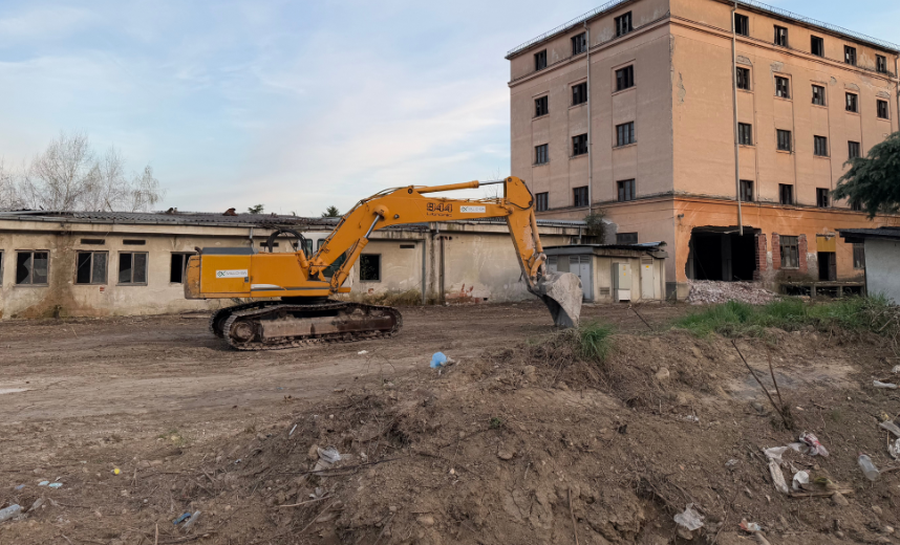
On the edges of a city squeezed between two eras, there is – or more accurately, there was – a structure that once held not only tobacco smoke, but also the last breath of a turbulent time.
The collapse of the Tetovo Monopoli does not simply represent the disappearance of an industrial building from urban memory, but a silent institutional act towards a dark segment of the collective past that has not yet found a place in the official narrative. This building, in which every family in Polog had at least one member affected by the consequences of the violence and repression of a dark era, was more than a building; it was a living testimony to the silent experiences of an entire community.
On the outskirts of a city squeezed between two eras, there is – or rather, there was – a structure that once held not only the smoke of tobacco, but also the last breath of a turbulent time. The Tetovo Monopoly, an ordinary building to the ordinary eye, had experienced an unusual function in a dark season of history. For a short period, but one filled with tension and pain, it was transformed into a stopping point not for goods, but for people. People gathered, organized, separated. Not for commercial purposes, but for the “administration” of post-war political realities.
Many of those who entered those walls never came out. Many of those who did, carried the silence of that space forever. As is often the case with the collective memory of communities that have not had the fortune to have an “institutionalized” history, this event remained outside the texts and outside the monuments. It was transmitted in the most primitive form of memory: from mouth to mouth, from elders to grandchildren, from silent tears to unanswered questions.
Its dimensions were not of a narrow circle: almost every family in the Polog region had, at least, one member who was directly affected by this event, whether drafted, disappeared or mistreated. Some lost their sons, others their brothers, cousins or neighbors. This made Monopoli not simply a place of occurrence, but a collective wound, which lived through the silence of every house that had an open door to welcome someone who never returned.
Surprisingly, even though it happened in the same territory and at the same time as other stories that are solemnly commemorated today, the Tetovo Monopoly did not earn the right to be a symbol. It did not have the fate of becoming a museum, nor a place for reflection. No plaque was placed on it. Instead of a sculpture in memory, the silence of an excavator fell on it.
If memory is the asset of states that want to build a just and inclusive identity, then forgetting is a deliberate, often silent investment to select who is allowed to remember and who is not. And in this selective choice, some spaces remain outside the official architecture of memory. Not for lack of historical importance, but because of the ethnic biography of its victims.
It is not unusual for buildings with historical burdens to be treated with a kind of institutional nervousness. They are testimonies that do not speak, but call out. The Tetovo Monopoly called out a truth that did not fit the dominant narrative. It recalled an event that was not accepted as part of the “legitimate tragedies.” It touched the feelings of a community that has experienced exclusion from official memory for decades.
And perhaps for this very reason, the decision to demolish that building was made without any public debate, without ceremony, without any apology or documentation. It disappeared with the silence of a process that knows well the logic of erasing traces. Because in the end, when you cannot face the past, it is easier to demolish the building than to face the history it represents.
But history is not just on walls. It lives in consciousness, in memories, and in the questions that generations will always ask: Why was a camp in another city turned into a museum, and this one wasn't? Why was one victim cared for, and another forgotten? And can there be collective justice when memory itself is biased?
The collapse of the Tetovo Monopoly does not simply represent the disappearance of an industrial facility from urban memory, but a silent institutional act towards a dark segment of the collective past that has not yet found a place in the official narrative. This facility, in which every family in Polog had at least one member affected by the consequences of violence and repression of a dark era, was more than a building; it was a living testimony to the silent experiences of an entire community. Its demolition, justified in developmental language, actually speaks of a deliberate policy of selective forgetting, where Albanian pain remains outside of institutional commemoration and the collective state memory. In this collapse, not only walls are demolished, but the bridges of the intergenerational transmission of historical truth are undone, leaving behind a gap in the civic consciousness and strengthening the feeling that our memory is valid only if it complies with the permitted forms of commemoration. But history is not undone by bulldozers; it survives in the consciousness of those who refuse to be silent and will continue to seek its place, until it is recognized not as a burden, but as a shared responsibility.






Lini një Përgjigje