


 Shkruar nga Lydia Polgreen
Last week at a lavish global summit in the Russian city of Kazan, Ethiopia's Prime Minister Abiy Ahmed, once very close to the West - a Nobel Peace Prize winner and an ally in the country - spoke highly of the organizer of the event: Vladimir Putin, the black sheep of the current order...
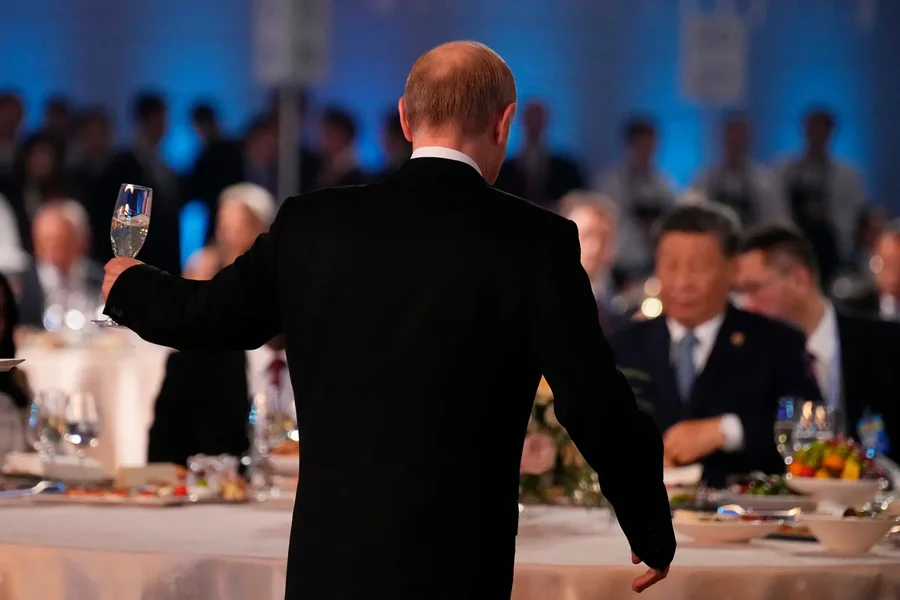
“Let me prepare you for economic sustainability during a difficult period. This time has not been easy for Russia, but under your leadership, you have managed to maintain economic stability, which can be a model for us to look at," he added.
To an untrained ear, this might sound like the kind of thing you hear at a summit attended by global leaders. But for me, it was a piece of theater that best shows the dangerous crossroads at which a world driven by inequality, beset by endless crisis, finds itself.
An example was a typical world that is happening on the horizon, and a change like the changing balance of global power, is avoiding the monitoring of more control of the West. Abiy is the leader of an ambitious nation with one of the fastest growing economies in Africa.
Yes, he is clashing a lot with the West, so it's more about Russia's resilience in the face of very tough sanctions on not a few products. Abiy was speaking at the annual BRICS language summit, the largest gathering and leaders of all in Russia since their 2022 invasion.
The pompous event was intended to show the West that its attempt to isolate Putin as a form of punishment for invading foreign countries has failed. Even the Secretary General of the United Nations participated in the summit, in his first visit to Russia in more than two years.
In a press at the end of the summit, Putin said: "As you can see, we continue to live and work in our economy as normal!". Then he mentioned the economic growth statistics of Russia, for which the International Monetary Fund says that this year will continue to other established economies.
For this, he should be grateful for the sentiments he has signed with other BRICS members, especially India and China, 2 of the 3 main importers of life in the world, and a crucial source of trade for Russia under Western sanctions. “Good luck with your first order in the rules. My friends and I are building a different future" - he emphasized.
It was a far cry from the first BRIC summit, the acronym coined by Goldman Sachs for the beneficiaries of change and shaping an improved and globalized world. The powerhouses - Brazil, Russia, India and China, with South Africa added later - joined for the first time in 2009 amid global financial reckoning to wrest a share of power from the footballing order dominated by The West, in proportion to their growing economic and geopolitical power.
Fifteen years later the world looks very different. War, pandemic, climate crisis and others have burdened the globe. The enthusiasm for Cold War globalization is long gone, replaced in many parts of the world by a grim return to a nationalism fueled by state self-interest.
Russia and China, distanced from the West, have joined forces aiming to unite the developing world against the hegemony of the arrogant West, which leaves behind other areas to rise. They claim to speak on behalf of the "global majority", a term that Putin has started to use a lot lately, although in his case it is purely a matter of opportunism rather than solidarity.
However, it is attracting a real group of disaffected countries across the Global South. The latter hear from the north a message of such a poor message: "Do not cross our borders. Trade on our terms. Support us in the fight against climate change, even though the main damage is from us.
Defend its sovereignty with us, and condemn the war crimes committed by the Russian army. all our lectures on human rights, democracy and international law, but don't question us about Israel's bloody war in Gaza.
Of course, there are nuances and counter-arguments on these perceptions. But it is hard to deny the basic truth: the global balance of power does not reflect actual economic and political power, or even the inevitable tilting of the balance of power towards the South and East.
And against this background, he brought together the members of the BRICS bloc - Putin's financing with Egypt, Iran and the United Arab Emirates in Ethiopia, as well as with many aspirant countries, in the case of Turkey, which is a member of NATO and a former aspirant for membership in the European Union.
Obviously it is a grouping of countries, their interests are different and often in conflict with each other. For some new members and aspirants, such as Iran and Venezuela, entry into this bloc is based on the interest of protection from the anti-Western axis of China and Russia.
However, the founding members of BRICS are divided over the grouping's goals. For the powerful few, the goal is to protect themselves from advantages in whatever arena they can, and to remind the West that they have other options.
India, Brazil and South Africa reject the first anti-Western tilt and take a more flexible approach. So I doubt the economy if many of these countries, home to half the people, will voluntarily secede from other existing ones in favor of one dominated by China, an emerging superpower and strategy, and its smaller partner, Russia. .
The news is that there is a good time to change existing ones, and many such partners are the ones who are engaging in these actions. In a few weeks the leaders of the G20, a club of the world's largest economy, will meet in Brazil.
Vladimir Putin will be absent, as he faces an arrest warrant from the International War Crimes Tribunal, a battered but still enduring institution of order, and of his own imperfect aspiration to it. a fairer world. It is possible to imagine a more important moment, that in one case, the real West really and truly begins to give up some of its power to the rest of the planet. / Adapted Pamphlet from "New York Times"



Lini një Përgjigje