


 Shkruar nga Paolo Mieli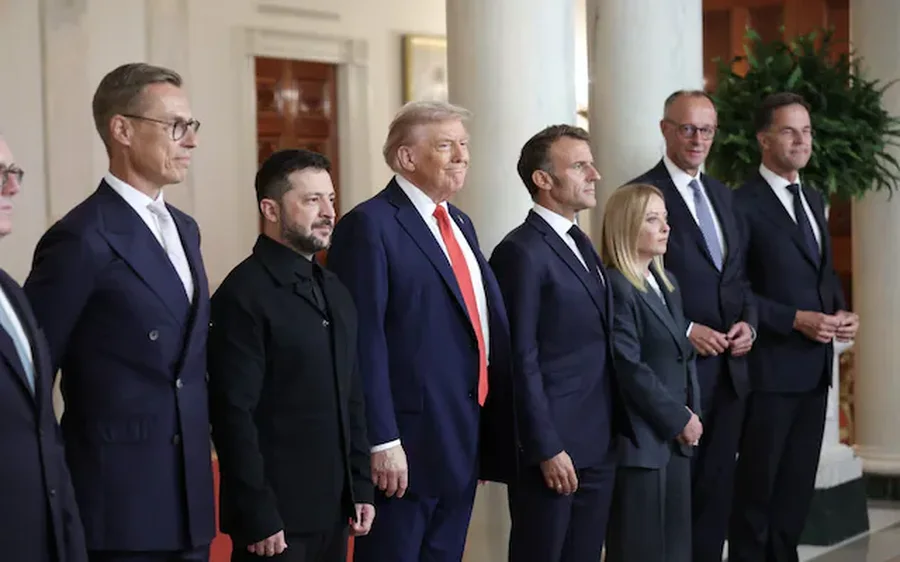
The world of yesterday is gone and will never return.
There is no point in lulling ourselves into illusions: the world of yesterday is gone and will never return. Neither will a few Republican victories in the US midterm elections bring it back, nor will any Democratic victory in the next presidential election, assuming they are held under normal conditions. No one can guarantee that the course of history will resume as it was before. After eighty years of a more or less stable West with its North Star in the White House, one year of the Trump administration was enough to ensure that no one will feel safe under Washington’s umbrella any longer. This is also because Obama and Biden had already warned Europe that the days of unconditional protection were behind us. Definitely behind us.
Which is not to say that the past, marked by democratic elections, economic and informational freedoms, freedoms in lifestyle and religious choice, and, above all, the rule of law, does not mean, as we were saying, that that world is finally destroyed and must be considered indefensible and irreversible. We just need to consider new ways to protect it and secure its future. The post-war frameworks, the UN, NATO and even a united Europe, have proven no longer functional in providing protective guarantees for democracies. Democracies, which we define as Western by convention and which still flourish all over the world.
But the time has come for them to grow up, the time for them to stand on their own. By engaging and reaching agreements with the United States when possible. Otherwise, by moving independently within new frameworks that coexist with the old ones.
In this sense, the speeches given by Canadian Prime Minister Mark Carney and Volodymyr Zelensky at the World Economic Forum in Davos were, if you read between the lines, completely comparable. Carney's words were more systematic, those of the Ukrainian leader more tactically oriented, their words were not spoken to protect the interests of Ottawa or Kiev. It is we, the West, who are being talked about.
How can we react quickly to the "surprise" represented by the fact that "our American friend" is not simply evading the responsibilities assumed after World War II, but is making an alliance with the enemy. Today in Europe, tomorrow in the Middle East, the day after in Asia. The most unimaginable twists and turns must be taken into account: there is no linearity in the erratic choices of the US administration. And the possibility of authoritarian degeneration in the Trump world cannot be ruled out, far from it, even if it is too hasty to take them for granted.
Ultimately, the ease and convenience with which the American president establishes relationships with countries that do not conform to Western norms should tell us something. He does so for obvious economic interests, of course. But the pleasure with which he abandons himself to dictators or dictatorial figures tells us that he finds pleasure in imagining his future in the company of those who, on January 6, 2021, did not criticize him during the siege of Capitol Hill. And at the same time, he gets rid of the representatives of those countries that considered and still consider that episode an original sin.
At this point, the West must have the courage to split into two, three, and perhaps even four or five. And create new alliances that, without clashing with the old ones, are capable of making decisions, including military ones (always, of course, defensive), quickly, without being vetoed and without being forced to enter into the kind of discussions for which Zelensky has reproached us. This seems to us to be the only way to compensate for the West's declining global leadership. Limited alliances that can eventually be intertwined. And they should not exclude, in principle, possible agreements with the United States, if they ever become available in good faith. But without ever allowing them to regain control.
The path that many are suggesting, to throw ourselves into the arms of Russia, China or some Middle Eastern power, acting as "little Trumps" when necessary (that is, engaging in politics and business), is full of pitfalls. Especially at a historical moment like the current one, when there is a Trump, the real one, who will do everything he can to thwart such initiatives. Just as he did with the Anglo-European "Wills".
The alternative? Following him, day after day, in his strange behaviors, yesterday Greenland, today the board with satraps and some unfortunate head of government forced to humiliate himself, is neither dignified nor wise. We do not know what will happen to Trump (although we have an idea). We know for sure what will happen to his entourage: they will inevitably end up in the abyss predicted by Mark Carney. Without extenuating circumstances, since everything is already clear./ Adapted from “Pamphlet” by “Corriere Della Sera”




Kane bere shume gjynahe e zullume me popujt e botes e ka ardhur koha te paguajne mbrapsh. Thote bukur Englezi: "What goes around comes around".
Europës po i del gjumi, dhe keqas. Për 80 vite e kepërdori sigurinë e dhënë nga Amerika ndërkohë që pothuajse kurrë nuk bënë diçka të vlefshme për mbrotjen e vet. Amerika i ka mbrojtur se gjithmonë shtetet e Europës kanë luftuar mes vedi, dhe se Bashkimi Sovjetik lshte rrezik për rendin botëror. Tani BS nuk ekziston, rreziku është në Paqësor, dhe për Amerikën, Europa ka më pak prioritet ekonomik se Amerika Veriore dhe ajo Jugore.
SHBA ka qene e forte, por shteti me i fuqishem u be sidomos pas kapitullim te gjermanise naziste,ku shkencetaret fizikante me te mire ne bote si Openhairer etj, preferuan SHBA dhe jo BS, zhvilluan te paret armen berthamore qe sot eshte forca e Rusise per presion, zaptuan hapsiren,zhvilluan shkencen dhe kontrolluan Europen ne çdo qelize te saj,nedemek oer ta mbrojtur. Ke te mbroje? Vetem gjermanine be ate kohe qe e shfrytezoi oer interesa qe u thane me lart.Sot i bejne karshellek europes pasi ka ardhur koha te vene ne zbatim plane per zaptime si puna e gronlandes,etj.