


 Shkruar nga *Thomas Cantwell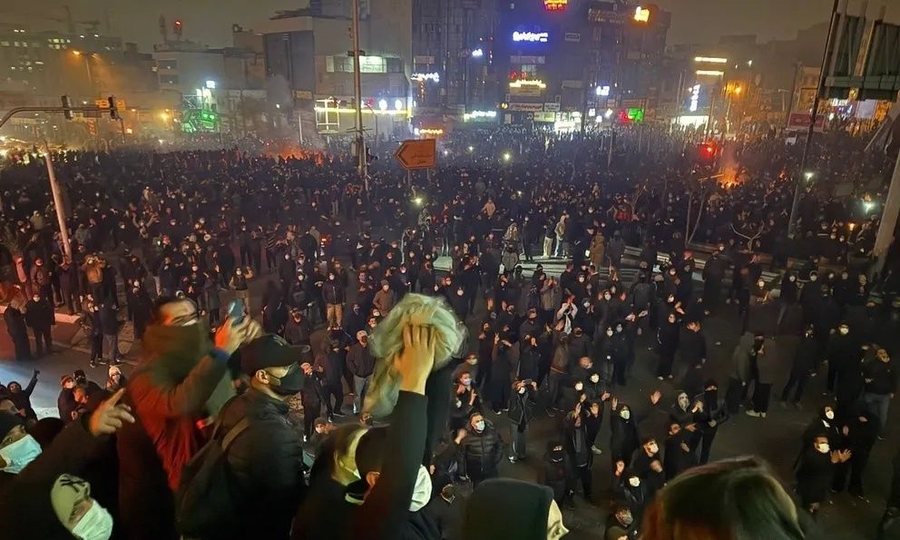
We asked them to disarm. In return, America gave them its word: we would protect them. Among those I met was Hossein Madani, a tireless spokesman who had studied in the United States and later became my friend. A decade later, Hossein was killed. He was shot first in the stomach, then executed with a bullet to the head as he sat wounded and defenseless against a wall. Fifty-one others were killed with him. The Iraqi forces entrusted with their protection were either elsewhere or pulled the trigger themselves.
I have not forgotten that betrayal since. Today, as Iran enters the most important phase of its uprising in generations, that memory has returned with new urgency. For what is unfolding now is not another cycle of transitory protests.
It is a nationwide showdown, the outcome of which will determine whether Iran will remain under the control of religious fascism or will finally be liberated. The uprising that erupted on December 28, following the collapse of Iran's currency, has shattered any illusion of a return to the status quo.
What began with strikes by Tehran bazaar merchants against rampant inflation quickly spread to universities, industrial centers and more than 400 cities. The slogans are unambiguous: "Death to the dictator, be it the Shah or the Supreme Leader."
Iranians are rejecting all forms of tyranny, old and new alike. This is not a spontaneous reaction. It is organized resistance. The Islamic Republic understands this better than many in the West. That is why it has responded with unprecedented brutality.
Since the uprising began, thousands have been killed or wounded, tens of thousands have been detained, and executions have accelerated at a pace not seen in decades. The confirmed death toll is 3,000, although unofficial figures are several times higher. The MEK has identified 1,000 martyrs so far, including 100 women and dozens of children. No fewer than 10 were members of the MEK Resistance Units. However, repression has failed to break the movement. For more than four decades, the MEK has been the backbone of organized resistance inside Iran. Its network of Resistance Units—young men and women operating under extreme risk—has transformed public anger into sustained action across the country. This was true in 2017, in November 2019 when some 1,500 protesters were massacred, and again in 2022 after Mahsa Amini was killed in police custody. Each time, the regime shot to kill. Each time, people returned. Today, this cycle has reached the point of no return.
The regime’s obsession with destroying the MEK explains its crimes. Since 1981, more than 100,000 members and supporters have been executed. In the summer of 1988 alone, approximately 30,000 political prisoners, most of them MEK collaborators, were massacred in a matter of weeks. The survivors were chased from Tehran to Camp Ashraf and later into exile in Albania. And yet, the movement continues. Today, the MEK forms the core of the National Council of Resistance of Iran (NCRI), a broad coalition that has won recognition from thousands of lawmakers and 137 former world leaders and heads of state across the United States and Europe as a viable democratic alternative.
Its president-elect, Maryam Rajavi, has presented a clear 10-point plan: free elections, separation of religion and state, gender equality, minority rights, abolition of the death penalty, and a non-nuclear Iran that lives in peace with its neighbors.
This is not abstract theory. It is a roadmap for transition, forged by people who have paid in blood for every inch of political ground they hold. The current uprising may be the bloodiest yet. But it is also the most determined. Young Iranians, many of them born long after Hossein Madani received his “protected person” card, are now confronting the Islamic Revolutionary Guard Corps with a courage that leaves no doubt about the direction of history. The international community, and especially the United States, faces a clear choice.
We can repeat the failures of the past: issue statements of concern, cling to illusions of reform, and watch the regime try to drown a nation in blood. Or we can finally honor the promises we made, to the people of Camp Ashraf and to the Iranian people as a whole. That means standing unequivocally with those who risk everything for freedom.
It means recognizing the NCRI as the democratic alternative it has proven itself to be. And it means holding Iran’s leaders accountable for crimes against humanity. In 2013, I wrote that the abandonment of Camp Ashraf left blood on Americans’ hands. Today, as a new generation dies on the streets of Iran, the stain threatens to deepen. I think often of Hussein. I think of the card I gave him and the promise I made to him. He kept his word. He remained committed to democracy until his last breath. The least we can do is keep ours. /Adapted from Stripes /
*In 2003, as one of the first US Army commanders at Camp Ashraf in Iraq, I personally handed over "protected person" identity cards to members of the People's Mujahedeen Organization of Iran (PMOI/MEK).


Lini një Përgjigje