


 Shkruar nga Pamfleti
On this date, in Tirana there seems to be an attempt simply to appease officials with a wreath and a public appearance, but not at all the sublime celebration that November 17th should really have.
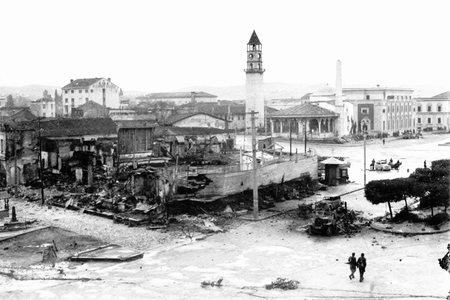
The lukewarm ceremony for the celebration of November 17 shows the way we relate to the national issue on all levels. To honor those who fought; for those who fell in the battle of those days; for the innocent victims who were waiting for the war to end and to serve their country; for the spirit of the capital that fought the fiercest battle for liberation; for the allies and the identity of the city and even more: Respect for our anti-fascist values. For some time now, a part of people associated with this date in various forms have been demanding that this date also represent the unifying date of the liberation of the country. It would be the most ideal solution.
But, the SP and the DP, the two main political parties that have changed places in rotation in the direction of the country, have never been in favor of this date being a unifying one. The result of this is that the narrative against November 17 has included and extended to the broad base of the capital's residents. Many of them are ashamed to even mention that Tirana fought and was liberated on November 17. Or to mention the time when the emblematic team of Albania with this name achieved some of the most historic results in the country. Just as it is a shame that even today, after so much time, there is no grave for many of those killed on that day, shot without trial, many of them civil servants who would have been so needed by the destroyed country.
November 17 should have been more than a day of celebration, but also of reflection. For the citizens who gave everything from their simple homes and left them on the barricades; for those who fought without any prejudice against the Germans; for the well-known victims, many of whom were true patriots, for everything. But, as war historians note, today’s militant approach is quite different from traditional anti-fascism, where everyone was asked to fight, a narrative that lasted until the mid-20th century, writes a researcher in “Fascism, Anti-Fascism and the British Left, 1919-1939”, referring to the case of his country. (Hodgson, 2007). However, on this date, in Tirana, there seems to be an attempt simply to wash the mouths of officials with a wreath and a public appearance, but not at all the sublime celebration that November 17 should really have.
This date complicates politics because it did not know how to give the right place to liberation, its heroes, the citizens of Tirana themselves, the executions of prisoners, or because it failed to create a great apology for those shot by the infamous lists. November 17 will always weigh on the conscience and the lacking contemporary morality, so every year it reminds us that we are a society without scruples and often insidious. Best explained by the pre-World War II political militant, Carlo Alberto Rosselli, who failed to see where his country Italy and those who executed it ended up: "We are anti-fascists because our homeland is not measured by borders and cannons, but coincides with our moral world and the homeland of all free people". This complicates our politics that cannot honor free people.



Lini një Përgjigje