


 Shkruar nga Veton Surroi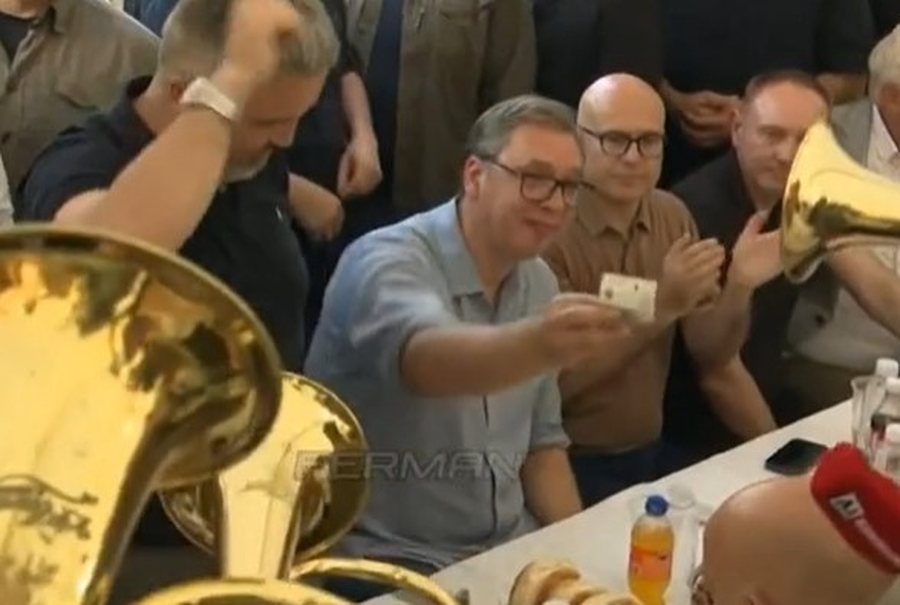
When protesters call President Vučić a "Serbian" they do so with two goals...
1.
Andrej, the brother of the president of Serbia, Vučić, came out to protest against the student protesters (as they are known, even though they have long been no longer students, but a broader popular movement). His appearance was a sign that even the government knows how to protest in the streets, moreover, it can do so because it enjoys broad support from citizens, support that has been ritually verified in elections since 2012, which his brother wins at the head of a populist political movement.
Approaching the points where the anti-government protesters were, the cameras recorded the cry of Andrej Vučić's group towards the opponents: "Ustasha, Ustash...!"
During the same night, anti-government protesters formulated their chants directed at the Serbian president, whom his supporters call “Aco Srbine” as a popular endorsement of his nationalist or nationalist credentials. The chant against Vučić was “Aco Šiptare!”
The protesters then made it clear what they thought about the ethnic affiliation of the government by formally challenging the special police units with the question and cry “why don’t you go to Kosovo?”; if they went to Kosovo, the special police units of Serbia would have to traditionally beat and kill Albanians, a kind of implicit role that differs from the one they were implementing and that was being done, the routine beating of Serbs.
2.
Serbia has entered an unprecedented tension between the two opposing sides, a tension that I do not believe existed even during the fall of Milošević on October 5, 2000. A quarter of a century after the fall of Milošević, this tension is not between "partisans" and "chetniks", between "communists" and "democrats" or "pro-Europeans" and "pro-Russians", but has managed to be something that is simplified into insulting football hooligans and thus the war between Vučić's power lovers and his opponents is a war between "šiptars" and "ustas".
Of course, not all protesters for and against the government call each other “Siptar” or “Ustasha”, but it seems to me that this one-night lecture manifestation may be indicative of a cross-section of the social phenomenon of Serbia. It shows the revival of the term “Siptari” as an insult. In socialist Yugoslavia, respecting the correct linguistic form, Serbian citizens had the right to choose the term “Albanci” for their fellow citizens, but some of them chose “Siptari” not only to distinguish between Albanians in Albania and those in the former Yugoslavia, but also to describe the lower social status of the named person. “Siptar” was not so much an ethnic designation as a designation of social rank, of physical labor professions. “Siptar” was another name in Belgrade for the porter who had to carry coal for burning or the sawyer who had to cut and stack wood for burning in the winter.
And so, when protesters call President Vučić a “Srpski” they do so with two goals. One, to show that he is not “Aca Srbin” and being a “Srpski” is the opposite of a defender of Serbian national interests. And two, with this term he is also on a lower social and civilizational level than any Serbian citizen.
The use of the term “ustash” has a similar purpose. The term, which is the name of the Croatian quisling formations during World War II, began to be used in Serbia during the breakup of the former Yugoslavia in an attempt to show that the war of armed Serbs (“of the unarmed people”) for the occupation and division of Croatia was a war of “anti-fascists” against “ustashes.” Since then, anyone who opposes Serbian nationalist politics in Croatia is an “ustash,” and this excludes few in that country. And, as a discursive extension, the “ustash” is now the student movement directed against President Vučić.
3.
Both designations are part of an old and well-known pattern of dehumanization. If Vučić is a “Šiptar”, then he is not only a foreigner in Serbia, but also belongs to a social rank that one day justifies violence against him. The violence of Serb against Serb (of brother against brother) is not acceptable, but using it against a “Šiptar” is not only tolerable, but is traditionally and completely legitimate. It is even more legitimate, in this interpretation, today when that lower class that was once called “Šiptar” created an independent state from Kosovo recognized by a large part of civilization, even the most advanced one.
This makes the violence that will be applied to the "Ustasha", the name associated with the systematic persecution of Serbs in World War II and then given to all Croats who created their own independent state and made it a member of NATO and the EU, completely and historically justified.
In a strange way, Serbia is preparing for a new war. Throughout the nineties, the dehumanization of opponents in other parts of Yugoslavia was a warning for a campaign of violence against them. The Slovenes were “Vienna scoundrels,” the Croats “Ustasha,” the Bosniaks “Turks,” and the Albanians simply “Siptars” – all part of a vast anti-Serbian Vatican-CIA-Iran conspiracy. Being a scoundrel, an Ustash, a Turk, or a Siptar made it easier to fight them.
Now, after all the wars against other peoples, Serbia is entering a discourse that must justify violence against political opponents within the country. The “Albanian-Croatian” war is thus becoming Serbia’s last war.
4.
The actors of the confrontation on the streets of Serbia today are children born or raised during this century. While the world's attention has been directed to other crises in the world, that same world has assumed that somehow, with the passage of time, the wounds of the past will heal, that the new generations that will grow up in Serbia will automatically be democrats and liberals like most of their European peers. A number of critical intellectuals in Serbia have warned that Serbia, as well as the entire space of the former Yugoslavia, must confront the past, as a kind of necessary foundation for democracy, as something that Germany did with its own example after World War II.
In various resolutions of the European Parliament and in the programs of the Berlin Process, it has been emphasized time and time again that Serbia must confront its past. Not only has it not done so, but it has rewritten the past in such a way that every crime against other peoples, including genocide, has justification and reasonableness within the value system of the contemporary Serbian state.
Serbia has not known or wanted to face its past. Now its problem is becoming its inability to face the present.





Lini një Përgjigje