


 Shkruar nga Diplomatico | Pamfleti.net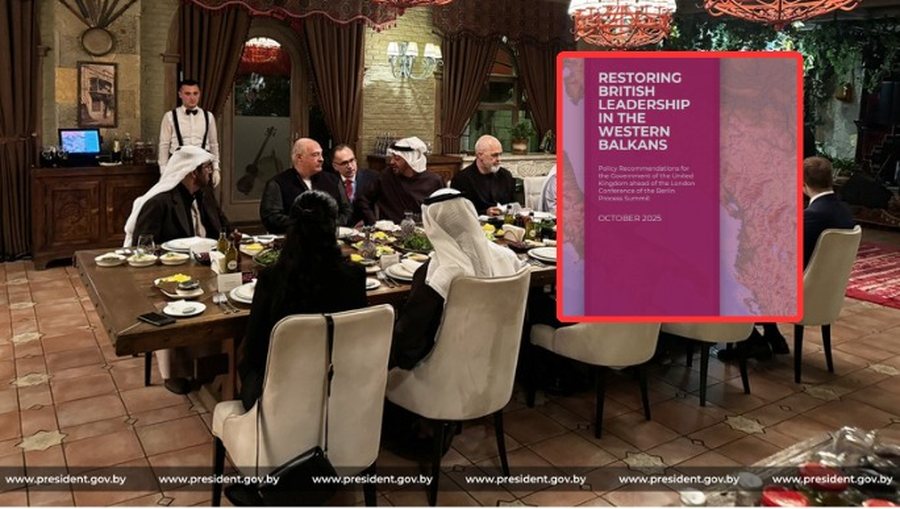
The strategic report led by former NATO chief Lord George Robertson warns that Moscow is using Serbia, intelligence networks and local allies to destabilize the region and challenge NATO allies...
A British strategic paper, drafted by senior security experts under the direction of Lord George Robertson, warns of indirect Russian aggression in the Balkans, with Serbia as the center of intelligence, paramilitary and economic operations. The document also mentions Albania, Montenegro and North Macedonia as places where Moscow aims to expand its influence. The analysis comes at a time when statements and movements by Prime Minister Edi Rama, including a meeting with Putin’s main ally, Alexander Lukashenko, have raised concerns among Western partners. The report reflects the increase in pro-Russian disinformation in the mainstream media and emphasizes that Russia is using Serbia to supply weapons, recruit fighters and organize intelligence networks in the region. Evidence from the Banjska crisis in Kosovo and the attempted coup in Montenegro shows that the Balkans remain one of the most vulnerable security hotspots in Europe. In this context, Britain seeks a new leadership role and asks the countries of the region to position themselves clearly on the Euro-Atlantic side.
A recently published British strategic paper by a group of senior security experts states that Russia has extended its tentacles into the Balkans and is engaging in indirect aggression against NATO allies in the region. The document was signed by former NATO chief Lord George Robertson, one of the most influential figures in the Euro-Atlantic security architecture.
In the main analysis, Robertson calls on the UK to take a leading role in the Balkans to curb what he calls “Russian indirect aggression”, which is expanding through political, economic and paramilitary networks. According to the material, Serbia and Bosnia and Herzegovina remain the strongest points of Russian influence, while NATO members Albania, Montenegro and North Macedonia are also mentioned as countries where Moscow seeks to open corridors of influence.
The British stances come at a time when statements by Albanian Prime Minister Edi Rama have raised sensitive doubts among allies. The mention of some pro-Russian positions in interviews and the meeting with the President of Belarus, Alexander Lukashenko, Vladimir Putin's closest ally, during a summit in Azerbaijan, have raised questions about Tirana's positioning in today's geopolitical context. The meeting was also attended by the President of the United Arab Emirates, Mohammed bin Zayed.
Along the same lines, some mainstream media outlets have recently emerged as open supporters of the Russian narrative, attacking Ukrainian President Volodymyr Zelensky and circulating material originating from the Kremlin's propaganda apparatus. Parts of these narratives tend to distort the reality of the war, including false claims about the population of Ukraine or the geopolitics of the conflict.
The British material details that Russia maintains a strong intelligence presence and paramilitary capabilities in Serbia. Belgrade is a key supplier of Russian and Chinese weapons to Europe and Moscow's direct partner in intelligence operations aimed at curbing NATO expansion in the Balkans. Serbia is also the central transit hub for volunteers joining the Russian occupation forces in Ukraine; some of them are then recruited by Russian intelligence services. The Russian Humanitarian Center in Niš has served for years as an operational base and a cover for Moscow's strategic activities in the region.
Following the launch of Russian aggression against Ukraine in February 2022, the Western Balkans has been identified by the British government as an area vulnerable to increased Russian interference. British Deputy Prime Minister David Lammy has expressed similar concerns, stressing the need for continued monitoring and engagement.
In Kosovo, Serbia’s cooperation with Russia has produced the most dangerous security crisis in Europe outside the Ukrainian fronts. The paramilitary attack in Banjska in September 2023, carried out by armed extremists with direct ties to Vučić’s government, left three dead, including a Kosovo policeman. Serbian troop movements toward the border have fueled fears of a possible intervention, drawing a strong public rebuke from the Biden administration.
In Montenegro, a NATO member since 2016, Serbian-Russian influence remains deep and entrenched. Since the 2016 coup attempt, orchestrated in part by Russian and Serbian operatives, the country has faced increased activity from Kremlin-linked political and economic networks. As in Serbia, Russian-owned companies operate here to circumvent sanctions and maintain economic and media influence.
These developments confirm the British analysis: Russia does not only aim to create local instability, but also seeks to jeopardize Euro-Atlantic alliances and create spaces of influence in weak political and institutional areas. The Balkans remain one of these spaces, and Albania is no exception. The rise of pro-Kremlin voices, uncontrolled diplomatic closeness, and the lack of strategic transparency create open terrain for foreign intervention.
The British material is a clear call for a review of security policies in the region and a warning to Balkan governments. In this context, it is required that Tirana also position itself unequivocally as a full ally of the West and avoid any move that could be interpreted as a deviation from the Euro-Atlantic axis./ Pamphlet




Britaniket e tere Europa e kane mendjen te ca piskuriqe Shqiptare qe merren me ca kanabis e jo te kolerat ziatiko-sllave e ligesite e te gjitha feve qe u krijuan ne Azi nga qe nuk na mundnin dot me shpate e zotesi. qe po e ha si krimbi drurin kontinentin qe i dha tere te mirat njerezimit.