


 Shkruar nga Pamfleti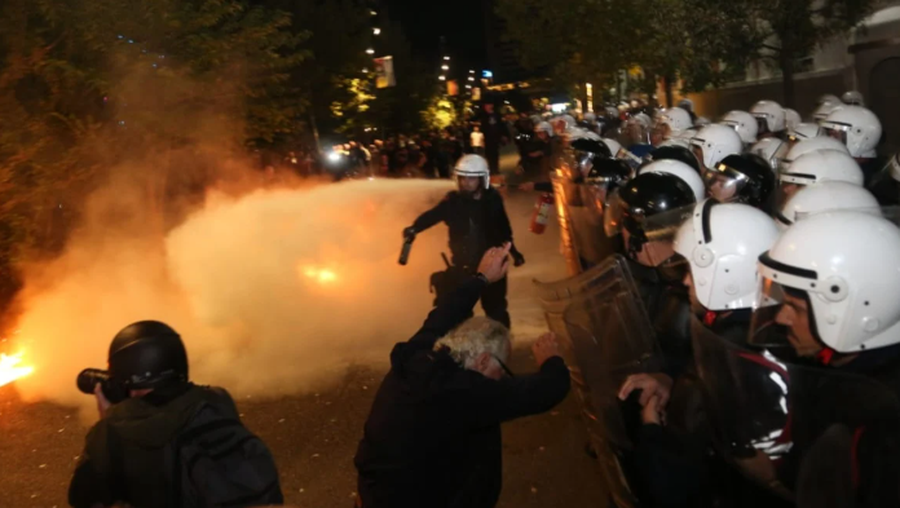
Edi Rama is trying to sell his skin dearly. But chances are that the amnesty he is seeking will not happen...
The Democratic Party MPs seem to have been surprised at Friday's protest when they saw an increase in police aggression towards them. An aggression that they are able to measure and analyze, because they have already created a kind of long experience with the behavior of the police in such clashes.
It was obvious that the rapid intervention forces were overly bold, and this time they immediately used pepper spray on the DP leaders. In previous protests, they had endured insults, some stronger pushing, and even some physical confrontations. Not this time. This time they were blinded with pepper spray as soon as they approached.
After this aggressiveness, which the DP deputies clearly did not expect at this level, the opposition leaders attacked the new police chief, Skënder Hita, in the media. And this is understandable, because he is today the main person responsible for the structure that implemented the operation and, in all likelihood, personally followed its development on the ground.
However, the order to tighten the grip does not seem to have originated with Skënder Hita. It seems to have come from Edi Rama himself. And with this violent behavior, Rama is not so much seeking to scare the opposition or appease the radicals of the DP, as to send a signal to the internationals.
Because there is a growing conviction that an active process has begun behind the scenes to prepare the political end of Edi Rama. A process that seems to have its own phases, its own rhythm, and a complexity of developments that do not all immediately appear on the surface.
Convinced that the path he has embarked on is one of no return, Edi Rama seems to be no longer negotiating his stay in power, but rather the manner of his departure. Not the departure itself, but its form, so that it is as less traumatic as possible for him and his circle.
Such negotiations, in various forms, have also been attempted by Sali Berisha and Ilir Meta. But as usually happens in such cases, when negotiations are conducted at a distance and with signals, the scenario does not always go according to the wishes of the parties. It suffers deviations, because each tries to gain as much ground as possible.
In this context, Edi Rama is trying to show the international community that he is still able to control the situation and that he will not give up easily. In short, he is playing the strongman, as autocrats often do in the end, who leave, deepening the oppression even more.
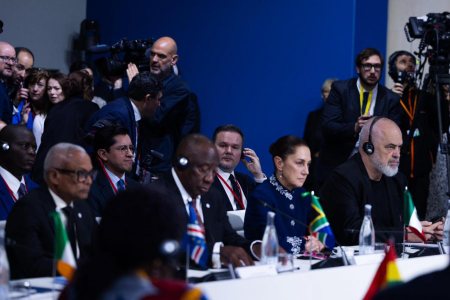
Both the visit to Rome and the participation in the summit in Spain seem to be part of this movement. Rama is trying to activate his contacts in Europe, in the hope that someone can intervene in those centers that, according to the majority voices, have already decided on his departure.
It is also said in these circles that Edi Rama is sending frequent signals that he has decided to leave politics and that he is also preparing the figure who could succeed him. And as if by coincidence, the most talked about name as successor, Lea Ypi, has given an interview where she has sent a significant signal.
In an interview with the prestigious magazine "Jacobin", Lea Ypi talks about a new alternative to left-wing cosmopolitanism. This is an idea that is read as a clear distancing from Trump's politics and from the extreme right, the very space with which Edi Rama has flirted politically, directly or indirectly. And in that camp, the leaders are falling one after the other. With Orban, the end seems already apparent.
Edi Rama is trying to sell his skin dearly. But the chances are that the total amnesty he is seeking will not happen./ Pamphlet



Ish 'helikopteristi dhe vozitësi' në Dhërmi, Toni Bler - Protokëshilltari i qeverisë Rama, nuk ka si mos të mendojë për zëdhënësin e Edi Ramës, tash që po i bien poturet të dyve.