


 Shkruar nga Carl Bild dhe Wolfgang Petritsch
Bosnia and Herzegovina no longer needs international administration. Christian Schmidt's withdrawal offers the opportunity for a fundamental reorientation...
Christian Schmidt's sudden resignation as High Representative for Bosnia and Herzegovina raises much more than just the question of his successor. It forces Europe to confront an uncomfortable geopolitical reality: 30 years after the Dayton Peace Agreement, the country remains stuck in a state of political limbo, formally sovereign but in practice still under international supervision.
The institution of the High Representative of the international community is the ad-hoc institution that, to a large extent, successfully achieved the reconstruction of the war-torn country. Without the American-European commitment, where Russia, Japan, Canada and the European Union were also represented in the “Peace Implementation Council”, as well as the main sponsor, the implementation of the Dayton Peace Agreement after 1995 would hardly have been possible.
However, what was intended as a temporary solution for the immediate post-war period turned into a permanent state of affairs. For a long time, this civil institution, which has lost influence and legitimacy over the years, has served many local politicians as both a common enemy and a rescue mechanism, thus freeing them from the obligation that democratic societies have to find, under their own responsibility, functional political compromises.
Russia has become a regional destabilizing factor
It would therefore be a mistake to now reflexively appoint another High Representative and thus continue the unsatisfactory status quo. The international community, especially the EU, should ask itself whether it is truly promoting stability and independence with this step, or simply maintaining a managed stagnation.
Added to this is the fundamental change in the geopolitical situation. While in the Western Balkan countries the long road to Brussels is losing traction, the international consensus on the future of Bosnia has long been fragile. Russia has been openly opposing the role of the High Representative endowed with special powers for years and has now become a regional destabilizing factor.
Now, however, a clearly transactional approach to the Balkans is emerging in Washington as well. The recent visit of Donald Trump's son to the capital of the Serbian part of Bosnia and Herzegovina should be seen as an attempt to establish yet another dubious business relationship. Similar developments are already taking place in Serbia and Albania, and this in flagrant disregard for European rules and laws. Under these conditions, a successor to the outgoing High Representative would hardly have more legitimacy than his predecessor.
The crucial question, therefore, is not who will replace Mr. Schmidt, but what reforms can successfully bring Bosnia closer to the European Union. For it is not compatible with the fact that Bosnia continues to be held under a continuous form of external control, without the prospect of full sovereignty and responsibility, while at the same time aiming for the path to the European Union. Based on an in-depth analysis of the thirty-year state-building process, Europe needs a new strategic start in Bosnia.
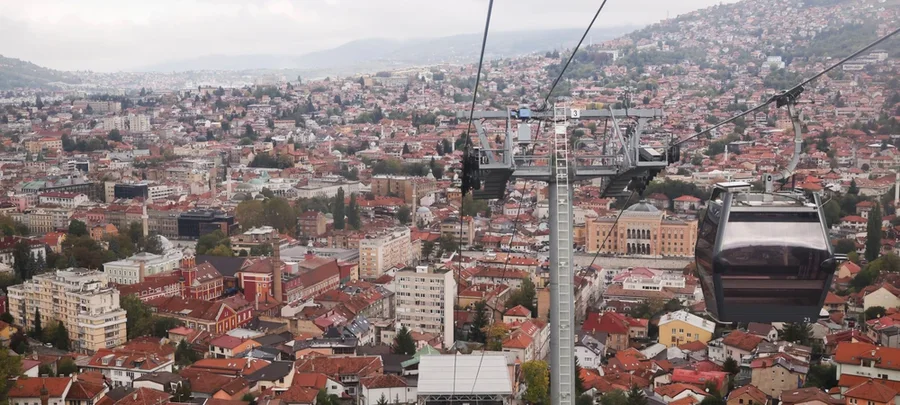
This new beginning must be based on two interrelated elements: on the one hand, the correction of the dysfunctional system of governance and, on the other, the end of special international supervision. This reform agenda must be closely coordinated with the gradual rapprochement with European structures. This is not a question of a radical reorganization of the Dayton system, but of realistic adjustments: more efficient decision-making structures, clearer competences and the limitation of permanent possibilities for political deadlock have long been necessary.
In parallel, the closure of the Office of the High Representative should be closely linked to the EU accession process. The conditions that Schmidt and his predecessors have been demanding for years without success, such as the regulation of state property, could be transferred to the relevant chapters of the accession treaty. In this way, the almost endless discussion about whether Bosnia “belongs” to Europe would come to a clear end.
Integrated into a credible European perspective, Bosnia and Herzegovina would become part of a dynamic political project. This would be the transition from international supervision to European integration. For this reason, Christian Schmidt's withdrawal offers a long-overdue opportunity to fundamentally rethink international policy towards Bosnia, in a European way. Bosnia and Herzegovina does not need endless international administration. What the country needs is a credible European future. /Adapted from Pamphlet by FAZ /



Lini një Përgjigje