


 Shkruar nga Pamfleti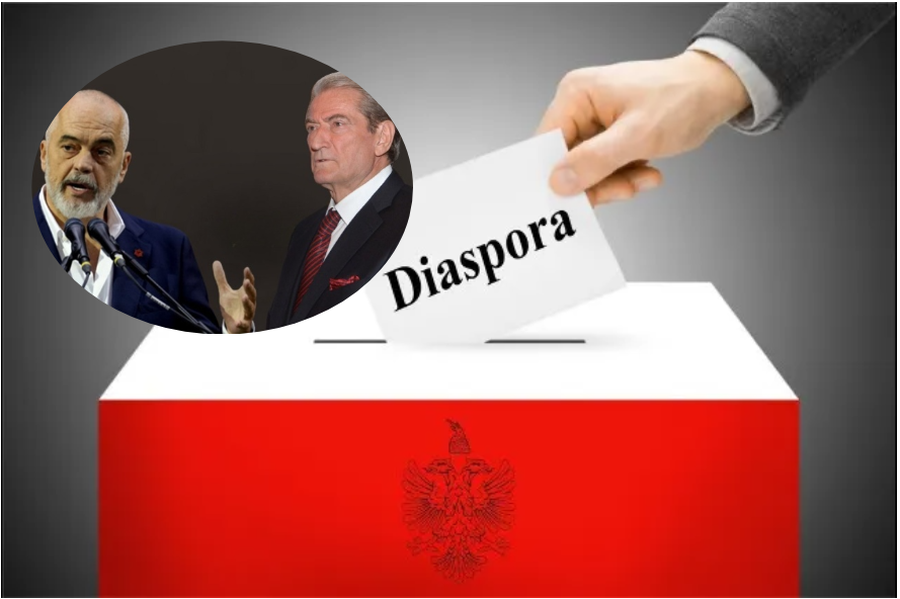
New parties find it easier to get votes in the Diaspora or among immigrants than in Albania, where political "dinosaurs" are spread out and have clear schemes for how to gather votes on the ground, without the need for beautiful speeches or promises of change.
As the May 11 parliamentary elections approach, perhaps the most used phrase in Albanian politics is the “emigrant vote.” They are seen on the one hand as an alternative that could define change in Albania and on the other as an opportunity for Edi Rama to collect as many votes as possible in what he is trumpeting as a plebiscite election victory.
The two parties that have dominated the Albanian political scene for 34 years, the DP and the PS, with their respective leaders Sali Berisha and Edi Rama, are treating emigrants as their electoral collateral. Each is playing the game, trying to turn what is known as the Diaspora into a property, where each has the highest percentage of control. Both parties are playing dirty, they are using every opportunity that the political podium gives them as “1” and “2”, even though both Rama and Berisha until the last moments of decision-making have had no interest in allowing emigrants to vote.
Both Berisha and Rama were forced to accept a constitutional right of those who had been known for their reminiscences for 3 decades only after the decision of the Constitutional Court. The latter was put into motion by the association "Diaspora for a Free Albania", as the issue of emigrants' voting rights had become a ball that was sometimes thrown by the DP towards the SP and the latter passed it back to the Democrats.
Today, both Rama and Berisha are on the attack, not just for votes, but also to recruit, if they can, as many of those prominent names in the Diaspora as possible, to include in their lists of candidates for MPs. One of these cases was denounced by Florian Haçka, one of the protagonists in the legal battle to give Albanians living abroad the right to vote in Albanian elections, who was invited by both Rama's Socialists and Berisha's Democrats to be included in the lists of candidates for MPs under the logo of one of the two parties.
In this way, the strategy is clear, an attempt is being made to divide as much as possible the factors that could have an impact on the Diaspora. The fear is that the Diaspora vote could get out of the control of the two main parties and it could actually form a third political pole, that of new parties.
The latter find it easier to get votes in the Diaspora or among immigrants than in Albania, where political "dinosaurs" are widespread and have clear schemes for how to gather votes on the ground, without the need for beautiful speeches or promises of change.
But to what extent will the vote of immigrants or the Diaspora be absorbed by parties that are trying to be outside the fold of Rama or Berisha?
In theory, the possibilities are great, while in practice every attempt will be made to have this vote controlled in the cell. Not just in the registration process, but also later in the counting. Within January, the Assembly may meet and approve that the emigrant votes be counted by political commissioners, although the CEC had proposed that there be apolitical groups of three, while the parties would have their own observers.
The CEC proposal was opposed by the DP, while the Socialists remained silent, and recently, after secret negotiations, it seems that Celibashi himself has withdrawn from the proposal that votes be counted by counters who would not be proposed, at least officially, by the political parties.
Both Rama and Berisha could not accept that these votes would not be administered by them and that the negotiations would inevitably lead to the process being placed under political control. This is due to the fact that the vote of immigrants, from the moment the discussion began, has not been seen by Rama and Berisha as their constitutional right, but as a reserve bag of votes, which would be added to the traditional bag of votes that they possess. / Pamphlet /






Lini një Përgjigje