


 Shkruar nga Pamfleti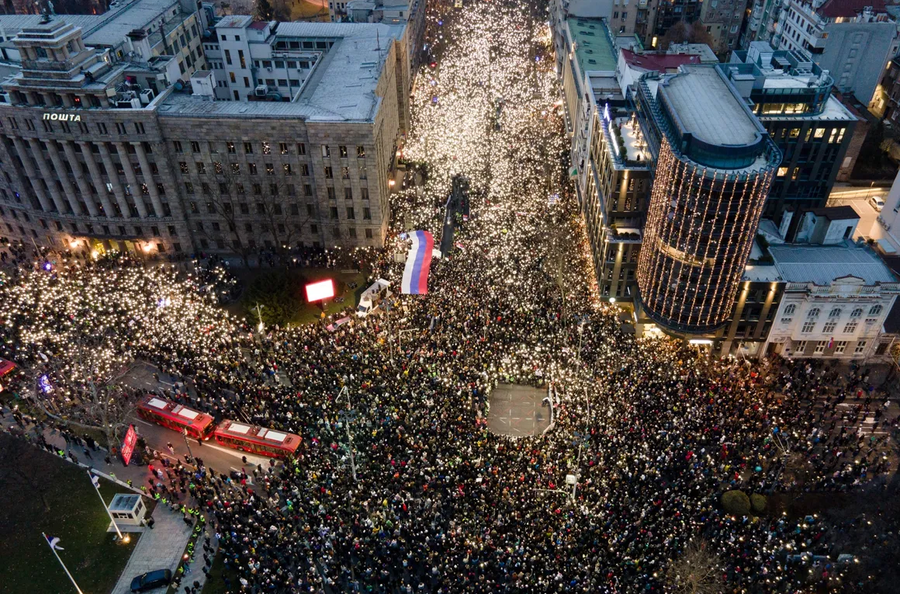
How the unrest in Serbia affects the dialogue with Kosovo and stability in the region
As Serbia faces a deep internal political crisis, fueled by massive student protests and the Vučić regime's refusal to accept demands for elections; the consequences of this situation are beginning to be felt beyond its borders, especially in relation to Kosovo and regional stability.
1. Blocking the Kosovo-Serbia dialogue
Internal clashes in Serbia are seriously hindering the resumption of dialogue with Kosovo, which is a key EU condition for the integration of both countries. The Vučić regime, focused on maintaining power and suppressing internal protests, has lost the will, and perhaps even the political ability, to take concrete steps towards a final agreement with Pristina.
This stagnation comes at a critical moment, when the EU and the US are demanding concrete progress, especially in the implementation of existing agreements such as the one on the Association of Serb-Majority Municipalities.
2. Diplomatic advantage for Kosovo in the eyes of the West
With Serbia mired in a legitimacy crisis, Kosovo has a golden opportunity to strengthen its position on the international stage. If the Kosovo government manages to maintain institutional stability and show a willingness for dialogue, it can present itself as a constructive party, in stark contrast to Belgrade, which is gripped by repression and crises.
This perception could translate into stronger diplomatic support from the EU and the US for Kosovo's Euro-Atlantic aspirations.
3. The risk of provocations in the north to distract attention
If the Vučić regime feels it is losing control domestically, it is not excluded that it will incite tensions in northern Kosovo, a scenario that has historically been used to divert attention from domestic problems. An escalation in the north, whether through illegal structures or controlled incidents, would be a dangerous signal for regional security.
4. Crisis as a catalyst for regional change
If the protests in Serbia lead to elections and a change of government, it would be a development that could completely change Belgrade's approach to the region. A new government, more democratic and more open to the West, would bring a new spirit to relations with Kosovo, but also with other neighbors such as Montenegro, Bosnia and Albania.
Serbia is at a historical turning point. The stability of the region depends not only on the outcome of the internal crisis in Belgrade, but also on Kosovo's ability to diplomatically benefit from this situation and maintain the Euro-Atlantic line./ Pamphlet








Lini një Përgjigje