


 Shkruar nga Pamfleti
Once again, the British were in the vanguard together with the Germans of the BND, while the Americans were more in the shadows...
The situation of 1999 has been repeated with almost the same intensity, when the commander of the KFOR troops in Kosovo, British general Michael Jackson, clashed fiercely with the commander-in-chief of NATO, American general Wesley Clark over the fate of the Russian troops that entered Kosovo.
As learned from diplomatic sources, on the day of the operation on November 24, there were British MI6 secret service officers on the ground, as well as special SAS troops, who have been training the special forces of the Kosovo police for years.
The British MI6, as it has been proven for years, is the service that has the most detailed information about the transitions in the Balkans, it has been in the vanguard since 2016, in the attempt of the Russian GRU to kill Milo Djukanovic, the shooting of Zoran Zaev and Zijadin Sela in North Macedonia in 2017, but also other cases.
Once again, the British were in the vanguard together with the Germans of the BND, while the Americans were more in the shadows.
The British provided the notification to the NATO service about the riot plan, as they also warned KFOR about the attack by the Serbian paramilitaries on them in Leposavic.
The delay in KFOR's reaction was only a consequence of the slow reaction of the Italian command of KFOR, which received an order from Rome, to leave room for political negotiations with Belgrade. Which gave the paramilitaries time to hit the KFOR soldiers hard, which was considered by the Prime Minister of Italy, Giorgia Meloni, a breach of faith on the part of the Serbs.
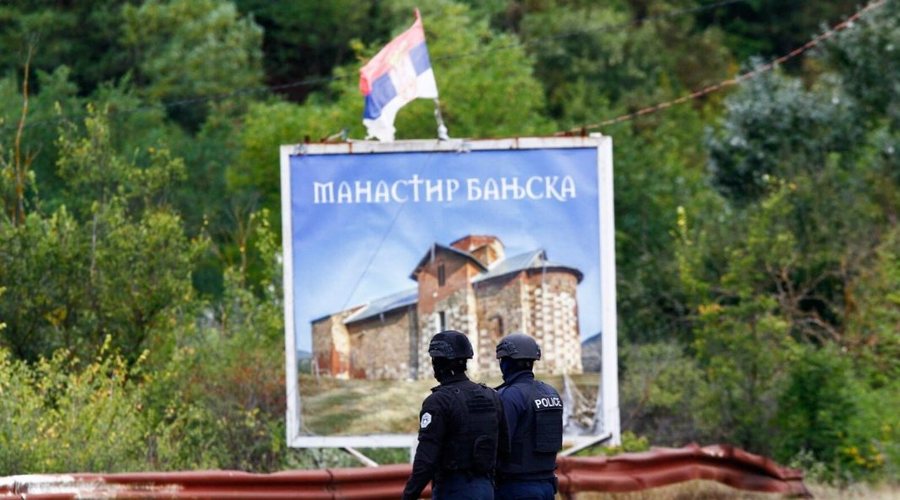
Meanwhile, the British, together with the police forces of Kosovo, have followed in detail all the movements of the Serbian armed group, from the arming, the transportation of the arsenal, the organization, to the gathering in the Monastery of Banjska.
The quick and efficient reaction of the special police of Kosovo happened also thanks to the adequate information of the British.
It is also learned that during the exchange of information, there have been many clashes between the British secret services and the Americans, even the accusation that the American intelligence had full knowledge and even contacts with Radojčić's armed forces.
However, the clashes peaked in the final hours of the operation against the terrorists, just as orders arrived not to completely annihilate the armed group. Thanks to their 'know how' and professionalism, the special forces of the Kosovo police targeted almost the entire group, which could be annihilated in a short time. But here Vucic has activated channels from Washington to negotiate the rescue of as many rebels as possible who undertook a terrorist attack in Kosovo.
Therefore, Vučič declared after the event that those killed were not destroyed while they were carrying out an action, but from a distance by a sniper.
As it is learned, the British have argued that if all those who are armed are not arrested, they can become even stronger and return to Kosovo, with greater ferocity.
Albin Kurti, meanwhile, was offered to allow an exit corridor, which he categorically refused. It is very likely that this story will be reflected in the Western media, as happened with the Jackson-Clark fight, which was also a reflection of the Bill Clinton-Tony Blair clashes.
Even then, the Americans were negotiating with Boris Yeltsin independently, and are even said to have paid large sums of money so that Russia would not make noise about the liberation of Kosovo.
Even these days, it is clearly noticed how British officials or parliamentarians are tougher with Belgrade and Vucic.
Meanwhile, the British The Guardian has been the most active 24 hours a day among the European media to reflect the events of Kosovo, where both Prime Minister Albin Kurti and Interior Minister Xhelal Zveçla were present. / Pamphlet


Lini një Përgjigje