


 Shkruar nga Pamfleti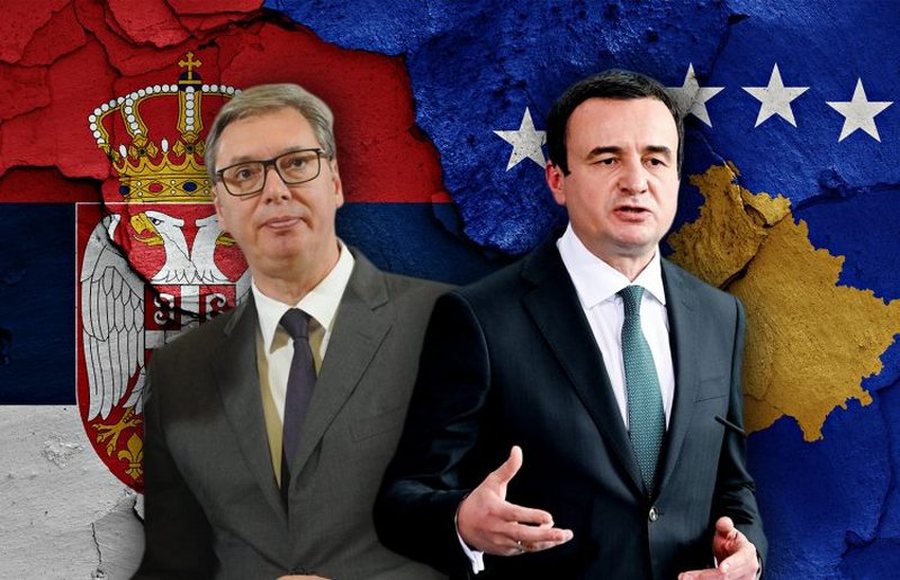
Vucic basically has three options: a solution, escalation, or maintaining the status quo with targeted provocations.
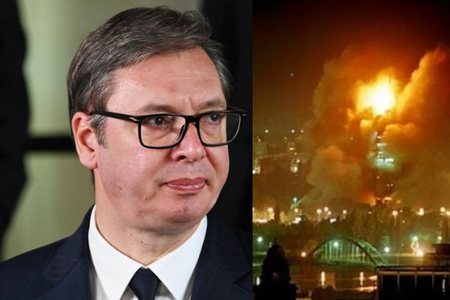
Serbian President Aleksandar Vucic cooperates closely with Russia, including on security and weapons issues. Now he is threatening to invade Kosovo, which Serbia does not recognize as an independent state. If Donald Trump were to win and NATO were weakened, Vucic might be ready to move.
"We will wait for the right time and take our chance... " was the ominous warning last weekend from Serbian President Aleksandar Vucic with the prospect of the West throwing its weight behind Kosovo as the long Balkan conflict continues to heat up. .
It is worth noting that Vucic had already spoken admiringly in December of the current and previous presidents of Azerbaijan, who had waited a total of 27 years for the "right time" and geopolitical circumstances to reclaim Nagorno-Karabakh. Last September, Vucic deployed Serbian troops to the border with Kosovo after Serbian paramilitaries attacked Kosovar police and holed up in a monastery.
Against this background, it is difficult to see in his last words anything but a threat. A new Balkan war is not inevitable, but the conflict between Serbia and Kosovo has been coming to an end for months. It is about the status of Kosovo as an independent state, which Serbia does not recognize. The EU and the US have been trying to find a solution for years, but the situation is deadlocked.
Should the West prepare for a worst-case scenario in the medium term, or are the words of the Serbian president just rhetoric?
Vucic's interests
A US intelligence report warns of an "increased risk" of inter-ethnic violence this year and cites the Serbia-Kosovo conflict as a prime example.
" The motivation for Vucic to keep this crisis simmering is great ," says Florian Bieber, Director of the Center for Southeast European Studies at the University of Graz.
Russia also has an interest in all this: as Europe's home court, a conflict in the Western Balkans would be devastating for the West.
Vucic basically has three options: a solution, escalation, or maintaining the status quo with targeted provocations.
The first option would be for Serbia to recognize Kosovo or at least normalize relations. But a solution would deprive Vucic of an important issue that he uses in both domestic and foreign policy. The conflict is not only useful to appeal to nationalist sentiments throughout Serbian society, but also helps position it as a crisis manager in the international context.
The second option - escalation - could appear as an offensive by the Serbian army against Kosovo or as a provocation of major disturbances in the north of Kosovo. This possibility is mostly theoretical, because in practice, the soldiers of the defense force led by NATO KFOR would immediately intervene and the US would be called into action. In addition, Serbia would lose its prospects in the EU. None of this is in the government's interest.
Both arsonists and firefighters
This leaves the third option : maintaining the status quo with targeted provocations. According to Bieber, Vucic is "inciting tensions so that a subsequent de-escalation to the status quo can be considered a success." In other words: Vucic is both an arsonist and a firefighter. But there is a great danger that a wrong calculation can lead to a fire.
Vucic is also likely hoping for different geopolitical conditions. For example, a victory for Donald Trump in the US presidential election. A radical weakening of NATO could also have a new impact on Vucic's calculations.
As president, Trump had been in favor of a territory swap between Serbia and Kosovo. This provided that the north of Kosovo, with its local Serb majority, would go to Serbia, while the region of Preševo in southern Serbia, where there is a local Albanian majority, would be incorporated into Kosovo. However, experts have warned that any border changes could be the prelude to a new regional conflict.
Playing with nationalism
A few years ago, Vucic was still considered a pro-European. But his political career began in Serbian ultra-nationalism. He was the Minister of Information under war criminal Slobodan Milosevic and drastically limited the work of the media during the Kosovo war.
At its core, it has a nationalist and anti-Western worldview. The year 2008, when Vucic was 38 years old, marked a turning point. He suddenly admitted to Serbian war crimes and said he had changed.
" He understood that you cannot win elections with an anti-Western line. He's a man of power ," Bieber says of Vucic's alleged change of heart.
But Bieber would not describe the Serbian president as having no ideology. "At his core, he has a nationalist and anti-Western worldview. Depending on his strategy, he sometimes rejects that," he says.
Moscow's support
Russia is Serbia's most important ally in the Kosovo issue. This will help Serbia protect its "legitimate" national interests, the Russian Foreign Ministry has claimed in the past. Belgrade has not joined Western sanctions against Russia and cooperates with Moscow on security, armaments and economic issues. At the same time, the country is said to have supplied weapons to Ukraine, as leaked US intelligence documents show.
Daniel Sunter of the Balkan Security Network, a Belgrade-based platform that focuses on defense and security, describes Serbia's foreign policy as a four-pillar strategy: the EU, the US, Russia and China. Serbia relies on the latter exclusively because of the Kosovo conflict, a defense for Serbia's position.
Sunter attributes Vucic's inflammatory rhetoric to stalled negotiations between Belgrade and Pristina. This has drastic consequences for the Western Balkans.
" A practical and long-term solution must be found. The region must be integrated into the EU as soon as possible. Who knows what else can happen here in the future ," he says./ Adapted "Pamphlet" from "WorldCrunch"



Lini një Përgjigje