


 Shkruar nga Pamfleti
The pre-university education system in the country is facing a rapid decline in the number of students, as a result of demographic factors with the aging population and emigration at young ages.
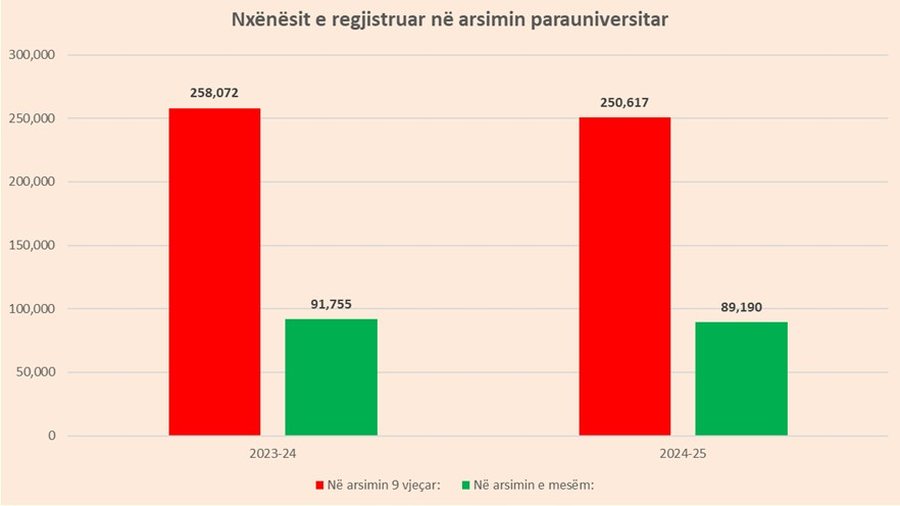
The latest official data from INSTAT show that within just one academic year 2024-2025, the total number of students attending 9-year primary and secondary education has decreased by 10,020 people or 3%. The total number of students enrolled in all educational levels has decreased from 349,827 students in the academic year 2023-24, to 339,807 students in the following year 2024-25.
Considering that the average number of students per classroom is 25, it is estimated that 400 classrooms will be closed during the 2024-2025 school year.
This decline is reflected in a similar way in all education cycles, but the hardest hit has been primary education, which has lost the largest number of students. This cycle has suffered a contraction of 4,710 fewer children, shrinking by 3% and dropping to 136,379 registered students. The same negative trend is also observed in the upper cycle of basic education, where the number of students fell by 2,745 people, going to 114,238 from around 117 thousand a year ago.
The same trend was observed in secondary education, where high schools and vocational schools will have 2,565 fewer students for the 2024-25 academic year, which corresponds to a 3% decrease in this group. Experts in the field see this dynamic as an alarm bell, as the emptying of classes in primary education predicts a long-term contraction that will gradually shift to the country's universities and the labor market in the coming years.
The emigration of young families remains one of the main and most visible causes. Unlike previous years where mainly single individuals emigrated, in recent years, emigration with families has been observed.
The decline in birth rates is another factor with a long-term impact. Changing lifestyles, rising living costs and the postponement of the age of starting a family have led to a significant decline in the number of new births each year. Last year, about 21,400 babies were born across the country, down from 32,715 in 2015.
In addition to emigration, there is also an exodus of rural areas and small towns towards large urban centers such as Tirana or Durrës. While in the capital some schools may still face overcrowding, in the districts and villages the situation is critical, often leading to the closure of schools or the creation of collective classes due to a lack of students.
The contraction of over 10,000 students within a year in pre-university education will be reflected in a chain reaction throughout the economy and the labor market.
In the short term, the decline in student numbers brings an immediate imbalance in the management of human resources in education. The closure of classes or entire schools, especially in rural areas and small towns, creates a surplus of teaching staff.
This means that the government will have to review the school funding formula, while teachers risk being left without full-time hours or without jobs. On the other hand, the decline in the number of students in secondary schools automatically translates into fewer applications to universities after a few years, putting the existence of many branches of study at risk, especially in regional universities./Monitor








Lini një Përgjigje