


 Shkruar nga Pamfleti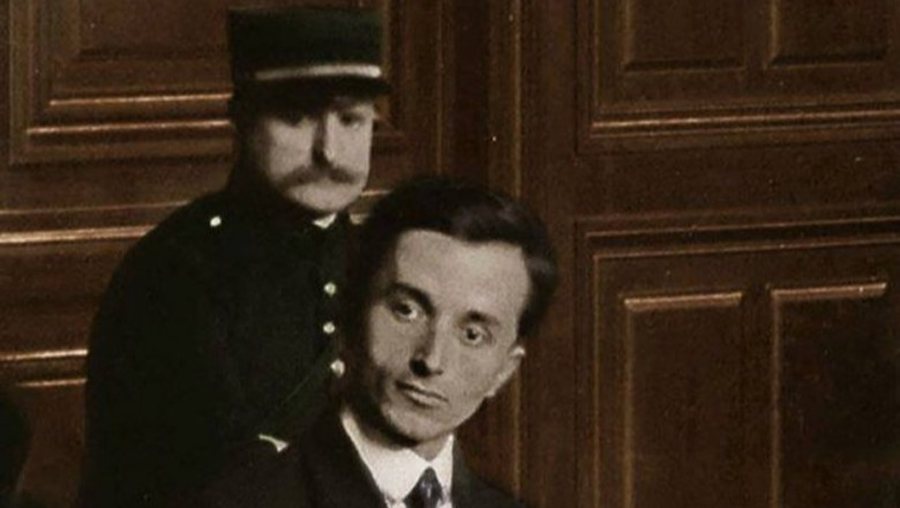
Rustemi, the patriot of money: Rejected by the Americans, appreciated by the fascist and communist regimes
Memorie.al / The murder of Esat Toptan in Paris on June 13, 1920, was ordered from Tirana, from the opposing wing of the victim. There is, apart from political competition, no patriotic motive. It is related to the breakdown of the compromise reached at the beginning of 1920, which made Esat part of the government. In March 1920, supporters of Esat, through Osman Bali, put armed pressure on the government (but without killing anyone) to enter into negotiations with Esat. On April 15, 1920, unable to cope with the pro-Esatist forces, the Parliament decided to send a delegation to Paris, for talks with Esat, consisting of Monsignor Gjergj Koleci, Ymer Deliallisi, Fuat Toptani and Bajram Fevziu, where the main points were ; the dispersion of the people on the day this declaration was made known, forgiveness for those who participated in the uprising and the punishment of the disobedient.
Precisely in the negotiation phase, Avni Rustemi is offered, against payment, to kill Esat in the interest of his political opponents. What Osman Bali could do with his forces remains hypothetical and unclear. But, if Bali did not do such actions, no one would have driven Esati to where he was, nor would we ever hear tales of "betrayal" towards him. Sejfi Vllamasi remembers the moment of Avni Rustemi's appearance:
"Avni Rustemi continued his studies in Rome. One day he goes to the house of Tefik Mborje, inspector of Albanian students in Italy (actually he was the chief secretary of the Albanian representation in Rome - KD note) and tells him that; had decided to kill Esat, to save Albania, but he needed the money for later expenses. At that time you had come from Tirana to Rome, a mixed government-Esatist delegation, which was on its way to Paris, to meet Esat.
Tefik Mborja, meets Bajram Fevzi, a member of that delegation, reports Avni's decision about Esat and B. Fevziu, promises that he will write to Xhavit Leskovik in Tirana, supporting Avni's thesis, as well as for the help of money that he would need. Avni landed in Durrës on May 5, 1920, with Bajram Fevzi's letter to Xhavit Leskovik, and Tefik Mborje's letter to Qazim Kokoshi. Supplied with the necessary tools and escorted by Tefik Mborja, Avniu leaves for Paris and after a few days, carries out his mission, at the decisive moment, at the moment of the large-scale uprising that Esati had prepared".
Avni Rustemi was a person who is not remembered for anything important, except for the implementation of terrorist methods, the legalization of murders with any kind of justification, as well as the misuse of youth. After the terrorist act of Paris on June 13, 1920, against former Prime Minister Esat Toptani, and the transition to a strange process of French justice, Rustemi came to Albania.
Skipped the mission and from a man ordered for a murder, entered politics by being elected deputy under dubious circumstances, after clearly losing in other constituencies (in 1923, he ran in more than one constituency).
In his destructive activity for the Albanian state, especially in the direction of the bad education of the youth and the administration, he did not stop. He thought that only through murder, he could achieve his political goals. He ordered other murders, in the direction of Ahmet Zog and some families, such as Vlora or Libohova. As a result, another reaction came, related to the popular philosophy "what you sow you will reap". On April 20, 1924, Avni Rustemi was wounded by Isuf Reçi. Two days later, from the single wound received, he died in the Tirana hospital.
Two burial ceremonies were held for him, in Tirana and Vlora. They started on April 28, 1924, with the ceremony held in the square in front of the old mosque in Tirana. The coffin with his embalmed body traveled to Durrës, and from there on the steamer "Belgrade", under the Yugoslav and Albanian flags, arrived in Vlora on Tuesday, April 29, 1924. The funeral ceremony took place on Wednesday, April 30, 1924.
The image of the murdered person took on such a large dimension that the anti-government press wrote that Avni Rustem's grave would become like Mecca or Jerusalem. After delivering harsh speeches in front of Rustem's corpse and heart, placed in a glass container, Rustem's supporters organized three meetings in the town hall of Vlora.
Avni Rustemi's resting place was thought to be a type of basement in the center of Vlora, which was honored for only 6-7 months. After that, there was a 58-year silence. It took 1982, when the Minister of Internal Affairs of that time, Hekuran Isai, became interested in Avni Rustemi's grave. The body of Avni Rustemi was embalmed with great quality by Dr. Sezai Çomo. In addition, the coffin was better insulated, enabling the body not to decompose.
At the top of his head, he had a glass to look into, while the burial place was a subterranean chamber, adapted to pay homage on occasion. Although it seems somewhat strange, the possibility of imitating Lenin's embalming in Moscow is not excluded. The lid of the burial chamber was opened at 13:00 on October 8, 1982. Several well-known names in history, ministers and local government leaders were present. The disinfection was done and the reopening was decided two hours later.
Fillimisht regjimi fashist, (periudha e pushtimit Italian të Shqipërisë, 1939-1943) e më pas ai komunist, e nderuan Avni Rustemin, me emra rrugësh, shkollash, bustesh dhe monumente. Secili sipas interesave të veta, fashistët e shikonin si antizogist, ndërsa komunistët, përveç kësaj edhe si revolucionar, kundër shtresave të pasura, etj. Asgjë nuk ka ndryshuar edhe sot, kur i adhuruari nga fashistët dhe komunistët nderohet me emra sheshesh, buste e shtatore.
Eqrem Vlora e quante Avni Rustemin, një “karagjoz politik”, i cili prej vitit 1922, drejtonte shoqërinë “Bashkimi”, aktiviteti i së cilës, synonte kapjen e administratës dhe të rinisë. Por, Avni Rustemi u vra i refuzuar nga amerikanët, atij nuk iu dha viza që kërkoi. Rustemi mori pjesë për herë të fundit në Kuvendin Kushtetues, më 12 prill 1924, pasi kish kërkuar leje tremujore, tri paga dhe pesë pensione paradhënie (Avniu merrte pension prej disa vitesh, përveç rrogës), duke deklaruar botërisht se do shkonte në SHBA-ës, pavarësisht se nuk kishte marrë vizë.
E mendonte këtë proces të sigurt, sepse kujtonte se ishte njeri i madh, tepër i rëndësishëm. Më 25 mars 1924 ai paraqiti kërkesën për vizë me arsyetimin se do mblidhte ndihma për të varfrit dhe një ditë më pas depozitoi në legatën amerikane në Tiranë shumën prej 20 napolonash. Duke paguar, ai u soll në mënyrë fyese me personelin e legatës.
Ministri amerikan në Tiranë, Grant Smith, në relacionin përkatës, analizonte figurën e Rustemit, duke nënvizuar faktin; se kishte mbrojtur figurën e Leninit në Kuvendin Kushtetues, sjelljen e keqe në legate, etj. dhe i sugjeroi Departamentit Amerikan i Shtetit (DASH) që të mos i jepej viza.
Më 2 prill 1924, duke nuhatur se mund të ishte i refuzuar nga Amerika, Rustemi kërcënoi legatën amerikane në Tiranë se nëse përgjigja do ishte negative, “do ia tregonte qejfin” Grand Smithit, duke protestuar me deputetët që e mbështesnin në Kongresin Amerikan kundër tij. Legata amerikane theksonte se Rustemi e kishte njoftuar publikisht vizitën në Amerikë edhe pse vizë nuk kishte marrë. Më 8 prill 1924, DASH, ktheu përgjigje se Rustemit, nuk mund t’i jepej vizë diplomatike,
Rustemi erdhi në Tiranë më 20.4.1924, për të marrë vizën, por mori përgjigjen refuzuese dhe po atë ditë u plagos dhe dy ditë më vonë, vdiq në spitalin e Tiranës. Ai u refuzua nga Amerika, ndërsa në vitet e fashizmit dhe komunizmit, u nderua sikur ishte ndonjë figurë e madhe, duke u kthyer në një shembull të keq, për cilindo që e kishte për model.
Lidhur me këtë, Reshat Këlliçi, në librin e tij “Me djemtë e Bashkimit” (botimi i vitit 1965, fq. 126-127), midis të tjerash shkruan: “Më 25-28 prill 1921, Avni Rustemi mblodhi në Vlorë 47 delegatë, që përfaqësonin 25 shoqëri dhe 15 katunari e, shpalli formimin e Federatës “Atdheu”, e cila kishte si qëllim kryesor, depërtimin në nëpunësinë e shtetit, me programin e saj.
Based on this, the government of Xhaferr Ypi ordered the closure of the federation. However, Avni Rustemi, on October 13, 1922, formed in Tirana the society "Bashkimi", which also approved its statute and regulations. The goal of the "Union" society remained the attraction of the youth to its ranks, as well as the destruction of that class that was in power.
After Avni Rustemi's murder, the society carried out military mobilization, creating a volunteer militia and calling for conscription and terror. Society oscillated between communist and fascist ideals. They created a kind of armed force, which seemed end to end, Bashibozuke, but also funny, as the form was also supplemented with oaths, for an imaginary ideal. On the chest they had written a letter "B", which symbolized the name of the company. They wanted to resemble Avni Rustem, killing.
With the return of Ahmet Zogu to power in December 1924, a good part of the members of the "Union" turned to the country of ideal and world crime, the Soviet Union, proving how many crooked paths they had taken. The boys of the 'Union', a youth completely disoriented and without a compass, traveled with the government of Noli, after receiving the balance of the treasury of Tirana and the revenues of the customs of Saranda, Durrës and Vlora. With three steamers, they left for Italy. After being thoroughly checked by the Italian police, they landed in Brindisi, like a distracted crowd. There they won the anger of the people, because of the letter "B" they carried in the comparative.
From there in the evening, immigrants poured through the streets of the small town, especially those who had never been to Italy, to see a bit of Europe with their eyes; stood in front of the few display cases, looking in amazement at all kinds of things. However, with that 'B' on the chest, the boys of 'Bashkim' found trouble from the locals, who watched with astonishment at how Mussolini had allowed the Albanian "Bolsheviks" to roam the streets of Brindisi. After a while, all those who were still wearing the uniform of the "Union" quickly bought some cheap clothes, which they sold for fakirs in the shops tucked away in some alleys, and thus escaped from the trouble of "B". !/Memorie.al



Lini një Përgjigje