


 Shkruar nga Sarah Rainsford
It is fundamental: the concept of 'safe country of origin' can no longer be used to carry out transfers to Albania, until Italian law is amended to be in line with EU legislation...
A ruling by the EU's top court has dealt a further blow to Italy's efforts to create a fast-track system in Albania for processing asylum claims abroad.
The European Court of Justice (ECJ) has said that the way the Italian government currently determines whether a country is "safe" to return someone whose application has been rejected is contrary to EU law.
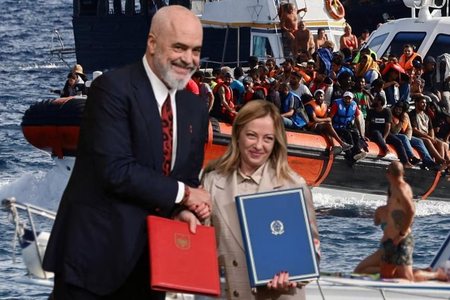
This concept of "safe country" is central to the agreement that Prime Minister Giorgia Meloni reached with Albania in 2023 to send migrants caught at sea directly there for expedited processing.
Anyone from a "safe country" who was denied asylum had to be deported within a week.
But the European Court of Justice has ruled that a nation can only be included on the government's list if the entire population there is safe, meaning Italy will have to review its procedure.
Currently, it identifies Egypt and Bangladesh, for example, as safe, while acknowledging that certain groups there need protection.
The decision sparked an angry reaction from the government in Rome, which said the European court was overstepping its role, adding that the ruling would weaken countries' ability to "protect national borders".
The European Court also said that the government must make public any evidence and sources it uses to reach its conclusions on safe places, so that asylum seekers can challenge the decision in their cases.
“Today, the court makes it clear that a country cannot be defined as safe if it does not offer effective and generalized protection, for everyone and everywhere, and if this claim cannot be independently verified and refuted,” explained Katia Scannavini of ActionAid Italy.
"The so-called Albania model collapses at its legal core," she argued.
The fate of the Italian project in Albania was being closely watched by other governments, including the United Kingdom, which are keen to handle asylum claims abroad while trying to reduce the number of irregular migrants arriving in their countries.
Conceived as the centerpiece of Meloni's tough approach to immigration, the deal with Albania has encountered legal hurdles from the start. The small number of migrants who were sent there were all returned to Italy after lawyers intervened.
Many times over budget, the centers that were built were never used as intended.
This significantly hinders the plan for Albania.
In its ruling, the European Court did not oppose in principle an accelerated procedure for migrants from safe countries, but made it clear that the implementation of this policy must change.
"It is fundamental: the concept of 'safe country of origin' can no longer be used to carry out transfers to Albania until Italian law is amended to be in line with EU legislation," Amnesty International migration researcher Adriana Tidona told the BBC.
"This puts a significant damper on Italy's plans in Albania."
Amnesty, like others, considers the agreement with Albania a more fundamental violation of human rights. "This is not about safe countries of origin, but about the fact that it is based on an automatic detention system," said Adriana Tidona. "This is illegal."
It is not clear what impact the decision might have on the EU's new migration pact, which comes into force next year and introduces a common list of safe countries for returns, including Egypt and Bangladesh.
But the decision makes clear that the definition of safe places is not ultimately up to politicians.
"The court says that it is the judge who has the power to make assessments regarding safe places," explains Daniele Gallo, professor of EU law at Luiss University in Rome. "Whatever the government says, every judge in Italy now has the duty to set aside Italian legislation and apply EU law." /Adapted from BBC/







Lini një Përgjigje