


 Shkruar nga Pamfleti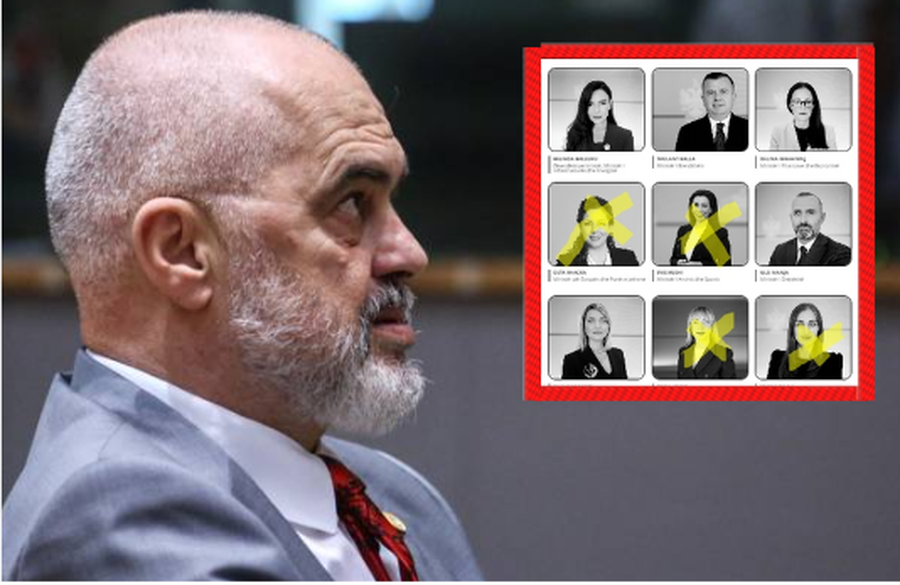
Considering that the changes in the government are always preceded by criticisms of the government's work made by the Prime Minister and in the meantime, the changes have produced other criticisms, clearly the governing equation of long-lived prime minister, short-lived ministers has not been laid out correctly.
The partial changes of the government, announced by the prime minister in the middle of his third term, gave us the idea to calculate an indicator for the stability in office of a minister and if this indicator follows the trend of the stability of the government as a whole.
Logically, a stable government is expected to have stability in its structures as well.
The current government, in terms of the political force it represents, has shown the highest stability among all previous governments since 1991. It is in power for the third term and has been governing the country for 10 years.
In the last two mandates, he ruled alone, without a government coalition. In the first mandate, he governed in coalition with LSI, but without the risk of creating governance crises, and in six months in 2017, with a group of ministers offered by the opposition, as part of the position-opposition agreement.
The government is neither challenged by the other institutions of the non-executive wing, nor is it endangered by the opposition. Above all, for 10 years, the government has been headed by the same prime minister.
Against this stability in the perimeter, the government has actually been in continuous movement, both in changing the number and functions of the ministries, as well as the ministers.
To make the comparisons, the ministries that have functions related to the economy, including finance, agriculture, tourism, transport, energy and entrepreneurship, etc., were analyzed.
The calculated indicators are the average service in years of a minister and his turnover rate, calculated as the ratio of the years in office to the governing mandate (Rate 1 means that the minister has served for 4 years at the head of the ministry. This ratio takes value from 0 to 1).
In the Rama I government, 6 ministries are identified, in which 10 ministers have served, with an average period in office of 2.4 years and an average turnover rate of 0.6.
In the Rama II government, 5 ministries are identified, in which 10 ministers have served, with an average period in office that decreases to 2 years and a turnover rate of 0.5.
In the Rama III government, which has reached the middle of the mandate, 5 ministries are identified, where 5 ministers have served, of which after the recent changes, only 2 of them continue to be in the same position.
So in the 10-year government with a 10-year prime minister, a minister of the group of ministries with functions for the country's economy is short-lived, staying in office for only half a governing mandate or 5 times less than the prime minister.
The indicator of the average years of tenure of a minister is lowest in the functions of economy and finance, with 1.4 years, and highest in the tourism sector, with 3.3 years.
There can be many factors that affect the level of development of an economy sector. However, the argument that the higher stability in the policy-making structure (Ministry of Tourism) has had its own contribution to the revitalization that the tourism sector has undergone in recent years cannot be rejected.
While there is no reason for instability to appear so high in the field of economy and finance, especially when the country needs to sound the financial administration of the state and make its economy competitive and diversified.
Considering that the changes in the government are always preceded by criticisms of the work of the government made by the Prime Minister and in the meantime, the changes have produced other criticisms, clearly the governing equation long-lived prime minister, short-lived ministers has not been laid out correctly./Monitor








Lini një Përgjigje