


 Shkruar nga Pamfleti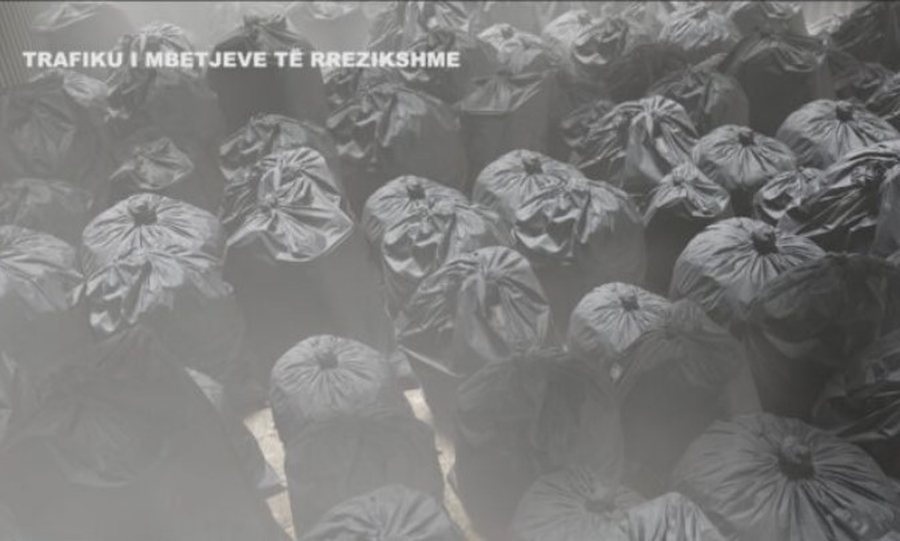
KURUM's reaction came after the news that the only company that could produce this category of waste in large quantities was the Turkish firm.
As we speak today, the industries of many countries produce millions of tons of hazardous waste such as chemicals, heavy metals and radioactive waste, which if not processed pose a risk to the environment and human health.
The more dangerous the toxic waste, the more it costs to treat it to turn it into non-hazardous waste or dispose of it. According to the environmental expert Rodion Gjoka "The treatment of this waste itself, even the storage of this waste itself according to the conditions provided for by the European Union directive on the management of hazardous waste is very expensive, so we see today the majority of hazardous waste in the Republic of In Albania, they are stored or treated in a very elementary way, even in some cases in open spaces".
Interest groups lured by profits prefer to take the hazardous waste and transport it to third world countries, where corruption and poverty ignore the permanent dangers that come from the disposal of this waste.
Environmental expert Ahmet Mehmeti says that "heavy metals are one of the most prominent when we talk about dangerous waste, since in addition to common diseases that can cause organs, they cause serious cancerous diseases. So they must be prioritized, the industry in Elbasan, relatively developed, has suffered a lot from the failure to clean the placement of filters."
Who are the companies suspected of being involved in hazardous waste trafficking? After the publication of the news in the media, the Prosecutor's Office of Durrës started an investigation into the issue of illegal traffic of toxic waste, where it is suspected that the company "SOKOLAJ" owned by Gjovana Sokolaj exported hazardous waste to Thailand.
According to "BIRN", which referred to the file of the Durrës prosecutor's office, the company "Sokolaj" is an exporter of containers and the Turkish company "Kurum International" turns out to be the source of products that are suspected to be dangerous.
On August 21, 2024, KURUM made a public statement to the media, denying links to the export of hazardous waste.
"Kurum International has never exported hazardous waste, so even in this case, this shipment in question was not exported by Kurum International," declared the Turkish company.
KURUM's reaction came after the news that the only company that could produce this category of waste in large quantities was the Turkish firm.
Doubts about the involvement of the latter were reinforced by the statement of the Ministry of Tourism and Environment, which indirectly implicated the company based in Elbasan.
According to the statement of the Ministry of Tourism and Environment, "volumes of goods which are suspected to contain waste from the technological process carried out by international companies operating near the metallurgical complex in Elbasan, have been loaded into container units near the Rifuxhio Goods Terminal in Durrës, which is operated by the German concession company EMS".
"SOKOLAJ" sh.pk was founded in 2006 by Gjovana Sokolaj together with her husband, Doni Sokolaj and has as object of activity the import/export of minerals, as well as the transportation of hazardous waste.
During these years, the company has also had the Turkish "Serdar Can Hakliol" as a shareholder, who is also a partner with Gjovana Sokolaj in the company "Florester Metalik".
From the data provided by "VETTING" it appears that the company "SOKOLAJ" shpk has financial interests in Turkey, where it has signed a contract with the Turkish company "Hakliol Madencilik". From 2014 to 2023, SOKOLAJ has transferred to the Turkish company sums with a total value of 319 million ALL or 3.2 million euros.
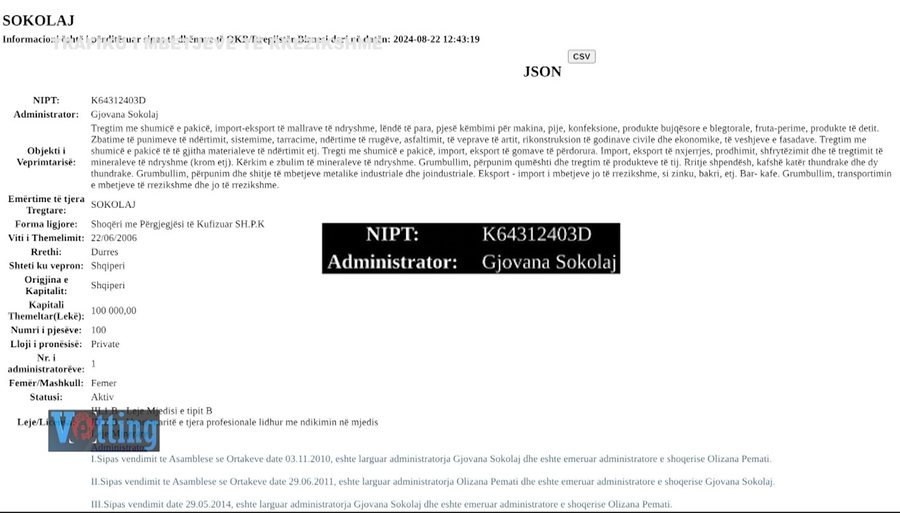
In 2022, "SOKOLAJ" sh.pk was granted a license for the transport and collection of hazardous waste by Minister Mirela Kumbaro. However, an important detail has gone unnoticed. From the documents provided by "Vetting", a year later the company's permit would undergo changes, which would increase the capacities for the processing of toxic waste.
Specifically, code 12 01 17 has been added for explosive material waste, other than those mentioned in code 12 06 01. The question that arises is: What explosive material waste are we talking about, which are used by private companies or the army, which are processed the company "SOKOLAJ" shpk?
The investigations of the prosecution have set in motion the administrators of the company, where the relative of Gjovana Sokolaj, Olizana Pemati, has carried out other actions with the companies. Immediately after the publication of the news in the media about the export of suspected hazardous waste, on August 13 the decision was uploaded to the National Business Center, where Olizana Pemati was dismissed by the company's shareholders earlier on June 27./ Vettingt


Lini një Përgjigje