


 Shkruar nga Pamfleti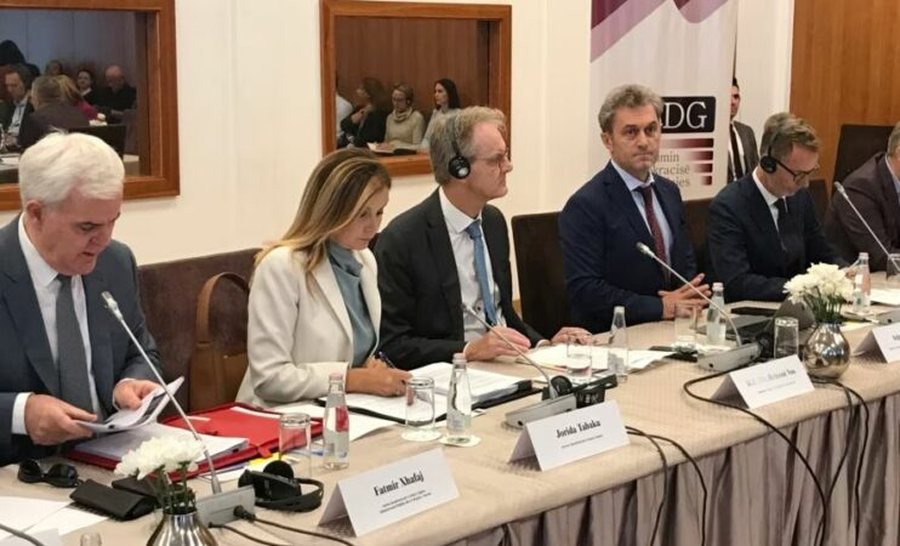
The Center for the Study of Democracy and Governance (CSDG) published today the comparative annual report 2020 - 23 on the work of the Special Prosecutor's Office (SPAK) and the Special Courts against Corruption and Organized Crime.
The study notes that the number of new investigation cases for corruption has decreased during 2023, but the number of convicts who have been tried for corruption has increased significantly.
The statistics show an increase in investigations by SPAK in matters of organized crime, as well as the number of suspects for these crimes.
In the Special Courts, the study emphasizes that there have been more investigations and decisions on criminal cases, where high-level officials are accused, the time of consideration of criminal cases has been significantly shortened, while the average workload for judges remains high.
Pursuing corruption
Criminal prosecution by SPAK for corruption cases has increased continuously in 4 years, reaching 447 cases of suspected corruption in 2023.
However, the last year recorded a low rate of prosecution for corruption, as only 38 cases or 8.5% of corruption cases were sent to trial in 2023, compared to 43 cases or 10.2% in 2022 and 33 cases or 21% in 2020.
Corruption cases sent to court decreased last year, and with them the number of defendants dropped significantly from 208 to 142 people suspected of corruption.
But on the other hand, the defendants for corruption, who end up with a sentence, increased significantly last year. Convictions for corruption reached 174 people in 2023, an increase from 140 in 2022 and only 29 in 2020.
The study notes that the number of new corruption cases has seen a steady decline, from 46 cases in 2021 to 40 cases in 2023. But the number of completed corruption cases in 2023 rose to 44, after a notable drop in 2022 with 32 cases.
The cases of corruption referred have doubled during 2023 to 23 cases referred in 2023, against 12 cases in 2022. But on the other hand, the number of appeals has dropped to 30 in 2023, against 43 cases in 2022.
The study highlights that during 2023, the number of criminal proceedings initiated mainly doubled in relation to 2022, and there was also an increase in criminal proceedings compared to the previous year, but they are significantly lower than those of two years ago .
Pursuing organized crime
The prosecution of organized crime by SPAK has marked a continuous increase in cases, as well as the number of defendants for these crimes, although the number of cases sent to court remained at the same levels.
Last year, only half of the defendants for organized crime, who arrived at the trial, were sentenced by the court. Even in 2022, only one third of the defendants for organized crime, who went through the judicial process, were convicted by the court.
In the study, it is observed that the rate of criminal prosecution has a slight decrease of 5.5 percent, or 11 cases sent to court out of 201, compared to a year ago, when 10 out of 167 cases were submitted to justice.
In the Special Court of First Instance for Corruption and Organized Crime, 16 new cases were registered last year from 27 the year before. On the other hand, 25 cases were carried forward, or two more than a year ago, and 21 court cases were concluded in 2023 from 25 cases closed in 2022.
High level officials
In the multitude of over 1,533 corruption proceedings with a total of over 1,000 defendants, 43 high-ranking officials were investigated for corruption, 32 of them were sent for trial as suspects of corruption and were convicted for this type of crime 20 senior officials.
Among those convicted from 2020 to 2023 are 3 former judges, 1 former prosecutor, 1 former member of the KPA, 3 former mayors, 1 former mayor, 1 former deputy mayor, 1 former deputy interior minister, 1 former secretary general of the ministry, and 2 former deputies.
According to the study, there was an 8.5 percent increase in 2023 in investigations of high-level officials, compared to 0.5 percent in 2021.
Last year, GJKKO concluded with a court decision over 75 percent of the cases sent for corruption and organized crime to that court, which belonged to high-level defendants, while in 2020 this was 25 percent.
In 2023, 2 cases of corrupt schemes were investigated, while previously the reformed justice had investigated only one case.
Special Courts
In the Special Court of First Instance for Corruption and Organized Crime during 2023, fewer new corruption cases were registered, the number of cases brought increased, but more court decisions were made compared to the previous year.
In the same court, fewer new cases for organized crime were registered last year, as well as fewer court decisions, while the number of cases carried over from the previous year increased.
In the Special Court of Appeal for Corruption and Organized Crime, corruption cases dropped significantly compared to a year ago, while organized crime cases increased.
Both courts have significantly reduced the time of case consideration, although the average workload for judges is high, 325 cases for 2023 in the First Instance, against 298 in 2022.
While in Appeal, the workload has dropped from 42 cases to 32 during 2023. Another problem to be highlighted are the vacancies, namely two vacant positions for prosecutor in SPAK, 5 positions for judge in the Special Court of First Instance and 2 in the Special Appeal.



Lini një Përgjigje