


 Shkruar nga Pamfleti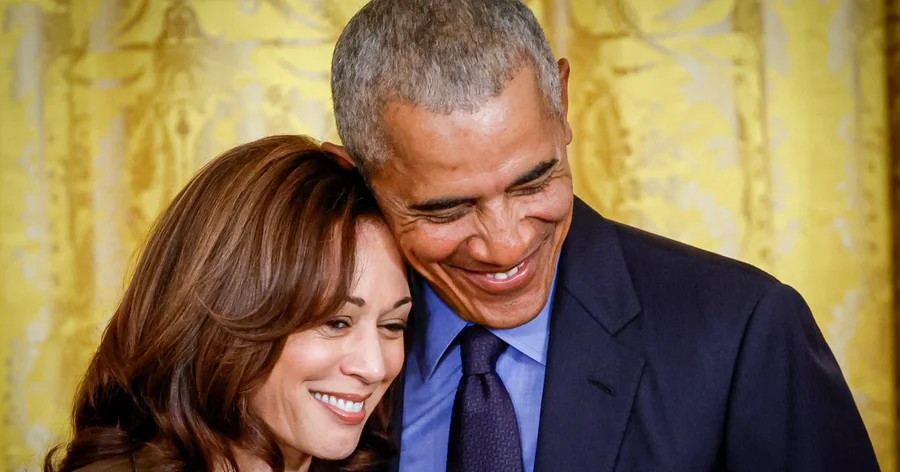
There's a Big Gap Between Obama and Harris: The Working Class Vote...
Many American Democrats feel like they are dreaming. Suddenly in the last nine days they feel like they are reliving 2008, the climate of excitement and euphoria that surrounded Barack Obama's first election campaign. All thanks to the abandonment of Joe Biden and the essentially certain nomination of Kamala Harris.
There are those who define Kamala as "Obama 2.0", the updated and improved version. Because she represents at the same time the black minority, that of Asian immigrants and naturally adds the fact of being a woman.
If the election of the first African-American president in 2008 was a historic turning point, Kamala's on November 5 would be historic many times over. Among the factors that lead to talk of a new "Obama effect" are two indicators: the increase in volunteers offering to participate in the electoral campaign and the flow of donations. The euphoria of friendly media does the rest.
The climate has changed, no doubt. But it's fair to test the comparison with Obama in 2008.
An expert in demographic and electoral analysis, Ruy Teixeira, is convinced that the comparison is wrong. There is a huge gap between Obama and Harris, which he boils down to one fact: the vote of non-graduate workers, or rather the working class, in the broadest sense. Obama had it, she didn't.
Kamala garners even less working-class support than Joe Biden and Hillary Clinton. It's a topic Teixeira calls attention to from Democrats, accusing them of "erasing social class" from their analysis of American society. His appeal is justified by these numbers: Workers without a degree will make up 60% of those who will vote on November 5. There will be an even higher percentage in the top six states: Arizona, Georgia, Michigan, Nevada, Pennsylvania and Wisconsin.
Teixeira is a special figure in the world of American political science. He comes from the democratic left, although he has distanced himself recently. He was the foremost theorist of a kind of ethnic determinism: the idea that immigration would permanently shift the political-electoral axis to the left, favoring the Democratic Party and reducing Republicans to a perpetual minority. Then he changed his mind, faced with the evidence: the more immigrants integrate, the more they move to the right. He was one of the first and most authoritative to report and analyze the phenomenon of ethnic minority voting for Donald Trump. (He himself has foreign roots).
Everything is relative. The Democrats maintain a consensus majority among women, young people, people of color, Latinos: what is accurately described as the "Obama coalition", now relaunched by the Kamala effect. However, some advantages are reduced and this is what makes the difference.
An example cited by Teixeira (drawing from a recent New York Times poll) concerns the "non-white" working classes, that is, the entire universe of black non-graduates that includes people of color and Hispanics. Harris wins the vote of this category of voters by a margin of 29 points over Trump. This may seem like a huge advantage. What should worry is the loss of consensus, however, because in the same category Biden enjoyed a 48-point lead over Trump in 2020, Hillary Clinton had 60 points. As for Obama, he won by 67 points over his Republican rival Mitt Romney among non-white workers in 2012. Therefore, there is a steady and significant erosion of consensus, the "Kamala coalition" has lost its way. more than half the lead Obama had among black graduates.
Looking at the working classes, non-graduate workers, as a whole, regardless of ethnic origin, Obama won in 2012 by 4 points, Hillary lost in 2016 by 3 points, Biden lost by only 2 points. But today, according to the latest New York Times poll, Trump's lead in this world has increased to 15 points.
"The problem is that today no one in the Democratic Party thinks about social classes anymore", comments Teixeira.
It wasn't like that in the days of Barack and Kamala's fathers. There is one trait that unites the two figures: Obama Senior, who left Barack's (white) mother to return to his native Kenya; and Kamala's Afro-Jamaican father, who also quickly divorced her Indian mother. Both were concerned with economics, both were trained in the texts of Marxist doctrine. Consequently, both analyzed the world in terms of economic relations, conflicts between social classes; race had a marginal impact on their worldview. Obama's father (an important figure in Barack's first book: "My Father's Dreams"), wrote of Kenya that he saw no difference between black capitalists and white capitalists in terms of the exploitation of workers.
The attention of "fathers" to social classes has disappeared in the world of Kamala, who grew up in a California where "woke" ideology rules and every problem is interpreted in the light of white racism or sexism. It's a left that is culturally light years away from that of the 1960s, which shaped the thinking of Obama Senior and Harris' father.
As for Barack, the hyped-up atmosphere of 2008 made us forget that he came from a moderate Midwestern tradition, and in fact once he arrived in the White House, he governed as a centrist moderate: starting with the bailouts of banks and car companies after the crisis of 2008. It is no coincidence that the Occupy Wall Street movement rose against the policies of the Obama administration, a precursor to the rise of the radical left with leaders like Bernie Sanders and Elizabeth Warren.
Therefore, be careful if you hastily equate the Kamala phenomenon with the Obama phenomenon, the differences run the risk of overpowering. / Adapted "Pamphlet" from "Corriere Della Sera"




Lini një Përgjigje