


 Shkruar nga Pamfleti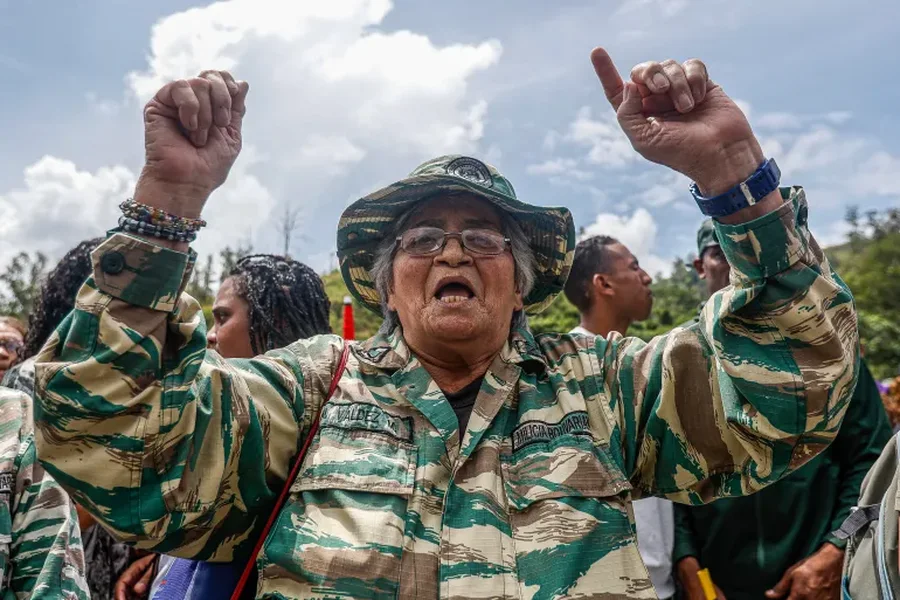
Trump declares Venezuela the capital of cocaine, UN and DEA facts show the opposite...
US President Donald Trump said this week that a ship in the Caribbean, which he said belonged to the notorious criminal gang "Tren de Aragua", was destroyed by US forces while transporting drugs to the US. According to him, 11 people were killed in the attack, whom he called "terrorists".
The intervention came just days after reports of US warships moving into Venezuelan waters. The New York Times reported that Trump had signed a secret order authorizing the Pentagon to use military force against drug cartels in Latin America, which have been designated terrorist organizations.
According to Reuters, three US Aegis-class warships and more than 4,500 troops, including 2,200 Marines, have been deployed near the Venezuelan coast. However, no official statement has been made about the exact mission of this military flotilla.
Was the attack legal?
Many legal and international experts have raised the alarm over the legality of this military act. Professor Salvador Regilme of Leiden University says that any military intervention in international waters must respect the right to life and the principles of proportionality, as set out in the United Nations Convention on the Law of the Sea (UNCLOS).
American expert Bruce Fein called the attack unconstitutional, emphasizing that any use of force by the US military without a direct attack on the US requires Congressional approval, as provided for by the War Powers Act.
However, Secretary of State Marco Rubio said after a meeting with Mexican President Claudia Sheinbaum that attacks on drug ships would continue. "What will stop them is not capture, but destruction," he said.
How did Venezuela react?
President Nicolás Maduro responded by calling on supporters to join the popular militias to defend the country from any foreign attack. The Bolivarian Militia, a parallel armed force inspired by Simón Bolívar, has been put on alert.
Maduro accused Washington of an act of aggression and an attempt to destabilize Venezuela through military and economic interventions.
Trump's accusations: Drugs and terrorism
Trump and his administration continue to accuse the leftist government of Venezuela of direct collaboration with drug cartels, particularly the "Tren de Aragua" gang, which he declared a terrorist organization on the first day of his second term.
In 2020, a federal court in the US charged Maduro with international drug trafficking and terrorism, while in August 2025, the US Department of Justice doubled the reward for Maduro's capture to $50 million, describing him as "one of the largest cocaine traffickers in the world."
Trump has also invoked a 1798 law that allows the president to deport citizens of enemy countries. Under this law, more than 230 Venezuelans have been deported to the notorious CECOT prison in El Salvador.
Are the accusations true?
According to a classified report by the US Intelligence Community, prepared in April, there is no evidence directly linking the Maduro regime to the Tren de Aragua. The report shows that the Venezuelan government has tolerated the activity of the cartels, but there is no documented collaboration with them. All 18 US intelligence agencies, except the FBI, support this conclusion.
How much cocaine passes through Venezuela?
The UN Drug Report 2023-2024 shows that the main source of cocaine in the world is Colombia, followed by Peru and Bolivia. Venezuela is used as a transit corridor, mainly for Colombian cocaine passing through the Caribbean, but is not a central part of the traffic to the United States.
According to the DEA, 84% of cocaine seized in the US is of Colombian origin – Venezuela is not mentioned as a major source.
After the unprecedented attack in the Caribbean, US foreign policy has entered a slippery slope. With an unconsulted Congress, a lack of evidence and high tensions in the Western Hemisphere, this is a dangerous precedent that could escalate into an open US-Venezuela conflict. / Adapted from “Al Jazeera”




Lini një Përgjigje