


 Shkruar nga Pamfleti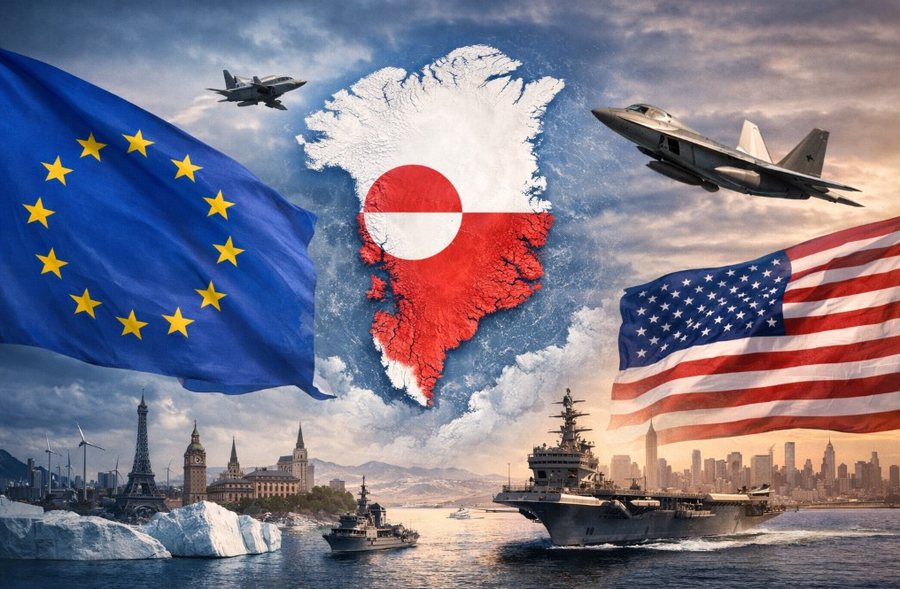
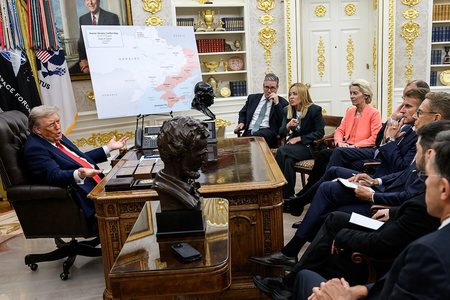
Trump acts, Europe remains a spectator in the Greenland crisis
In his first political comments since leaving his ambassadorship last year, Lord Mandelson declared that Trump had achieved more in one day than traditional diplomacy had in a decade, referring to the capture of Venezuelan President Nicolás Maduro.
While Starmer has avoided direct criticism of Trump's actions in Venezuela, he has reiterated the position that the future of Greenland is a matter that concerns the territory and Denmark alone.
But Mandelson, in an article for The Spectator magazine, argued that the reaction to Trump's maneuvers highlighted Europe's growing geopolitical weakness, calling for greater use of hard power and financial resources to regain international weight.
The former ambassador argues that Trump has no intention of invading Greenland. What will happen, he says, is that the threats to Arctic security from China and Russia will become increasingly clear in the minds of European leaders, while declarations about sovereignty and the future of NATO will fade in the face of a new and more serious debate. The essential question, he says, is how the two sides of the Western coin: America and Europe, will manage to coexist in this new Trump era.
At a time when British ministers are condemning the “destruction” of the rules-based international order and Starmer is strongly supporting international law after Maduro’s capture, Mandelson argues that this international order has long been gone. Trump is not a populist who is destroying this system, he argues, but it had lost its relevance long before Trump was elected president. He adds that the post-World War II global order, if it ever existed at all, began to fade two decades ago, when China emerged as a great power challenging US unipolar dominance.
Mandelson accuses European leaders of failing to understand the unfolding revolution and of having a superficial interpretation of the “America First” policy, confusing it with “America Alone,” despite US commitments in Ukraine and Gaza. He points out that Europe is obsessed with Trump’s posts on Social Truth, but fails to analyze the reasoning behind them. Instead of panicking, European leaders should ask themselves why the United States is reviewing its policy and how they, as allies, can help mitigate the consequences. His conclusion is clear: Trump’s straightforward approach to reality is preferable to the paralysis that characterized previous US administrations or the uncertain and slow movements of the UN and the EU.
It should be noted that Peter Mandelson is no longer an ambassador due to his involvement in the Epstein scandal, a factor that may damage his moral or legal credibility, but which does not diminish the weight of his political and strategic analysis.
The general state of European reactions is well summed up by Mujtaba Rahman, director for Europe at Eurasia Group. According to him, the Greenland issue has dominated the EU’s political agenda, while Trump’s statements have caused alarm among bureaucrats who had just resumed work after the holidays. A three-point plan has emerged from this move to defuse the crisis and perhaps reach an agreement, although confidence in its success remains low. The plan focuses on the economic, security and consequence management areas. The first point includes support for Greenland’s economic development, expanding its fishing rights – an issue that led to Greenland’s exit from the European Union in 1985 – and improving transport and communication links. 94 million euros will be invested in education, vocational training and the transition to clean energy. Although according to Eurasia Group, the economy is not the main factor for Trump in his interest in Greenland, European officials believe that the economic aspect plays a significant role.
One European official cited the Trump administration's obsession with rare earths and some ideas that have also been circulating regarding Ukraine. The EU is planning to develop infrastructure in Greenland to make rare earth mining cheaper and more attractive to the private sector. Another official stressed the need to improve the "economic sustainability" of exploiting the island's natural resources. In the current budget, the EU has allocated 225 million euros to Greenland and aims to double this amount in the next budget, to 530 million. As for security, responsibility will pass to NATO. The second element of the plan is related to increasing the military presence.
The third element of the European plan is related to the reflection on the consequences in case Trump takes a unilateral action that has been described by senior officials as a “hostile purchase”. European leaders are aware of the risk of a public clash with Trump, and are reluctant to make commitments that they cannot realistically fulfill. However, a wave of intensive diplomacy is expected in Davos and at the Munich Security Conference. The European response could focus on limiting American access to the common market through sanctions, digital tariffs or the use of economic anti-pressure mechanisms. The crisis over Greenland could disrupt the EU-US trade agreement and lead to an escalation of tariffs on both sides. The European Commission has presented a legal proposal to unilaterally reduce tariffs on US exports, but the European Parliament has not yet approved it. Now some Danish MPs are suggesting that this initiative be blocked until the US clarifies its intentions in Greenland.
European officials do not consider the worst-case scenario, a US invasion of Greenland, to be possible – and they do not think that such an act would lead to the dissolution of NATO. They see it as politically suicidal for the EU to abandon the US nuclear shield. They also do not believe that the US would unilaterally withdraw from NATO or from Ukraine. The main reason is that US arms manufacturers benefit from increased European defense spending, and this would not happen if the alliance were to collapse. That is why Danish Prime Minister Mette Frederiksen’s statement that this crisis could be the end of NATO has been met with skepticism.
The hope in Brussels is that the European willingness to do more, both economically and militarily, will refute the arguments of the US administration and mobilize the US Congress and public opinion to set some limits on Donald Trump. / Adapted from "Inside Over"



Lini një Përgjigje