


 Shkruar nga Claudio Tito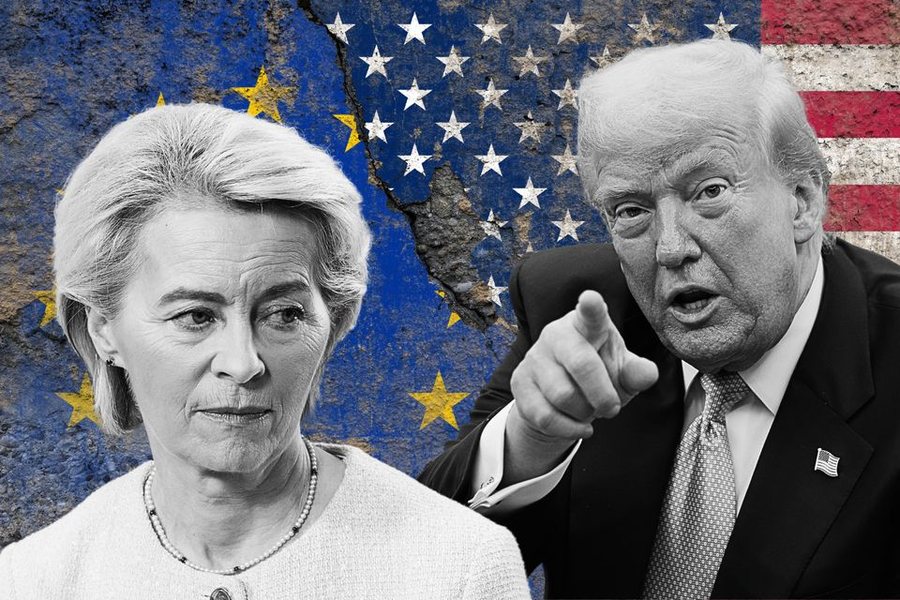
The US has launched a new attack on the EU and is trying to divide the Union. The refusal of visas to enter the United States for five Europeans, including former French Commissioner Thierry Breton, the "father" of unwanted digital measures by "Big Tech" (large technology companies), is considered by Brussels as a real intimidation.
The European executive is ready to respond, but the way this will be done is still under discussion with an unpredictable outcome.
There are currently three options on the table. A response equivalent to a ban on entry into the EU for some US officials, the use of the anti-coercion instrument and the acceleration of the publication of antitrust guidelines to confirm and strengthen the rules against digital "colossi" such as Google, X, Microsoft and Apple, companies protected by the US presidency of Trump. The first option seems too soft, while the second too hostile.
From rapid consultations with several European capitals, it has emerged that a response is nevertheless necessary. For two reasons: because it is an open threat to the Commission and the DSA (Digital Service Act that regulates online platforms), and to show that European officials dealing with this area will be protected under all circumstances.
But the way this response will be carried out is far from clear. Not all 27 member states are convinced of the use of strong measures: it is enough to recall that in recent days France, Germany and Spain reacted harshly, while Italy remained silent. Not to mention the Commission presidency's fear that a direct clash with the White House would jeopardize European participation in the possible peace process in Ukraine, or would give Trump the pretext to attribute the blame for the failure of negotiations with Russia to the EU.
The first hypothesis considered is legal assistance for those who will appeal the ban on entry to the US and the application of a reciprocal measure. But against whom? Secretary of State Marco Rubio? His chief of staff? Impossible. It would end with the visa refusal of an unknown American official, a useless measure.
The most appropriate weapon would be the anti-coercion instrument. “These measures,” said French President Emmanuel Macron in recent days, “are tantamount to intimidation and coercion aimed at undermining European digital sovereignty.” If this is the premise, the “last weapon” at the EU’s disposal would be precisely this. Moreover, Article 8 of the Regulation that establishes it seems to refer to such cases: “Measures applied to natural or legal persons” and who are “linked to the government of a third country.” A measure that would apply in particular to the purchase of services, namely digital ones of “Big Tech.” An intervention that is being studied, but which has already been assessed as too serious politically and in relation to the agreement just signed on customs tariffs.
The third option is the one that is being considered more carefully. Accelerating the revision of the antitrust guidelines for next year. It would tighten the rules on concentrations and the implications for digitalization. And also on another aspect: the way in which public interest factors can be taken into account in the assessment of concentrations. This solution would have the advantage of focusing on the issue that has brought about the American threat, but postponing the effects in time./ La Repubblica





Lini një Përgjigje