


 Shkruar nga Larisa Brown & Al-Atrush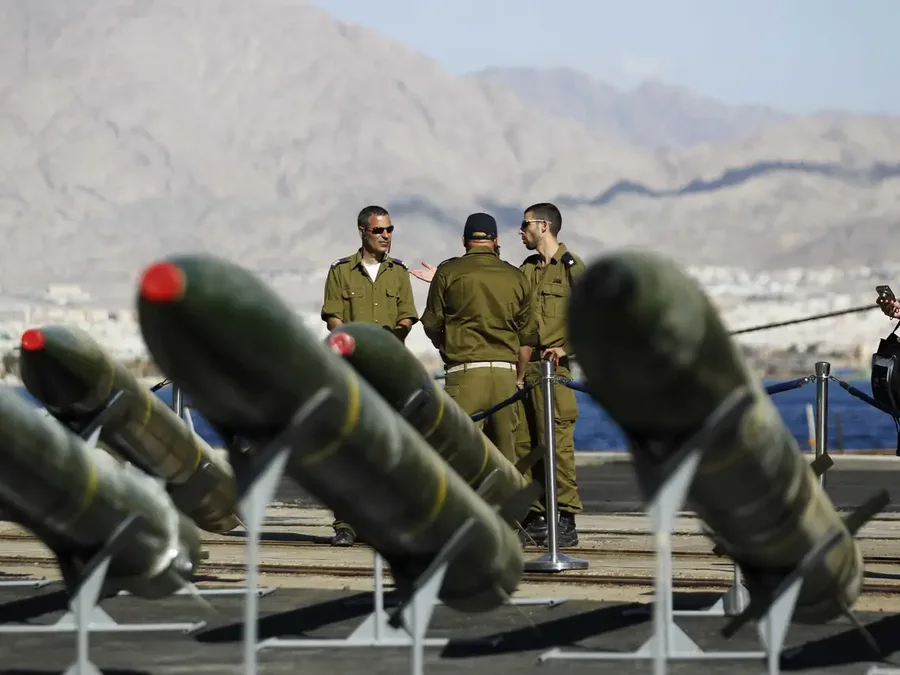
Even Israel, which is considered one of the most formidable and technologically advanced military powers in the world, would find it difficult to destroy Iran's nuclear bases with the conventional weapons it has in its arsenal.
Iran may be just 6 months away from having the first 10 nuclear bombs with which it can threaten or strike its enemies. The statement comes from an expert who has visited the bases of uranium enrichment on several occasions.
Olli Heinonen, the former deputy director of the International Atomic Energy Agency (IAEA), who once led the inspection of Iran's nuclear program, thinks that if Tehran "hurries up", it could have the arsenal ready by April next year.
"You can't wipe out a country with these missiles, but you can threaten it and be in a much stronger position in negotiations," he told The Times by phone from New York. Officially, Iran claims that its nuclear program has purely civilian purposes.
But officials in Israel and the West see it as a tool for developing nuclear weapons. In August this year, a report from the IAEA stated that Iran had increased its stockpile of 60 percent enriched uranium to almost 165 kg, or 20 kg more than the UN arms watchdog reported in May. and nuclear programs.
To make a bomb, uranium is required to be enriched to 90 percent, and Israel's prime minister, Binyamin Netanyahu, has long warned that Iran could achieve this within months if it wanted to. Heinonen, who now works with the Stimson Center in Washington, has had many meetings with the theocratic regime's top nuclear officials. He says the missiles fired at Israel on Tuesday could well be used for a nuclear attack.
That is why the USA and Great Britain are very worried, he continues, referring to the repeated calls for the reduction of tensions in the region. He also warns that officials in Iran have hinted that they have already changed their defense doctrine in a way that suggests using these weapons if they don't get what they want.
However, Heinonen added that by using nuclear weapons, the Iranians would risk facing "tremendous danger". Therefore, they are more likely to use these types of weapons as "a means of negotiation and threat".
"However, the American president must think that there is a possibility, however small, that those weapons will be used, so the US must be prepared for this scenario as well," he said. Under these conditions, will Israel preempt the worst by striking Iran's nuclear facilities?
US President Joe Biden declared on Wednesday that he does not support such an attack on the bases of Iran's nuclear program. He is the only one likely to have some influence on what Netanyahu does next. Although in any case its influence is assumed to be limited.
Because it is a fact that the US failed to convince its ally - to which it gives billions of dollars for defense - not to strike the city of Rafah in Gaza, due to the high risk of civilian casualties, or not to invade Lebanon , which Israel launched this week.
On the other hand, any significant move by Iran to achieve the production of a nuclear bomb risks detection. The most radical in Israel may ask Netanyahu to act now to prevent this scenario, as Israel has done in Iraq and Syria in recent decades, by bombing their nuclear facilities.
This is exactly where the main problem lies. Centrifuge centers that enrich uranium are usually hidden deep under deep mountainous regions, protected by troops and air defense missiles. Analysts say striking the nuclear facilities that enrich uranium at Natanz and Fordou with a direct strike could be "challenging" and could yield limited results.
Surrounded by the Zagros Mountains to the west, the Natanz complex in central Iran is thought to be embedded so deep in the ground that even some of the world's most advanced bunker-busting bombs would struggle to penetrate it.
According to the Nuclear Threat Initiative, a non-profit security organization, Natanz is believed to consist of 3 large underground buildings, two of which are designed to house 50,000 centrifuges. Six other buildings are above ground, and some of them consist of 2.5 km long halls used for gas centrifuge assemblies.
The facility of particular importance is protected by anti-aircraft batteries, a strong perimeter as well as by the Iranian Revolutionary Guard Corps. Satellite images analyzed during the first 4 months of this year show that the construction there has continued at a high rate.
Based on the size of the material excavated from the tunnels, it is believed that Iran is building a new facility at a depth of 80-100 meters. Fordout's enrichment plant, meanwhile, is built inside a mountain on the edge of Iran's Great Salt Desert.
Even Israel, which is considered one of the most formidable and technologically advanced military powers in the world, would find it difficult to destroy Iran's nuclear bases with the conventional weapons it has in its arsenal. "Perhaps Israel cannot destroy the program, but it can cause a lot of damage, delaying it for more years" - thinks Matthew Savill, director of military sciences at the Royal United Services Institute (RUSI) in Great Britain.
He points out that the main problem is that the two largest uranium enrichment bases are located under the mountains, and will probably need large bombs, which can only be used by the US military.
Thus, the Israelis will need the American Steatlh Spirit B-2 bomber to drop a giant 15-ton GBU-57/B bomb, which is designed to penetrate fortifications up to 60 meters underground, possibly more . But even the GBU-57/B may not be enough to destroy Iran's underground military facilities.
A 2010 study by the US-based Center for Strategic and International Studies cited several experts who believed that nuclear weapons alone could destroy targets deep underground or in tunnels.
Savill notes that Israel could hit many other targets related to the nuclear program, such as reactors, fuel production, and the uranium conversion facilities themselves. They can deploy the GBU-28 bunker-busting bomb, which can penetrate up to 6-meter-thick concrete armor and be dropped by F-15 military jets.
Olli Heinonen, thinks that destroying Iran's program will not be an easy task.
"This will depend on the quality of the secret data, and the measures taken by Iran to protect its military assets" - he emphasizes. / Adapted "Pamphlet" From "Sunday Times"







Lini një Përgjigje