


 Shkruar nga Pamfleti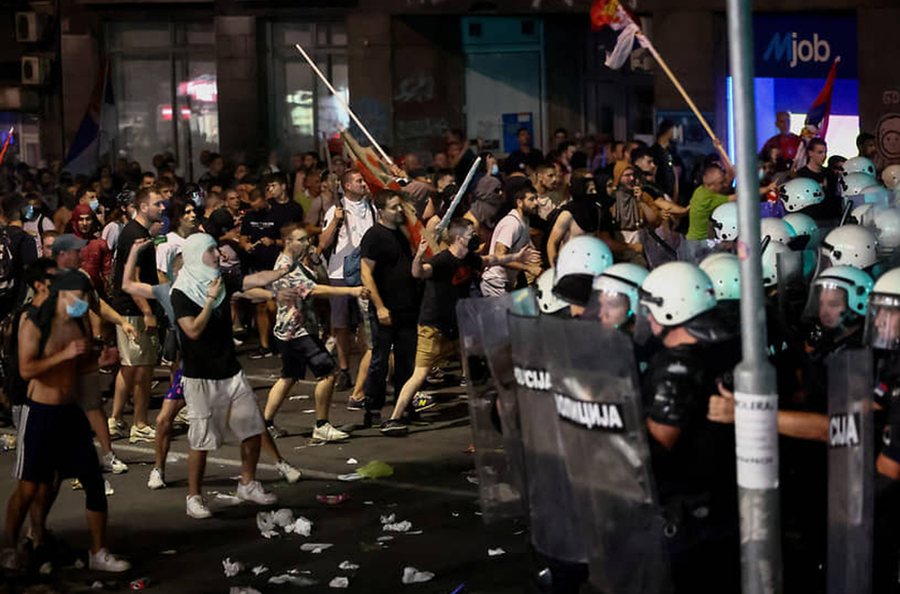
The police arrest more than a hundred activists a day, but have not been able to quell protests held under the slogan of early elections and the fight against corruption...
Since early July, a civil disobedience campaign and a "total blockade of the country" have been ongoing across Serbia, organized mainly by students. The protests, which began in November 2024 after the deaths of 16 people at the Novi Sad train station, were the most serious test for President Aleksandar Vučić.
Police arrest more than a hundred activists a day, but have not been able to quell the protests held under the slogan of early elections and the fight against corruption, according to an article in the Russian media " The Insider ".
Several activists were hospitalized with fractures, and among those detained there are many minors. Vučić accuses his opponents of "terrorism" and "undermining the constitutional order", ignoring calls to investigate the use of force by the police.
Experts believe that it is not so easy to end Vučić's thirteen-year reign. Unlike in 2000, when Slobodan Milosevic's regime collapsed in the face of national opposition, Vučić seems stable. But on the other hand, the students still show no signs of retreating.
The most serious test
Experts in Serbia are discussing various scenarios, from suppressing the protests and intensifying repression to calling early elections with the participation of candidates supported by the protesters. However, many emphasize that early elections, a tactic that Vučić has used several times in the past to assert his dominance and suppress the opposition, are not in his interest this time.
Political scientist Igor Novaković, research director at the Center for International and Security Affairs, said that the current movement is the most serious challenge for Aleksandar Vučić and his government. The protests have been going on for more than eight months and show no signs of abating, unlike most waves of protests, which usually fade after a few months.
The protesters' main demands are to uphold the rule of law and hold early elections, although it remains unclear whether such elections will be held.
The protesters have not yet submitted their candidate lists for the upcoming elections, but several opposition parties have already declared their full support for the student movement. " Among those who could be at the head of such a "protest list" is the rector of the University of Belgrade, Vladan Jokić ," Novaković said.
And in late June, Vučić accused the rector of "terrorism" and "attempts to destroy the state." Some of the president's associates openly called for Jokić's arrest.
-How resilient is Vučić's regime?
Experts say it is still too early to assume that Aleksandar Vučić will lose this battle. Bojan Klačar, executive director of the Center for Free Elections and Democracy (CESID), shared his opinion with Insider.
“It is clear that there is public discontent, especially in larger cities like Belgrade and Novi Sad. However, Vučić still enjoys strong support from the more disciplined layers of the electorate, pensioners and the population from rural areas. He also relies on a strong party infrastructure ,” he said.
The student movement has become a political actor in its own right and is now turning more openly to civil disobedience. However, the pressure is not yet strong enough to force the government to make concessions, nor has it managed to spread to the general public. For the time being, students are more focused on protests than on political organizing.
“Vučić would prefer to call elections in late 2026 or early 2027, and he has his own reasons for this - the completion of the Expo project and the consolidation of power. It is possible that elections will be scheduled earlier, but only if the crisis calms down ,” says Klačar.
When it comes to the previous elections, held in April 2022, domestic and international observers reported numerous irregularities and unfair advantages for Vučić and his SNS party. These included disproportionate access to the media, misuse of state resources for political purposes, and pressure on civil servants and poor voters.
Many analysts believe that the opposition has little realistic chance of expanding its support. Vučić’s regime uses various tactics to undermine the electoral prospects of its opponents, manipulating election dates, using influence over nominally independent institutions, and organizing the bringing of voters from neighboring municipalities and countries.
In addition to state-owned media, the regime also controls many private media outlets, using them to discredit critics. Intimidation and violence further contributed to the weakening of opposition representation at all levels of government.
-The biggest mistake of the 2000s
Nenad Canak, one of the leaders of the democratic opposition that overthrew Slobodan Milosevic in 2000, told Insider that the transformation of power in Serbia in recent years increasingly reminds him of the authoritarian regimes of Russia and Belarus.
" As the protests grow, Vučić is increasingly showing his true face: the Constitution is being violated, laws are being ignored, and the police are treating protesters in a manner typical of fascist regimes. A country that behaves like this shows that it is not interested in joining the European Union and the civilized world - it is copying the model of the dictatorship of Russia and Belarus. This should cause mass resistance, because the government beats children and breaks their bones," says Canak, who led the League of Social Democrats of Vojvodina from 1990 to 2022.
According to Canak, it all started with irresponsibility and corruption. The reconstruction of the railway station was carried out incompetently, which led to the deaths of innocent people. The former Minister of Construction has not appeared in public since then. According to some reports, he fled to Italy where he bought a villa.
Canak notes that, unlike Milosevic, Vučić does not wage wars. However, Serbia today has no real opposition, nor independent media, except for a small television station. Since lustration was never carried out, many figures from the Milosevic era are still in power. Canak considers this one of the biggest mistakes of the 2000s.
"Today we are seeing the same faces from the Milosevic era. The current police minister, Ivica Dacic, was the spokesman for Milosevic's Socialist Party of Serbia, and Vucic was the general secretary of the ultranationalist Radical Party led by convicted war criminal Vojislav Seselj. So, 25 years after the fall of Milosevic, we are still led by the same team, people who were never allowed to get close to politics. The country is on the verge of exploding," he says.
However, Canak believes that the worst-case scenarios can still be avoided.
"The worst can be prevented with a peaceful transfer of power and a partial transfer of the police to the side of the demonstrators. This may not seem realistic now, but if the government falls one day, lustration should be the first step, because otherwise only the color of the stick with which they beat us will change ," he concludes./ Adapted "Pamphlet" from " Danas "





Lini një Përgjigje