


 Shkruar nga Pamfleti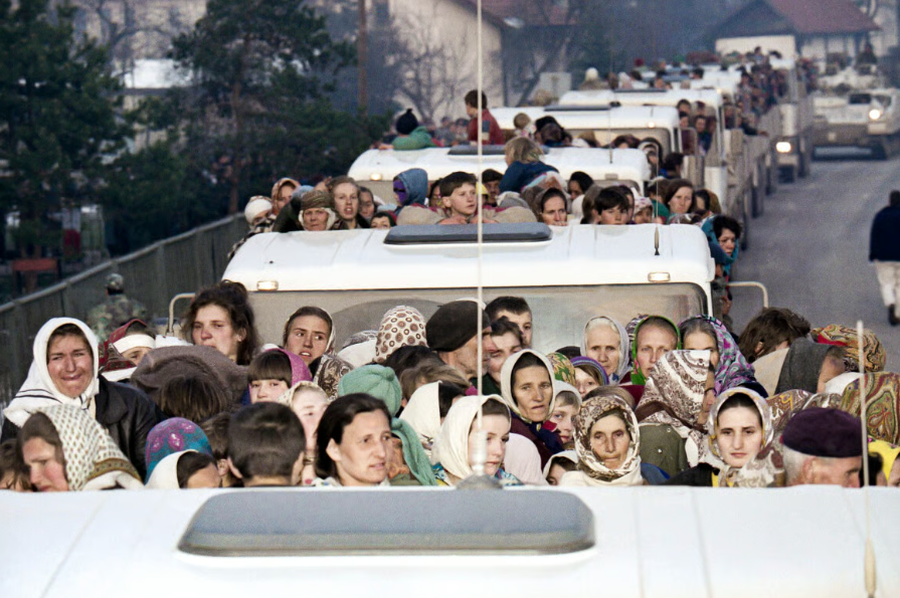
The hills surrounding Srebrenica are made of soil where blood never flows. It has lain beneath the surface for years, unmixed with the innocent soil, a reminder of the sins of the people. Thirty years after the massacre of 8,372 people, mostly Bosniaks, the remains of their bodies continue to resurface. There is a special office in Sarajevo dedicated to identifying the victims.
It's like the work of a mosaicist, watching them make you wonder how they do it, which often starts with a tooth or a bone. That's what this part of the world looks like, constantly busy putting pieces together without really getting the satisfaction that gives it the strength to move forward.
The discovery of mass graves also began the identification process, but it soon became clear that the army, under the command of executioner Ratko Mladic, had been constantly moving the bodies, opening new mass graves in different places. The remains were confused and mixed, as if the once living matter refused to maintain its former appearance out of contempt for the executioners.
Indeed, one of the reasons that led the International Criminal Court to define what happened in Srebrenica as “genocide” was precisely this: the burial and exhumation of almost 9,000 bodies to hide them from the world was a clear indication of genocidal intent. In addition to the public speeches of the leaders, from Radovan Karadžić, a former psychiatrist and misunderstood poet frustrated by the lack of recognition from society, who became president of Republika Srpska and the first theorist of the elimination of Bosniaks with his famous speech against the declaration of independence; to Mladić, the Chief of Staff; to members of the infamous Drina Corps, a kind of special unit of the Bosnian Serb army, commanded by Radislav Krstić.
This year marks the 30th anniversary of the events of 1995, and just like in previous years, the coffins of the newly collected bodies arrived at the Potočar cemetery (5 km from Srebrenica) on the night of July 9.
"Not all families agree to participate in the ceremony," explains Sergio Bonagura of Arci Bolzano, the Italian coordinator for educational projects in Bosnia and Herzegovina, especially in Srebrenica. "Some refuse to bury some bones or broken parts." For years, the staff of the special office has been collecting DNA samples, comparing remains from different graves, and adding new parts as discoveries continue. Now, several hundred victims remain unburied, but like the graves left in the open between July 9 and 10, history seems to be waiting to begin again.
Srebrenica was declared a "safe area" by the UN in 1993 following a Security Council resolution, when the Bosnian Serb siege of Sarajevo had been going on for more than a year. Being a safe area essentially meant accepting that only UN peacekeepers could possess weapons and use them in times of dire need.
They confiscated many (certainly not all) of the Bosniaks' weapons in exchange for a promise to protect them. On the afternoon of 11 July 1995, Bosnian Serb soldiers led by Mladić entered Srebrenica without encountering resistance. The shelling had begun on the night of 6 July, and as elsewhere, with the first signs of a ground operation, civilians fled. The approximately 40,000 people, mostly Bosniaks, who remained in the town had almost entirely fled. Women, children, the elderly and sick men, a human wave of at least 25,000 individuals, had set off towards Potocari, about an hour's walk away.
Many of them had already been displaced, even repeatedly, from neighboring villages and had sought refuge in what was then the largest Bosnian Muslim community in the area, hoping for protection from self-organized territorial defense groups and, ultimately, from the Dutch Blue Helmet contingent in Potocari.
But five days of shelling from the heights around Srebrenica and fear of the accounts of those who had already experienced attacks by the VRS, the Armed Forces of Republika Srpska, convinced the residents to leave in the hope that the war would spare them. Dutch soldiers allowed only 5,000-6,000 people into the base, expelling up to 350 of them in the following days. When the VRS soldiers arrived, they separated the men and boys over 12 from the women and began killing, raping and torturing them. The 350 people expelled by the peacekeepers were killed, leading to a conviction by the Hague tribunal and subsequent (albeit reduced) sentences by the Supreme Court of the Netherlands, as "they should not have turned them back because it was foreseeable that they would be killed".
Meanwhile, the men who could walk, approximately 16,000, took to the mountains, heading for Nezuk. Thus began the Death March. An ambush on Kamenichko Hill split the column in half. The leader, fighting when necessary, reached Nezuk. A search for the rest began. About 1,000-1,500 people were killed immediately between Srebrenica and Potocari; the rest were massacred in the mountains and buried in mass graves.
Rope, knife and Srebrenica, chanted the fanatical ultras of the Red Star Belgrade led by Arkan. Since 2001, a march called the March of Life has been held on July 10, covering 100km from Nezuku to Potocari in the opposite direction, ending at the cemetery where a collective commemoration awaits. The area is filled with thousands of people, many of whom travel this route on motorbikes, and in the evening Srebrenica is packed with people. “But it’s not usually like this,” explains Bekr. “This is a sad and silent town.”
The road to Srebrenica is lined by Serbs with photos of "their" dead, several hundred faces that perpetuate a narrative contrary to that of The Hague and the Bosniaks, and that echoes the writing on an abandoned building in the center of Belgrade.
"The only genocide in the Balkans is that of the Serbian people". Denial, erasure and reversal of history. Just like the bodies of Srebrenica that find no peace. / Adapted from Pamphlet by Il Manifesto/





Lini një Përgjigje