


 Shkruar nga Pamfleti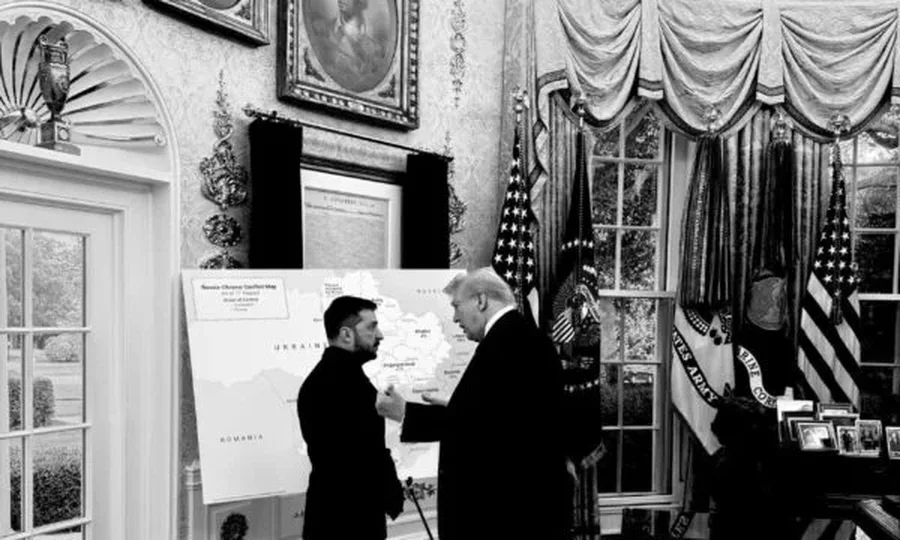
The American president tried to rationally explain the facts to the Europeans and Volodymyr Zelensky.
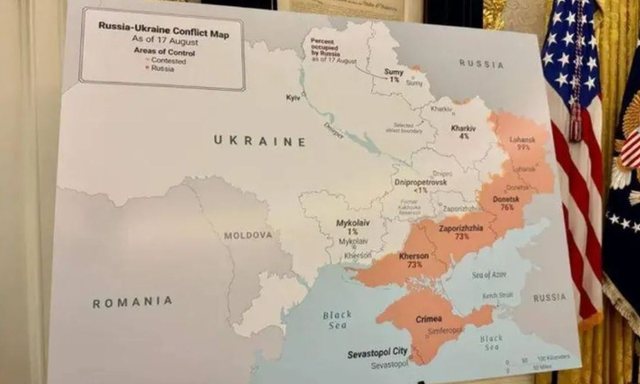
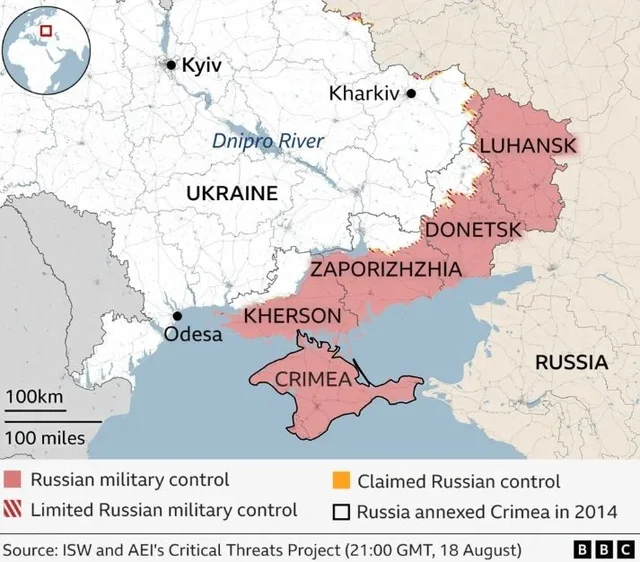
A large red cartographic depiction of occupied Ukrainian territories dominates the Oval Office, as if to emphasize the fact that Russia now controls about 1/5 of Ukrainian territory.
This image was a reference point at US President Donald Trump's meeting with Volodymyr Zelensky on Monday in Washington.
"I think you all saw the map," Trump commented the next day on Fox News, adding "a large portion of land has been taken and that portion has been lost."
The White House's message to Kiev was clear: this land has already been lost and it is time to consider a compromise with Vladimir Putin, what many call "land swaps."
However, Zelensky did not come to the meeting unprepared. The Ukrainian side presented its own map, with the Ukrainian president later explaining that he "had difficulty with what is depicted in it," insisting that the reality of the occupation is not always what is presented. Despite his efforts to correct "misunderstandings," Trump on Tuesday maintained his position unchanged. "Russia is clearly much more powerful and has not stopped," he said.
According to him, the European leaders who were at the same table were discussing Donbass, a region that, as he pointed out, is "79% controlled by Russia."

Percentages on the White House map
Before the conflict began in 2014, Donbass, the heart of Ukraine's mining industry, contributed 16% of the country's economy. Now, Putin has reportedly told Trump that he wants the entire region in exchange for a possible peace deal.
The map presented to the White House depicted the following percentages of Russian control: 99% in Luhansk, 76% in Donetsk, 73% in Zaporizhia and Kherson, 4% in Kharkiv, and only 1% in Sumy and Mykolaiv.
Analysts note that these figures are consistent with estimates from the American Institute of War, with possible variations due to different methodologies. In some cases, “1%” may mean only a limited presence or a simple assertion on Moscow’s part.
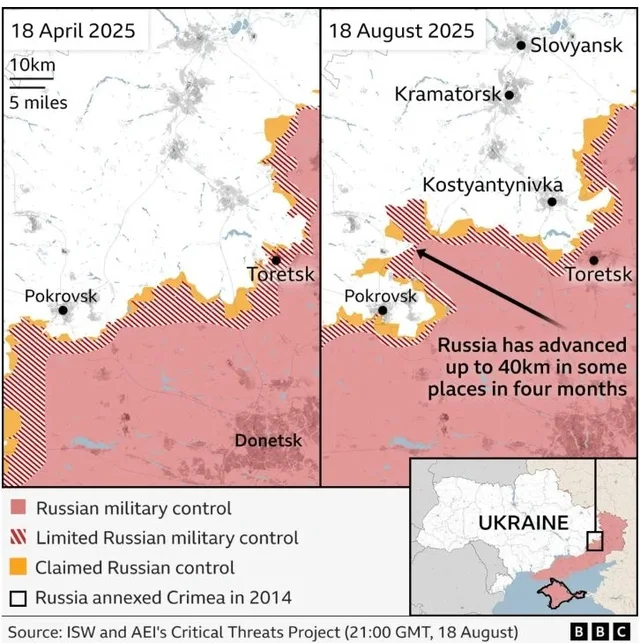
Despite the numbers, fortified cities like Kramatorsk and Sloviansk in Donetsk still house hundreds of thousands of residents under Ukrainian control, making it unthinkable for Kiev to hand them over to Russia.

Slow Russian advance and Ukrainian counterattack
The Institute for the Study of War estimates that the full capture of Donetsk would require “many years” and extremely difficult military campaigns. Zelensky, for his part, made a comparison with the Ukrainian map showing that in the last 1,000 days Russia has occupied less than 1% of Ukrainian territory, about 5,842 square kilometers, a figure confirmed by the research group DeepStateUA.
Although Moscow made rapid territorial gains early in the invasion, most of them were recaptured by the Ukrainian military. However, in recent months there has been an acceleration of the Russian advance in areas such as Kupyansk in Kharkiv and Kremina in Luhansk.
Defense analyst Konrad Muzyka of Rochan Consulting attributes this development to the increasing use of Russian drones and the insufficient number of Ukrainian soldiers defending a large front. Despite heavy losses, Russia managed to recruit 30,000-35,000 men, forming operational reserves.

The long-term perspective and the West's message
Despite local successes, Russian forces have been unable to replicate the same momentum on other fronts. A recent operation to penetrate 10-15 km into Ukrainian territory near Dompropilya was successfully repelled.
British military intelligence estimates that, at the current pace, it will take at least 4.4 years to fully conquer Lugansk, Donetsk, Zaporizhia, and Kherson — not counting Crimea.
These assessments explain the two leaders' different perspectives. For Trump, the maps reflect a reality that has already been formed and is difficult to overturn. For Zelensky, they are a motivation for resistance. “Thanks for the map, it was great,” he reportedly told Trump wryly. “I’m thinking about how to get it back.” /Adapted from BBC/



Lini një Përgjigje