


 Shkruar nga Nathan Meyers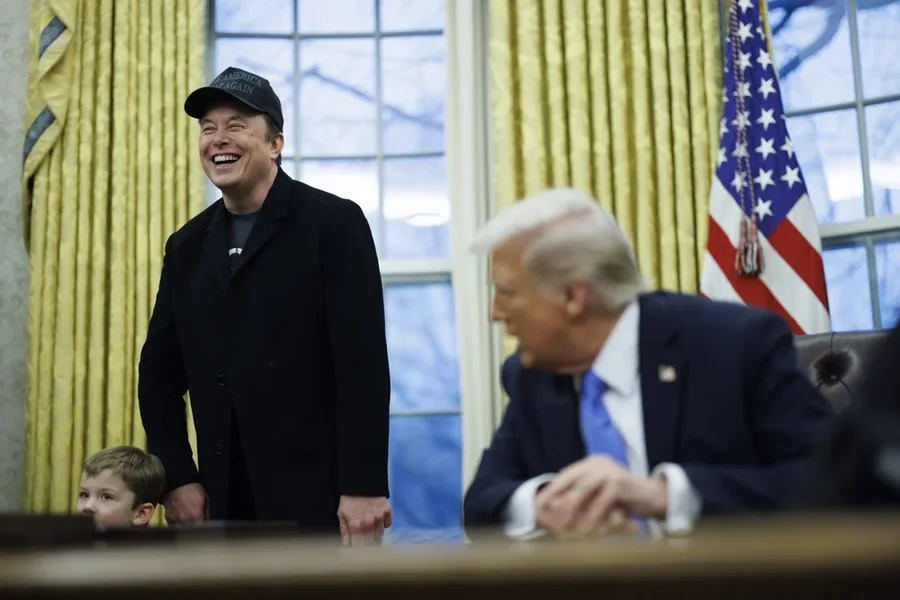
As the Trump administration aggressively restructures federal agencies, these changes are likely to proceed without public input, further entrenching private sector dominance.
Since returning to office, President Donald Trump has moved aggressively to shrink the federal government. His administration has frozen federal grants, issued executive orders in line with the Heritage Foundation's Project 2025, and, most importantly, created what he calls the Department of Government Efficiency, or DOGE.
DOGE has been billed as a cost-cutting initiative, though the actual amount of money being saved remains unclear. To lead DOGE, Trump appointed Elon Musk, a megadonor whose companies hold billions in federal contracts. Musk has already pushed through major cuts, including sweeping workforce reductions, scaling back government operations, and purges of entire agencies. Thousands of federal workers have lost their jobs.
While certainly dramatic, these actions reflect a longer trend of government privatization. Indeed, my sociological research shows that government has been steadily withdrawing from economic production for decades, transferring many responsibilities to the private sector.
3 indicators of privatization
At first glance, total government spending appears stable over time. In 2024, federal, state, and local spending accounted for 35% of the U.S. economy, the same as in 1982. However, my analysis of data from the Bureau of Economic Analysis offers a new perspective, reframing privatization as a macroeconomic phenomenon. I find that U.S. economic activity has become increasingly privatized over the past 50 years. This change occurred in three main ways.
First, government involvement in economic production has declined. Historically, public institutions have played a major role in sectors such as electricity, water distribution, waste management, space equipment, naval shipbuilding, construction, and infrastructure investment. In 1970, government spending on production accounted for 23% of the economy. By 2024, that figure had fallen to 17%, leaving the private sector to fill the gap. This means that an increasing share of overall government spending is being used to finance the private sector economy.
Second, the government’s overall ability to produce goods and services—what economists call “productive capacity”—has fallen relative to the private sector, in terms of both labor and capital. Since 1970, public employment has lagged behind private sector job growth, and government-owned capital assets have lagged behind those of the private sector. Although public sector capital investment recovered briefly in the 2000s, employment has not, signaling a shift toward outsourcing rather than direct employment. This has important implications for wages, working conditions, and unionization.
Third, and relatedly, the government is increasingly contracting out work to private companies, choosing to buy goods and services rather than produce them. In 1977, private contractors accounted for a third of government production costs. By 2023, that had grown to over half. Government contracting—now 7% of the total economy—reached $1.98 trillion in 2023. The top recipients in 2023 included professional services at $317 billion, the oil and coal industry at $194 billion, and construction at $130 billion. Other examples include private schools, private prisons, hospitals, and defense contractors.
The meaning of privatization
Privatization can be understood as two interrelated processes: the withdrawal of government from economic production and the increase in contracting. The government remains a major economic actor in the US, although now more as a buyer of goods and services than a provider or employer.
Research shows that contracting often fails to reduce costs. As government output has shrunk, government contracting has expanded with promises of cost savings and efficiency. These contracting decisions are typically made by local administrators managing budgets under fiscal stress and pressure from interest groups, including businesses and public sector unions.
However, research shows that contracting often fails to reduce costs, while endangering monopolies, weakening accountability and public input, and sometimes locking governments into rigid contracts. In many cases, ineffective contracting forces a return to public employment.
The consequences of privatization
Trump’s recent moves can be seen as a massive acceleration of a decades-old trend, rather than a break with the past. The 50-year shift away from strong public-sector employment has already privatized many jobs in the U.S. Trump and Musk’s plan to shrink the federal workforce follows the same blueprint.
This could have major consequences.
First, drastic job cuts are likely to mean more privatization and fewer government employees. Trump’s federal workforce cuts echo President Ronald Reagan’s 1981 mass layoffs of more than 11,000 air traffic controllers, a source of prolonged financial struggles and family instability for many laid-off workers. Trump’s layoffs and furloughs are already reaching far beyond Reagan.
The trend toward privatization risks eroding democratic accountability and exacerbating racial and gender inequalities. Moreover, since federal spending contributes directly to gross domestic product, cuts of this magnitude risk slowing the economy. The Trump administration has even floated the idea of changing GDP calculations, potentially masking any reality of the economic downturn.
Rapid privatization is also likely to cause significant economic disruption, especially in industries that depend on federal support. For example, USAID cuts have already sent shockwaves through the private-sector agricultural economy.
Finally, the privatization trend risks eroding democratic accountability and exacerbating racial and gender inequalities. This is because, as my previous research reveals, public sector unions uniquely shape American society by equalizing wages while increasing transparency and civic participation. Given that the public sector is heavily unionized and disproportionately provides employment opportunities for women and black workers, privatization risks undoing these benefits.
As the Trump administration aggressively restructures federal agencies, these changes are likely to proceed without public input, further entrenching private-sector dominance. This will undermine the functioning of government and democratic accountability. While often portrayed as inevitable, the American public should know that privatization remains a political choice—a choice that can be revisited for discussion./ Adapted from “Pamphlet” by “WorldCrunch”







Lini një Përgjigje