


 Shkruar nga Pamfleti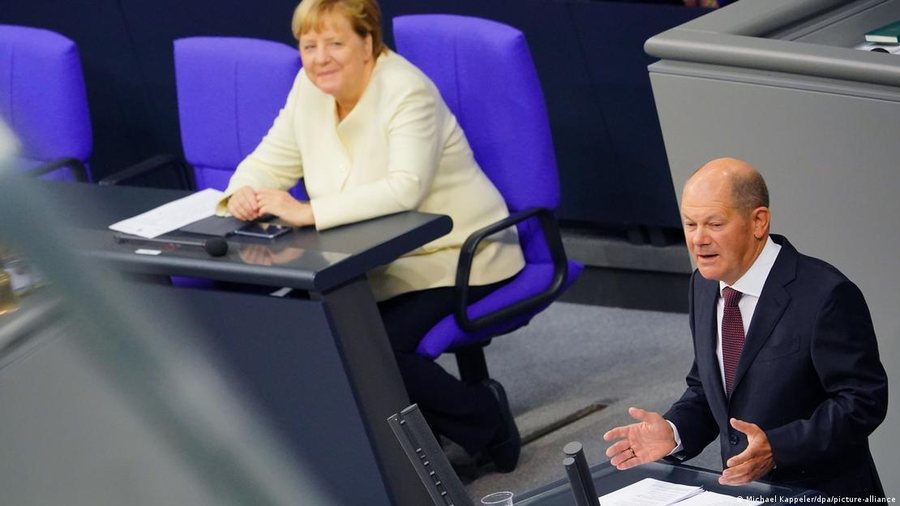
The German Constitutional Court forced the government to remove 60 billion euros from the budget. The government declares a year of emergency, Auron Dodi with the consequences.
Will civil servants' salaries and pensions be paid now? This question appeared in the media after the decision of the government of Chancellor Olaf Scholz to broadly freeze the country's budget. The question has its source in the parallel with the budget impasses in the USA, where political opponents put pressure on the other by not signing the transfer of funds.
In Germany, civil servants' salaries and pensions will continue to be paid, they are not at risk. The unusual situation has been created after the decision of the Constitutional Court and after Chancellor Scholz's government respected the decision of the prestigious German Court within a week. The Constitutional Court said that Chancellor Scholz's government had violated the constitutional rule on debts. Because he had transferred the loans set for recovery from the pandemic (2021) to the fund for climate protection and economic transformation, without convincing arguments. It is about a huge sum of 60 billion euros.
The judges also said that emergency loans, unconsumed, are not allowed to be kept as a reserve and used later, as the government did. The decision of the constitutional judges has caused a budget crisis, with possible political consequences. He has strongly shaken the fragile balance in the ranks of the center-left coalition between the social democrats, the greens, and the liberals in Berlin.
On Thursday evening, the Minister of Finance, Christian Lindner, said that he would declare 2023 a year of emergency. With this, the debt rule is suspended and expenses gain a "strong constitutional basis".
Pragmatic solution – but temporary
With this step, the government can fulfill the main promises made for the year 2023-2024. The pressure created by, among others, the steel industry, the German Bank for Reconstruction, the Armed Forces, affected by the expected cuts, is great.
So the liberal Lindner decided on Thursday the quick liberating blow: next Wednesday, the government will submit to the Bundestag the request to suspend the debt rule for the fourth year in a row. This rule fixed in the constitution prohibits the public deficit from exceeding 0.35% of the Gross Domestic Product - except in exceptional situations.
The government is expected to argue that it was a state of emergency in early 2023, as the consequences of the energy crisis were evident. With an emergency resolution, an additional budget for 2023 will be approved.
This will not only legally justify the expenses already incurred. But the promised subsidies for heating, in the amount of 18 billion euros, will also be paid; the steel industry will receive 4 billion euros, to produce steel with green technology; the semiconductor concern Intel in Magdeburg will receive the promised 10 billion euros and so on.
CDU/CSU: the tripartite government coalition does not know how to govern
Marcel Fratzscher, President of the German Institute for Economic Research, speaks of an "honest" mistake by the government with the reallocation of funds. He told the media on Friday (24.11.) that the government's mistake consists in forwarding the received and unused loans from the pandemic fund to the Climate and Transformation Fund and the Economic Stabilization Fund - instead of approving an additional budget . However, if we remember the fact that with the money from the second fund, the heating price of German families was also subsidized, so people suffered less, everything seems less dramatic.
This will not only legally justify the expenses already incurred. But the promised subsidies for heating, in the amount of 18 billion euros, will also be paid; the steel industry will receive 4 billion euros, to produce steel with green technology; the semiconductor concern Intel in Magdeburg will receive the promised 10 billion euros and so on.
CDU/CSU: the tripartite government coalition does not know how to govern
Marcel Fratzscher, President of the German Institute for Economic Research, speaks of an "honest" mistake by the government with the reallocation of funds. He told the media on Friday (24.11.) that the government's mistake consists in forwarding the received and unused loans from the pandemic fund to the Climate and Transformation Fund and the Economic Stabilization Fund - instead of approving an additional budget . However, if we remember the fact that with the money from the second fund, the heating price of German families was also subsidized, so people suffered less, everything seems less dramatic.
On the other hand, the Greens demand higher taxes for the richest, but this is opposed by the Liberals.
There are calls for cooperation for the CDU as well. But the CDU looks set to push Germany towards new elections. She says she can also sue the Economic Stabilization Fund. Therefore, Finance Minister Lindner accused the opposition of trying to throw Germany into chaos.
Behind the doors, at the same time, experts are working hard to find a solution./ DW







Lini një Përgjigje