


 Shkruar nga Pamfleti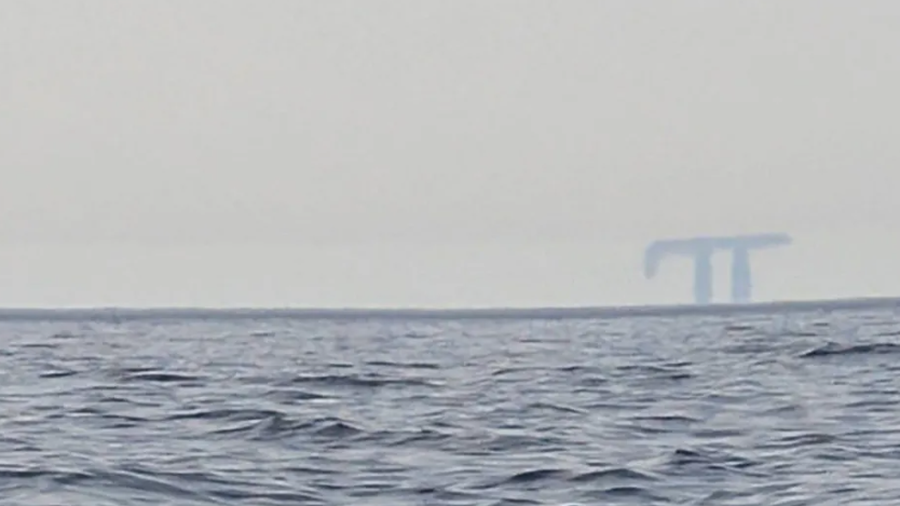
A rare atmospheric phenomenon known as Fata Morgana has sparked interest and discussion on social media after it was recently photographed off the coast of Cornwall, southwest England.
The mirage was spotted by Mike Hancock, a boat tour operator, who initially thought he was seeing a large object on the horizon. However, what appeared to be a giant structure turned out to be an optical illusion created by a distant aircraft carrier, distorted by atmospheric conditions.
"The shape kept changing. At one point it looked like a big bear on the horizon, then it took on completely different shapes. It was a surreal experience," Hancock said.
What is Fata Morgana?
Fata Morgana is a complex form of superior mirage, which occurs when layers of air with very different temperatures create special conditions for the bending of light. As a result, distant objects may appear magnified, distorted, inverted, or multiplied.
The name comes from Italian and is related to the mythological figure of Morgan le Fay (Morgana the Fairie), a character from the legends of King Arthur, known for her ability to create illusions and change shape.
How is the phenomenon formed?
According to meteorologists, Fata Morgana is created when a strong temperature inversion occurs, where a layer of very cold air remains trapped beneath a warmer layer.
This contrast creates a kind of "atmospheric channel" that acts like a giant lens, bending light rays and distorting the appearance of distant objects.
Because the layers of air are in constant motion, the image is also constantly changing, creating unusual and often unbelievable shapes.
What does a Fata Morgana look like?
The phenomenon can cause:
Vertical extension of small objects into gigantic shapes.
Multiple appearances of the same object.
Inverted or superimposed images.
Continuous change of shape within seconds.
An ordinary ship can look like a giant castle, while a low island can take on the appearance of a large mountain rising above the horizon.
Connection with maritime legends
Experts believe that the phenomenon may have influenced the birth of some of the most famous maritime legends, including that of the "Flying Dutchman", the ghost ship that according to stories appeared suspended above the sea.
Likewise, early explorers in the Arctic and Antarctic often reported "islands" and "mountains" that later turned out to be mere illusions created by Fata Morgana, even leading to the inclusion of imaginary territories on old nautical charts.
The phenomenon is considered relatively rare and is most often observed over large surfaces of water or in polar regions, when atmospheric conditions are favorable for creating these spectacular optical illusions.





Lini një Përgjigje