


 Shkruar nga Pamfleti
Talks between the US and Iran are focusing on the US demand to halt uranium enrichment. At the heart of the debate are questions about what uranium is, how it is enriched, and why the 60 percent level brings Iran much closer to the technical threshold of 90 percent, linked to nuclear weapons.
United States President Donald Trump has said that the new nuclear deal that Washington is trying to negotiate with Iran will be “much better” than the 2015 Joint Comprehensive Plan of Action (JCPOA), from which the US withdrew in 2018 during his first term. In line with this stance, recent reports indicate that mediation for another round of talks in Islamabad remains active, while one of the main American demands continues to be a complete ban on Iran’s uranium enrichment.
Iran, for its part, has consistently insisted that its nuclear program is civilian in nature and aimed at generating energy, as well as other non-military uses. In technical terms, this means that Tehran presents uranium enrichment as a necessary part of the supply for reactors and energy infrastructure. However, this is precisely where the main disagreement lies: the technology used for low-level enrichment can, if continued, take the material to much higher levels, linked to military use.
To understand the debate, it is first necessary to clarify what uranium is. Uranium is a heavy, naturally radioactive metal that is used as a fuel in nuclear reactors and, under certain circumstances, in nuclear weapons. It is found in nature in low concentrations, usually in rocks, soil and even in small quantities in seawater. Most of the world's uranium production is concentrated in a few major countries, including Kazakhstan, Canada, Namibia, Australia and Uzbekistan, while reserves are also found in other countries. This metal is extracted either through classical mining, or through chemical processes that dissolve it from the rock formations where it is found.

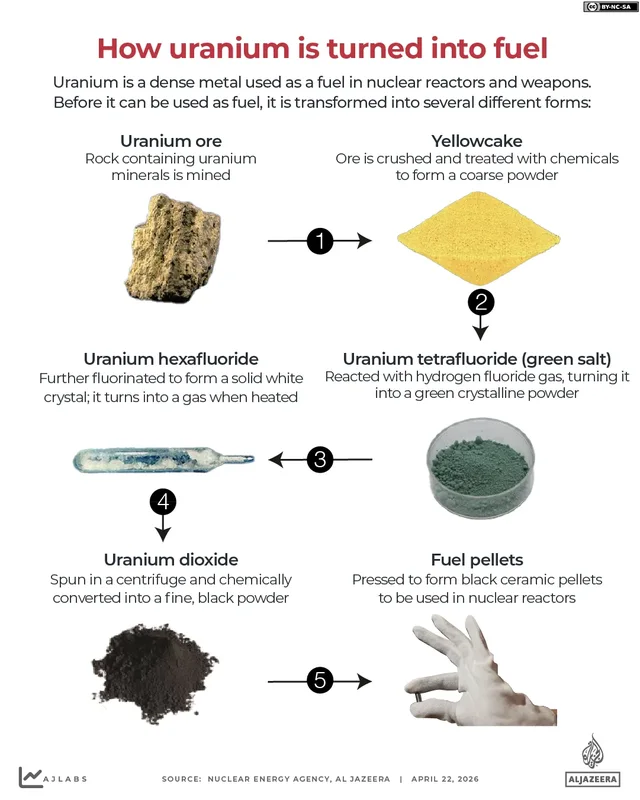
Before it can be used as nuclear fuel, uranium undergoes several different forms of processing. First, the mined ore is processed into a powder known as “yellowcake.” It is then converted into uranium tetrafluoride and then into uranium hexafluoride, a crucial compound for the enrichment stage. This is important because the uranium must be turned into a gas to be fed into centrifuges, the machines that separate isotopes. Only after this stage can the material be prepared for the production of reactor fuel or, if enriched much further, for other, much more sensitive uses.

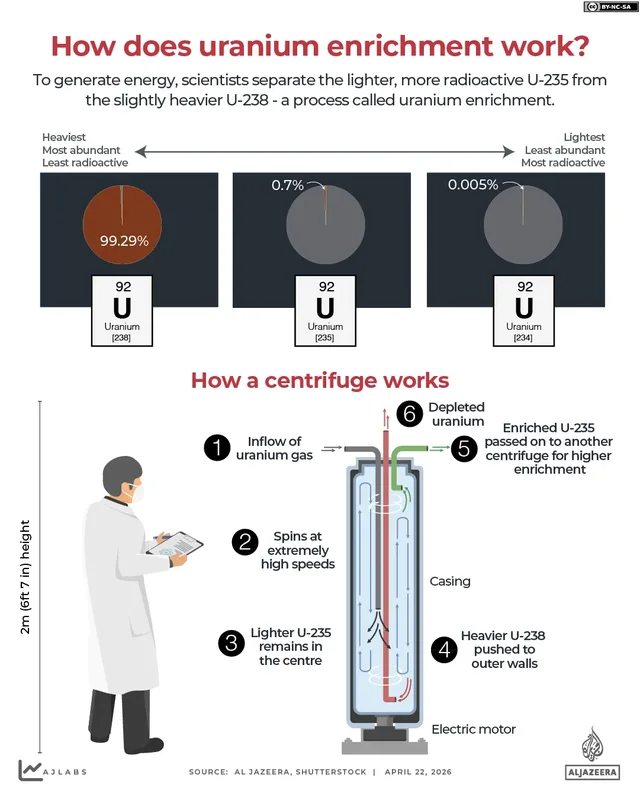
The essence of the process is related to the isotopes of uranium. In nature, uranium consists mainly of U-238, which makes up about 99.3 percent of the total, while U-235 makes up about 0.7 percent. It is U-235 that is the most valuable isotope for the chain reaction needed in reactors and nuclear weapons. Therefore, “enrichment” means increasing the percentage of U-235 relative to U-238.
This process is carried out using centrifuges. Uranium in gaseous form, specifically uranium hexafluoride, is fed into cylinders that rotate at very high speeds. Due to centrifugal force, the heavier isotope U-238 is pushed more towards the outer walls, while U-235 is concentrated closer to the center. The change is very small with each pass, so many centrifuges connected in series, in so-called cascades, are needed to gradually increase the percentage of U-235 to the required level.
This is why the level of enrichment is of great political and technical importance. For most nuclear power plants that produce electricity, uranium enriched to about 3 to 5 percent is sufficient. The International Atomic Energy Agency (IAEA) considers low-enriched uranium to be any material below 20 percent. Above this limit, the material falls into the category of highly enriched uranium. For nuclear weapons, a threshold of about 90 percent is usually mentioned, which is known as the level required for military-grade material.
In practice, there are several intermediate levels. Uranium 3 to 5 percent is widely used in commercial power plants. Levels of 5 to 19.9 percent appear in some more advanced reactors and in special research systems. Levels of 20 to 85 percent are usually associated with research uses or the production of medical isotopes. Above 90 percent, the material enters the zone directly related to the potential for nuclear weapons. For this reason, the diplomatic debate focuses not only on the existence of centrifuges, but especially on the question of how far enrichment is allowed to continue. / Adapted from "Al Jazeera"





Lini një Përgjigje