


 Shkruar nga Pamfleti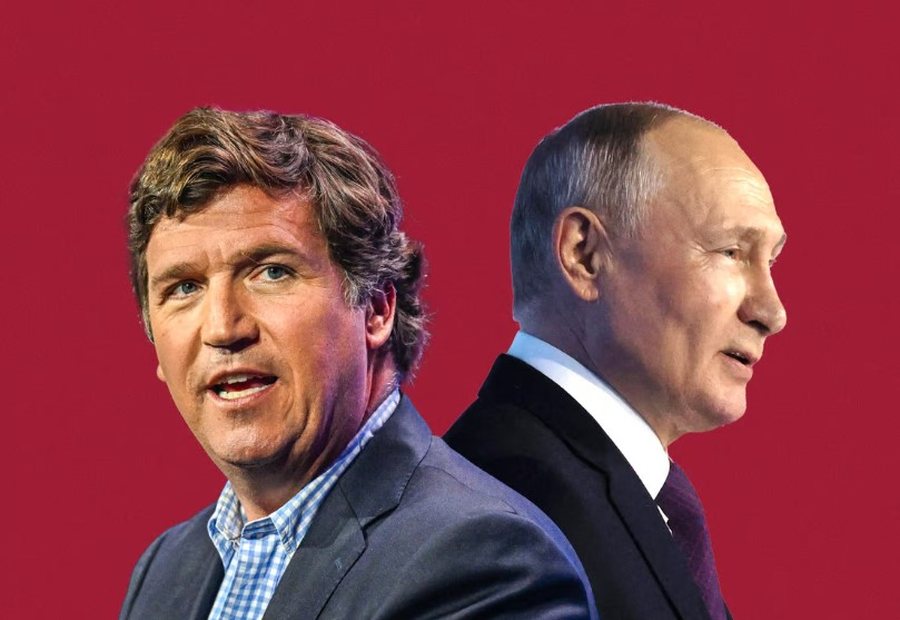
What were Putin's messages to the American journalist?
It didn't take long for Tucker Carlson to realize that his interview with Vladimir Putin might not go according to plan.
His first question was about the threat to Russia from NATO and America; President Putin's response was a long debate about Rurik, a ninth-century Varangian chieftain during the medieval reign of Yaroslav and the ravages of the Mongol horde.
To some on the American right, he is an enviable ruthless pragmatist, a warrior prince of white Christian nationalism. He came across as one of those people who obsess over a hidden part of history, except that his obsession - Russia's historic claim to Ukraine - rests on a nuclear arsenal.
The interview, recorded in the Kremlin on February 6 and published online two days later, was Putin's first to a Westerner since the 2022 invasion of Ukraine. It comes at a pivotal moment in more ways than one. A shortage of ammunition is hampering Ukraine's resistance. In America, congressional Republicans have shown further support for Kiev, given the presidential election this November and the candidacy of Donald Trump.
A provocateur and Trumpist on Fox News who was fired last year, Carlson gave Mr. Putin many chances to influence American politics. For an alleged wizard of election meddling, the president did a poor job. Could another administration in Washington help improve relations with Russia? "It has nothing to do with the leader," Mr. Putin said. Invited, more than once, to blame NATO for the war, he repeatedly attacked history. Mr. Carlson looked, at times, like a man who wasn't sure whether or not he had forgotten to turn on the oven.
The Russian president told blatant lies. He suggested Poland collaborated with Hitler in 1939. He said he launched the 2022 invasion to stop a war Ukraine had launched in 2014, following a CIA-backed coup. Russian forces withdrew from Kiev as a goodwill gesture, he said. He claimed, as usual, that the Ukrainian government and its Jewish president promote Nazi ideology.
Mr. Carlson, who confused Ukraine's 2014 revolution with that of a decade earlier, was unwilling (or unable) to challenge these lies. Nor did he ask about Russian war crimes, including those of which Putin is personally accused, or the crackdown on domestic critics like Alexei Navalny. (He lobbied for the release of Evan Gershkovich, an American journalist jailed in Russia on strict espionage charges.) However, Mr. Carlson came away with more than a file of letters from a 17th-century Cossack leader, which, surprisingly, Mr. Putin gave it to him.
Because Mr. Putin made some remarks that, taken out of their messy context, will help those who say that supporting Ukraine is not in America's interests. In the past he hinted, darkly, that Russia might use nuclear weapons; however he told Mr. Carlson that the idea was an intimidating way for Western politicians to extort money from taxpayers. He denied any interest in invading Poland or Latvia (although he previously said the same about Ukraine). And he was asked about the hypothetical deployment of US troops to the Ukrainian front; no matter the question, his answer will linger long in the mind. "Don't you have anything better to do?". He scoffed, citing America's border and national debt.
But this interview has many messages.
One concerns the dangers of rulers staying in power for decades. As his comments revealed, even now Mr. Putin does not regret the West's role in the wars in Yugoslavia of the 1990s and other crises long ago. In a democracy, the transition of power is an amnesiac balm for such grievances, allowing relations with other countries to heal and move forward. In office for nearly a quarter of a century, Mr. Putin is still wreaking havoc on old grudges.
Another lesson lay in his mocking hauteur. He faced a hand-picked interviewer who asked the questions the way the president wanted. However, Mr Putin's responses showed no respect for the viewers' patience or interests. Then why would he? He is not used to explaining. He does not rule through persuasion or charm, but through violence and fear.
Power in Russia is dark. Often only one man seems to be in charge and even he often seems to be squirming. Mr. Carlson was given rare access to it, and he squandered it. Still, one vital message was clear: Mr. Putin is not a leader to be trusted, much less emulated or admired. / Adapted "Pamphlet" from "The Economist"


Lini një Përgjigje