


 Shkruar nga Pamfleti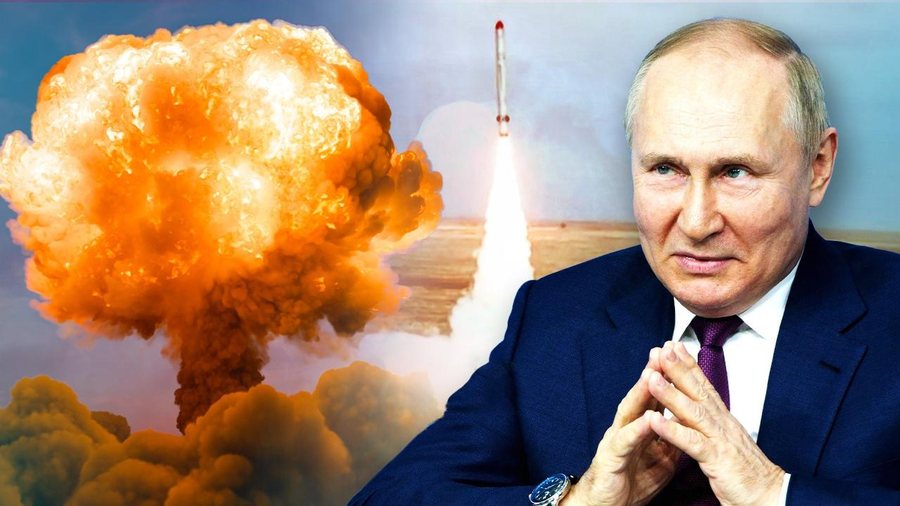
Putin also emphasized that Belarusian forces would be trained to use these weapons. And the Kremlin has taken these increasingly threatening steps in the belief that NATO and the West – in particular the US – are not paying attention to Russian demands on the global stage.
By Kevin Ryan, "Unherd"
Any way you try to analyze them, the drone attacks that hit Moscow's wealthiest neighborhoods on Tuesday night represented a grim turning point in Vladimir Putin's military campaign against Ukraine. The surprise attacks - which killed 8 people, and for which Kiev has denied all responsibility - were the first against Russian civilians since the start of the war.
They were also the most serious attack on Russian territory since World War II. Putin was quick to call them an act of "terror", while a shocked Yevgeny Prigozhin, head of Wagner's mercenaries, attacked Russian military chiefs for their inability to prevent 3 of the 8 drones that managed to evade air defences.
But while this attack gave Ukrainians a morale boost, on the horizon is the question of Moscow's retaliation. 15 months after the start of the war, Putin's bombs have not defeated Ukraine. Even throwing 300,000 more Russian soldiers into the war last winter hasn't made much of a difference to improve the fighting of Russian units.
Moreover, the sending to the front of tanks produced in the 1950s has added to the rumors that the Russians are running out of ammunition. In fact, Russian military commanders appear to have exhausted their ability to effectively respond to the escalating retaliation by the Ukrainian military.
And I think the only way Russia can deal with escalation is by deploying its nuclear weapons. Many Western experts say they take seriously the threat of a Russian nuclear attack on Ukraine.
But they are wrong when they think that the chances of this happening are low. For example, US Director of National Intelligence Avril Haines told a Senate hearing last month that Putin's weakened conventional force could prompt the Russian president to become even more dependent on "asymmetric options" to deter the worst, including nuclear capabilities.
But on the other hand, he added that this "was very impossible". On the same line, the director of the Defense Intelligence Agency, Lieutenant General Scott Berrier, was in the same session. And yet there is strong evidence that Putin has decided to use a tactical nuclear weapon in his war in Ukraine.
In recent speeches and interviews, he has said that Russia is facing an existential threat. A situation that, according to Russian policy, guarantees the use of nuclear weapons. He has also reshuffled his military leadership so that the 3 generals responsible for the use of tactical nuclear weapons command his "special military operation" in Ukraine.
Moreover, while NATO has made it clear that it will not authorize the use of its members' nuclear weapons to defend Ukraine, Putin already has tactical reasons for using them: to save the lives of Russian soldiers, to cut the duration of the war and destroy the Ukrainian forces.
He also has strategic reasons: to renew the deterrence value of his nuclear arsenal and to prove that he is not a bluff man. Therefore, we must assume that he is ready to use them, most likely as a response to his army's inability to sufficiently escalate the war by conventional means.
So the nuclear "genie" is out of the bottle. For most of the past 80 years, Russia's security has rested on 2 pillars whose relative strength has waxed and waned: its conventional ground forces and its nuclear weapons.
The former have been used to influence, bully and force Russia's neighbors and adversaries to bend to its will. While nuclear forces have aimed to deter the United States and the West from military intervention in Russia and its perceived sphere of influence.
However, since the end of the Cold War, Russia's conventional forces have proven their fragility. And to make up for it, Russian leaders have been forced to rely on their nuclear forces to do both: strategic nuclear weapons to deter the West and tactical nuclear weapons to threaten neighbors.
Today, a single nuclear attack on Ukraine could deter a Ukrainian counterattack with very little loss of Russian life. For Moscow, this scenario is as practical as it is moral: the large-scale mobilization and buildup of military units last year showed that Putin's army was too small for the mission at hand.
However, Russia has managed to create only a few new battalions, because most of the new personnel and equipment only replaced losses in existing units. Putin and his military leaders are running out of the men and materials needed to achieve their goals.
Earlier this year, Putin took some public steps to show that he is not bluffing about using nuclear weapons. In February, he signed a law that "suspended" Russia's participation in New Start, the strategic nuclear weapons treaty.
The move formally ended joint inspections of US and Russian nuclear weapons, and freed Russia from the obligation to limit the number of strategic nuclear weapons, although Russia promised to do so at some point.
Then in March, Putin announced that he would deploy some tactical nuclear weapons to Belarus, with a storage facility to be built as early as July 2022. Since Russia has already deployed nuclear-capable Iskander missile systems there – as well as thousands of troops – this significantly reduces the time to start using them.
Putin also stressed that Belarusian forces would be trained to use these weapons.
And the Kremlin has taken these increasingly threatening steps in the belief that NATO and the West – in particular the US – are not paying attention to Russian demands on the global stage.
In 2018, when Putin unveiled a batch of new nuclear weapons, he publicly warned: "Now you will listen to us!" In fact many people in the West did not. Four years later, the full-scale invasion of Ukraine was a wake-up call to those who had ignored it.
Putin, meanwhile, is under pressure from Russian nationalists, who supported his rise to power but are now vocal in their displeasure. That criticism could turn into opposition, forcing him to consider escalating his war before his conventional forces are ready.
This does not mean that we in the West should pressure Ukraine to abandon its goal of liberating all occupied territory. But to anticipate a nuclear attack and develop possible responses. Once Russia uses a nuclear weapon in Ukraine, the consequences will begin to spread.
Tens of thousands of Ukrainians will have died, or will be facing the consequences of the explosion. Hundreds of millions of Europeans will prepare for war. But another 7 billion around the globe will go about their business. They will be genuinely alarmed, but physically unaffected. So in this dramatically changed world, it is up to the West to decide how to respond. /albeu.com
*Kevin Ryan, retired U.S. Army Brigadier General. He was military attaché at the US embassy in Moscow and deputy director for strategy, plans and policy at the Army Headquarters.


Lini një Përgjigje