


 Shkruar nga Danilo Kalezic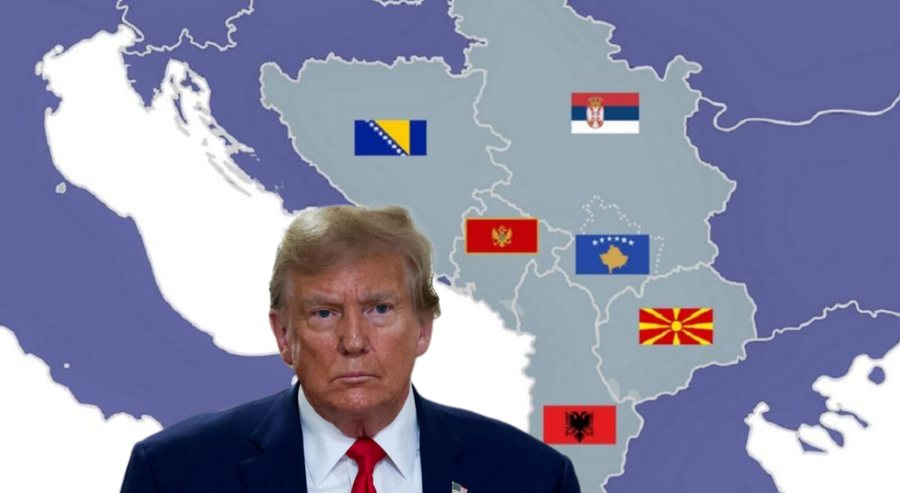
However, the key factor in the instability is the regime in Belgrade, which, emboldened by Trump's victory and supported by Russian logistics, would begin the astral expansion of instability in Bosnia and Herzegovina, Kosovo and Montenegro.
It's now official — Americans will be watching a repeat of the 2020 election in November. It will be the first time since 1912 that a former president participates in the election even after his defeat in the last election.
Relatively close internal party elections have already given current President Biden and former President Trump the necessary number of delegates for the party nominations, which will be formalized this summer at the Democratic and Republican national conventions.
Unlike partisan elections, national elections are likely to be the most uncertain in postwar American history. Polls show a slight lead for President Biden, which is a marked improvement from just a few weeks ago.
The key factor in the upcoming election will be the degree of mobilization of Donald Trump's party base, that is, the ability of President Biden to energize undecided voters.
Meanwhile, the only serious threat to Trump's nomination came from former UN ambassador and former South Carolina governor Nikki Haley, who averaged a quarter of the Republican vote before dropping out of the race within the party. .
It is understood that this number is not only an affirmation of her candidacy: that is, a significant part of the vote came as a protest against Trump, her party opponent. It is clear that part of the Republican electorate supports the traditional canons of Republican politics, from which Trump has irrevocably diverged by introducing an ideologically inconsistent populist creed into the party that he is gradually beginning to control from the top.
For now, it seems that Trump is more focused on reaching minority constituencies, which traditionally do not favor him.
With Biden, the situation is apparently easier, although, paradoxically, unfavorable. That is, it appears that a significant portion of leftist voters are turning undecided, which pulls them toward abstinence. At the same time, despite relatively favorable economic indicators and the fact that the unemployment rate is falling, as is inflation, this is not reflected in support for President Biden.
The main problem of the Biden campaign, but also his strategic advantage, is foreign policy. Although, during the presidential campaign, these topics may be the least represented - which is another illogical considering the complexity of the wars in Europe and the Middle East - foreign policy remains Biden's capital priority compared to Trump .
The concern that reigns in European diplomatic circles and that is related to the eventual return of Trump, has to do not only with the way NATO will continue to function, but also with the general climate that should define the American role in the world. A new policy of isolationism would leave key American allies in Europe and Asia vulnerable, while opening the door wide to the malign influence of Russia and Iran and China, no less.
The Balkans is a litmus for a hasty change of American tactics, but also for a non-strategic US withdrawal from our region. The latest warning from the US intelligence community supports the thesis that a further US withdrawal from the Western Balkans - or a policy of appeasement - would lead to a black scenario, which US lawmakers are aware of.
Milorad Dodik has been described as a source of instability in the aforementioned report. However, the key factor in the instability is the regime in Belgrade, which, emboldened by Trump's victory and supported by Russian logistics, would begin the astral expansion of instability in Bosnia and Herzegovina, Kosovo and Montenegro.
Montenegro is also the easiest target in this sense, since only there has not yet crystallized a clear, decisive and meaningful response to the galloping political madness. Did Montenegro, unlike Bosnia and Herzegovina and Kosovo, surrender in advance to the declared and increasingly open Serbian-Russian intention to turn the oldest state in the Balkans back into Zeta Banovina?
No matter how abstract the details of American foreign policy may be, especially in regions like ours, to the "average voter", Biden's main task remains to show the danger to US national interests in the event that the policy personified by Trump becomes dominant again.
However, Trump's first term was a kind of course in American politics, especially in understanding and mastering the intelligence system, both for the American president himself and for those structures that helped him win in 2016./ Adapted "Pamphlet ” from “Analytics”



Lini një Përgjigje