


 Shkruar nga Diplomatico | Pamfleti.net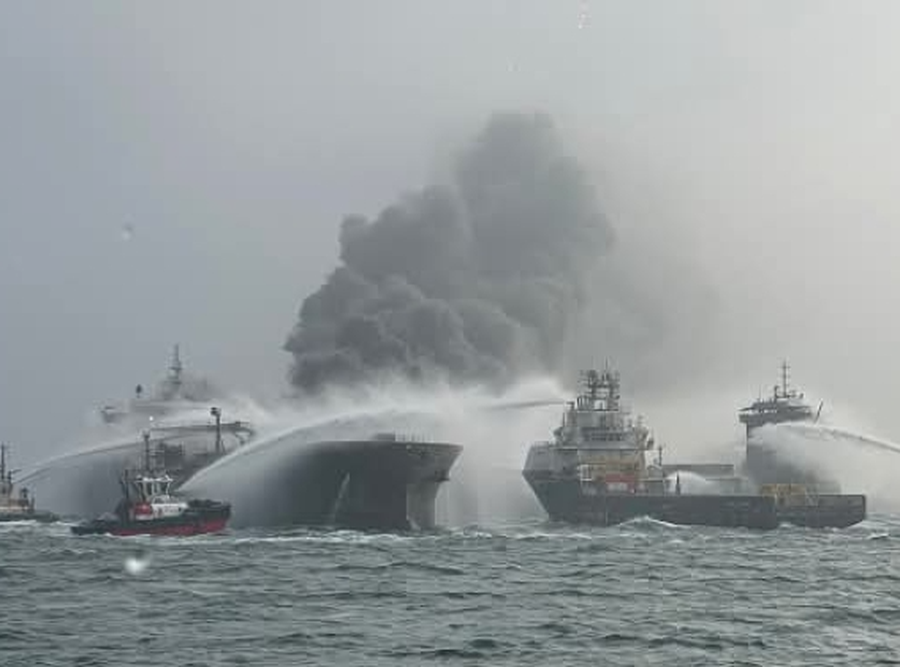
An attack on a Kuwaiti ship in the port of Dubai, explosions in Jerusalem, American strikes on Iranian military targets and open fears of a global energy crisis...
The war between Iran, the United States and Israel is entering a phase far more dangerous than a typical military clash. It is moving rapidly from the missile skies to the heart of the global economy: oil, ports, maritime corridors and Gulf security.
Developments reported today, March 31, 2026, by Corriere della Sera show that the crisis is no longer just a matter of bombings and counterstrikes, but a direct blow to the international energy system.
The most alarming point is the attack on a Kuwaiti tanker in the port of Dubai.
According to a report cited by the Kuwaiti state news agency Kuna, the national company Kuwait Petroleum Corporation announced that the ship “Al Salmi”, fully loaded with oil, was hit by an Iranian attack while it was in the port’s anchorage area. The attack caused damage to the ship’s hull, a fire broke out on board and created a risk of oil spilling into the surrounding waters, although no injuries were reported.
This episode alone was enough to send markets into a tailspin. Brent crude rose to $115.49 a barrel at the Asian open, while WTI was at $106.86. The rise reportedly came as authorities in Dubai struggled to contain the fire on the stricken tanker. This suggests that investors are no longer viewing the conflict as an isolated crisis, but as a direct threat to energy supplies.
Meanwhile, the military front remains tense. At least 10 explosions were heard in Jerusalem and the West Bank region after Iran launched another missile attack on Israel. Sirens were sounded in several areas, while the Israeli military said air defenses responded to the missiles launched by Iran.
In parallel, the strikes against Iran continue with intensity. Corriere reported that strong explosions were reported in Tehran, Isfahan and Zanjan, while power outages were also reported in the Iranian capital. In Isfahan, according to the same report cited by the Wall Street Journal, the US struck a large ammunition depot using a large number of 2,000-pound penetrating bombs. Donald Trump also published a video on his social network about this attack, giving the operation a strong political and propaganda stamp.
The balance of escalation does not stop only with Iran and Israel. According to the chronicle published by the Italian media, four Israeli soldiers have been killed in southern Lebanon, which shows that the conflict is also keeping the Lebanese axis open. Meanwhile, in the energy plan, China seems to be preparing to resume purchases of crude oil and liquefied natural gas from the US, as part of efforts to mitigate the consequences of the turbulence related to the de facto closure of the Strait of Hormuz. According to data cited by Kpler, in April, the transport of approximately 600 thousand barrels per day of American oil to China is expected.
This is where the most important geopolitical reading begins. When a tanker is hit in Dubai, the message is not just military. It is economic, strategic and psychological. The attack affects not just a ship, but the very idea of security of energy traffic in the Persian Gulf. And when the market translates this into Brent above $115, it means that the war is being dismantled as a regional conflict and is being reborn as a global crisis with immediate impact on supply chains, maritime insurance, transport costs and inflation. This is an analytical inference based on the attack on the tanker and the immediate jump in prices.
For Europe, this is a grim signal. The continent, which has not yet fully recovered from the shock of previous energy crises, faces the risk of a new wave of price increases. For the Balkans, the consequences will come not from the military front, but from the market: more expensive fuel, pressure on prices, financial nervousness and greater exposure to international fluctuations. Albania, as a small and open economy, does not have the luxury of seeing this as a distant war. Any escalation in Hormuz translates, belatedly but surely, into a heavier bill for the consumer and higher pressure for European governments. This part is an analytical assessment, drawn from the reported developments on energy markets and supply corridors.
In the end, the picture is clear: missiles are falling in the skies of the Middle East, but their echoes are being heard on Asian stock exchanges, on Gulf tankers, and in consumer accounts around the world. The war is no longer fought solely for territory or strategic prestige. It is being fought for control of energy routes, for fear in the markets, and for the ability of each camp to impose costs on the other that go beyond the battlefield. And it is precisely therein that the real danger lies: not just in what explodes today, but in what could paralyze tomorrow./ Pamphlet




Ne p*dh te semes do veje kjo pune. Prape populli do e haje, si gjithmone!