


 Shkruar nga Pamfleti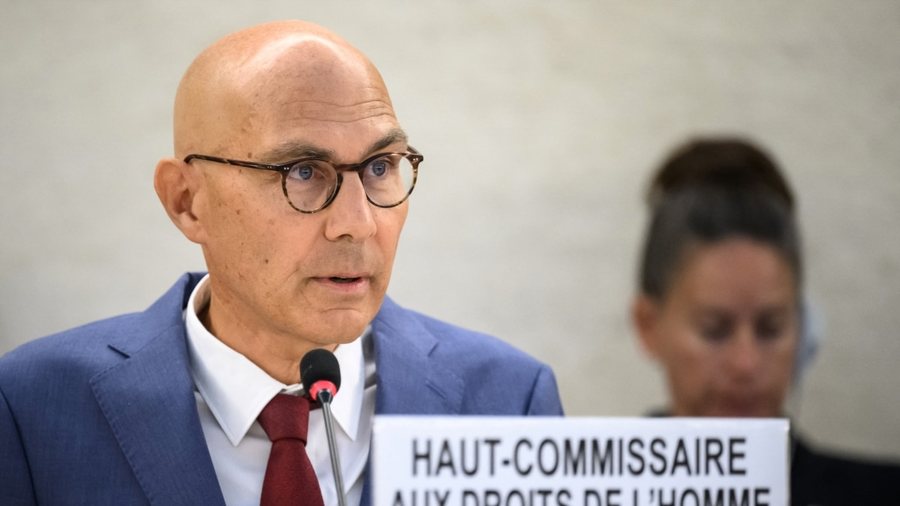
The United Nations' chief human rights official, Volker Turk, today called on states to act against what he called Israel's "flagrant disregard" of international law in the Palestinian territories. He said that stopping the war in Gaza, where the number of Palestinians killed has reached 40,000, and avoiding a regional war, is an "absolute and urgent" priority.
At the opening of the 57th session of the United Nations Human Rights Council in Geneva, the UN High Commissioner for Human Rights Volker Turk called on states not to accept Israel's behavior and as he said he non-respect of international law, resolutions of the UN Security Council and decisions of the International Court of Justice by this country.
"Stopping the war and avoiding a broad regional conflict is an absolute and urgent priority. At the same time, a comprehensive response must also be given to the broader issue, lawlessness throughout the occupied Palestinian territory, a consequence of Israel's policies and behaviors... States cannot and must not accept the flagrant disregard of international law... in this situation or in other circumstances," he declared.
Mr. Turk said that if the causes that lead to wars are not resolved, the wars will involve other countries and be passed on to future generations, causing, as he said, "continuous cycles of hatred." According to him, the war in Gaza is a typical example.
"Every day, Palestinians barely survive. Nearly 1.9 million residents have been forced to relocate several times along the Gaza Strip. After 11 months, 100 Israeli hostages are still being held in Gaza. And while the true number may be higher, an estimated 10,000 Palestinians are being held in Israeli prisons, most of them arbitrarily, and over 50 of them have died due to inhumane conditions and mistreatment. In the West Bank, bloody operations, some on a scale not seen in the past two decades, are exacerbating the catastrophic situation there, which was exacerbated by serious settler violence,” he declared.
In Israel, security measures have been stepped up following Sunday's attack at the border crossing between Israel and Jordan, where a gunman attacked Israeli security forces, killing three civilians, as Israel continued military operations in Gaza.
According to political science professor Ric Stoll, unless a ceasefire agreement is reached, the suffering on both sides is expected to continue.
"People will continue to be killed. Hostages will not be released. I don't see how Israel will eliminate Hamas. It's better that they focus on reaching some kind of agreement now," he told VOA.
A similar attitude was expressed over the weekend in Tel Aviv by the families of the hostages kidnapped by Hamas during the October 7 attack, during which the group's militants killed 1,200 people.
"If we want to change the situation in Israel, we have to come out and ask the government to stop the war and reach an agreement now," says Ifat Calderon, a relative of one of the hostages.
Professor Stoll says the United States is making every effort to ensure lasting peace in the region.
"I don't think we have enough influence on the parties. I think they are doing what they think is best for the region," he says.
The director of the CIA, William Burns, said on Saturday that a more detailed proposal for a cease-fire will be presented to the parties in the coming days./ VOA








Lini një Përgjigje