


 Shkruar nga Pamfleti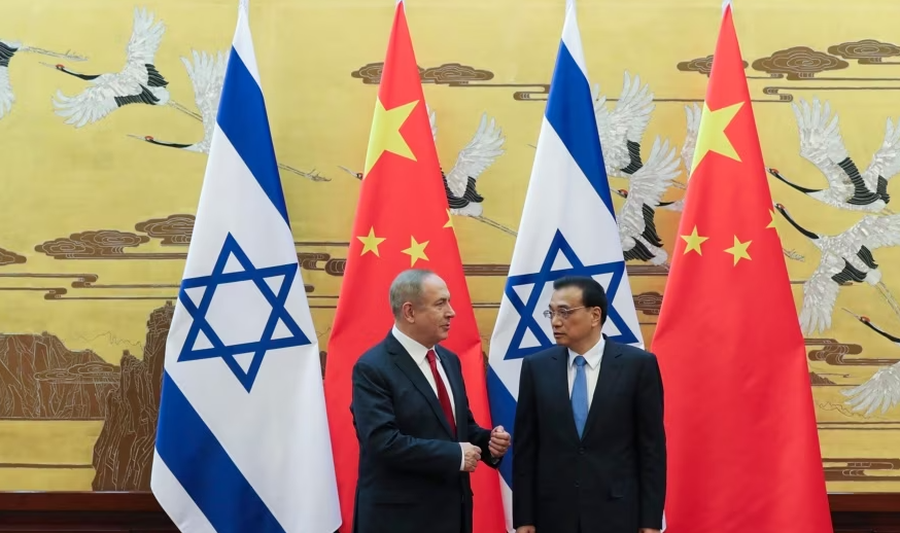
Chinese leader Xi Jinping made the first public statement on the conflict between Israel and Hamas, calling for a ceasefire and reiterating that the creation of "an independent state of Palestine" through a two-state solution is the "main way out" of the conflict.
"The main priority is to end the fighting as soon as possible, to prevent the conflict from expanding or even getting out of control and the possibility of creating a serious humanitarian crisis," Chinese President Xi declared during the meeting with the Premier of Egypt, Mostafa Madbouly in Beijing.
Some analysts say President Xi's statements are in line with Beijing's traditional position on issues related to the Palestinians.
"Statements from official Beijing since October 8 are consistent with positions that China has held since at least 1997," Professor Dawn Murphy, who teaches national security strategy at the US National War College, said in an interview with the Voice. of America.
She said China does not consider the current conflict between Israel and Hamas to be "a conflict that will dramatically change their attitude."
"They see it as part of a much longer Israeli-Palestinian conflict," Ms Murphy said.
In addition to reiterating the need to implement a two-state solution, Mr. Xi praised Egypt's efforts to help defuse the situation and said Beijing is "willing to strengthen coordination with Egypt and other Arab states" to facilitate finding "a comprehensive, just and lasting solution to the Palestinian issue as soon as possible."
The conflict began when the Palestinian militant group Hamas launched a surprise attack on Israel on October 7, leaving 1,400 dead and kidnapping nearly 200 Israeli citizens in Gaza. Israel is retaliating with airstrikes against targets across Gaza that have left at least 3,500 Palestinians dead.
China moderates with Hamas
China has been reluctant to publicly condemn Hamas for the attack on Israel, which was criticized by Jerusalem and Washington. As the Israeli military stepped up airstrikes on Gaza, Beijing has stepped up criticism of Israel, saying Israeli actions are going beyond self-defense.
Some experts believe Beijing's reluctance to condemn Hamas is related to efforts by Chinese officials to avoid damaging their deepening ties with other Middle Eastern countries.
"China has made significant realignment (in the Middle East) since Washington generally withdrew from the Middle East, and the Chinese don't want to offend the Arab world," said Dennis Wilder, who served as director of the National Security Council during the administration. of US President George W. Bush.
With the United States continuing to be the guarantor of security for most countries in the Middle East, Mr. Wilder said China is in a comfortable position that allows it to "call for peace" without having to take responsibility for developments in the region.
"The idea of China as a mediator in this situation does not match reality," he told VOA.
In recent months, China has tried to present itself as a mediator in the Middle East. In March, China brokered a deal between Saudi Arabia and Iran that allowed the regional rivals to restore diplomatic ties and reopen embassies.
Then in April, former Chinese Foreign Minister Qin Gang told his Israeli and Palestinian counterparts that Beijing was willing to help broker peace talks between the two sides.
In addition to Mr. Xi's statement, China's special envoy for the Middle East, Zhai Jun, who began his trip to the Middle East and met with Russian Deputy Foreign Minister Mikhail Bogdanov in Qatar on Thursday, said Beijing is willing to "communicate and coordinate" with Moscow to reduce tensions in the region "as soon as possible."
The meeting was held a day after President Xi met Russian President Vladimir Putin on the sidelines of the One Belt One Road initiative meeting in Beijing. In addition to reaffirming bilateral relations, Xi and Putin had "a detailed exchange of views" on the Palestinian-Israeli situation, according to an official statement from the Chinese Foreign Ministry on Wednesday.
Since Israel intensified its airstrikes on Gaza, China and Russia have repeatedly called for a ceasefire and have not condemned Hamas. However, some analysts say that it is not about a deliberate alignment of positions on the escalating conflict, but that the coordination between Beijing and Moscow is "accidental".
"I would describe this situation as an attempt by China and Russia to respond to the war between Israel and Hamas regardless of each other's position, but their efforts coincidentally coincide," said political analyst Wen-ti Sung of the Australian National University. .
"China doesn't want the impression that it needs Russia's help to lead," expert Sung told VOA.
China's limited influence in the Middle East
As China's special envoy Zhai continues his tour of the Middle East, Mr. Wilder, who is now a fellow at the US-China Dialogue Initiative on Global Affairs at Georgetown University, says Beijing is unlikely to play an active role in reducing tensions in the Middle East.
"China can offer the parties the opportunity to talk if they want, and there are relationships that can be beneficial," he told VOA. "But China must want to take these actions. I don't think they will use the influence they have in the Middle East effectively."
Although China is aware of its limited influence in the war between Israel and Hamas, Ms. Murphy said her prediction is that Beijing may show interest in efforts to send humanitarian aid.
"We are likely to see engagement on that issue," she told VOA, adding that the willingness of the parties involved in the conflict may determine the kind of results China can achieve./ VOA




Lini një Përgjigje