


 Shkruar nga Tom Witherow & Shayma Bakht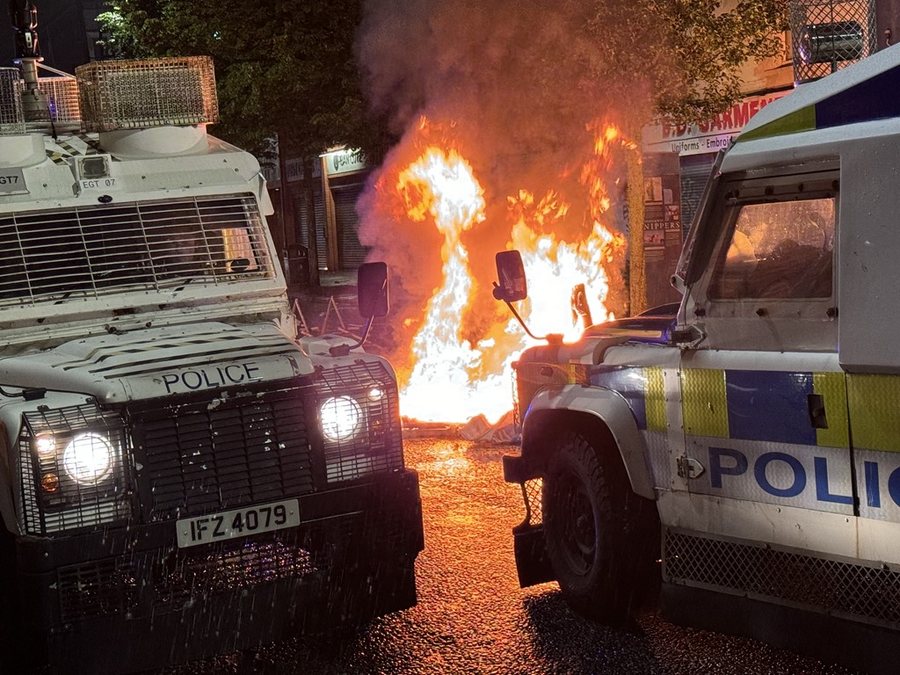
The chants and rhetoric used in these rallies show that a large part of the protesters are incited and directed by the former leader of the English Defense League.
While the recent protests in Great Britain have obviously relied on the far right to get the necessary publicity, the latter are not the only people being seen on the streets at anti-immigration rallies.
Sunday Times reporters have noticed a mix of far-right activists, thugs mainly interested in violent clashes, but also local residents who link migration to their area with concerns about the rising cost of living crisis.
On the other hand, the crowds have also been incited by spectators and teenagers, who are on summer vacation, and who have come out into the streets and squares to join the ranks of the protesters and challenge the police forces. In the opposing camp, we see a mix of anti-fascist organizations, including Hope not Hate and socialist groups.
These have tried to divide the extreme right, occupying the city centers.
Former anti-migration protests, especially those organized on the eve of the Brexit referendum in 2016, were brought under violent control by the extreme right.
They were active only after the main protest was over. This time the protests are different. The gatherings are not so well organized. In most cases, they originate from an anonymous account on the Telegram or TikTok platforms, before the plan is amplified by Tommy Robinson, real name Stephen Yaxley-Lennon, who has close to a million followers on X/Twitter.
The chants and rhetoric used in these rallies show that a large part of the protesters are being incited and led by the former leader of the English Defense League (EDL). Many of the people marching are young, but there are also women.
This has prompted some experts to suggest that this new wave of protest has important differences from the mobilization of only segments of the far right in recent years, which are dominated by "casual football fans" or hooligans.
Why have these people taken to the streets?
The spark that sparked the riots, a macabre knife attack on a young girls' dance class in Southport, quickly degenerated into a wider sense of hostility to mass migration. This despite the fact that the defendant in this case, who is accused of murdering 3 little girls, was born in Cardiff, Wales.
So he is a second generation immigrant, with parents who came from Rwanda. "There are many immigrants here. It is impossible to make an appointment with the doctor, as they are giving priority to foreigners and not to our people. This situation must end. If we were to go to their country, they would lock us in prisons!"- declared an elderly woman who joined the protest in front of a mosque in the city of Liverpool.
The overwhelming distrust of politics in general, fueled by highly influential far-right figures such as Robinson and Andre Tate, has also been instrumental in fueling this movement.
The police are being labeled by the protesters with the derogatory nickname "nonces", a symbol of anger at the failure of law enforcement to curb the activity of Asian criminal gangs in the 1990s and 2000s. They also complain of double-standard policing, and because of the belief that white Britons are more heavily policed than Britons of Asian origin or black communities.
Others attend these protests looking for a fight, in some cases clutching beer cans. They have seen counter-protesters on social media, and are prone to a physical confrontation with them. In some cities, protests degenerated into violence, looting and attacks on local shops.
Shocking videos last weekend showed groups of white men attacking lone black or Asian people walking to work in city centres, while witnesses in Liverpool claim Muslim-owned shops were targeted.
In Stoke-on-Trent, such gatherings forced the Asian and Kurdish communities to form gangs armed with sticks and poles. Hundreds of teenagers and young adults rushed to Hanley town center in Staffordshire, masked and armed with makeshift weapons and fireworks, in what they described as an attempt to "protect the mosques".
A resident of the area claimed to have seen young people "buying pencils from arts and crafts shops, and modifying them to look like knives". And in Stoke-on-Trent, a crowd of more than 200 members of the Kurdish community, joined by British Muslims, surrounded the Masjid Salahuddin mosque, which had earlier been targeted by far-right protests.
In retaliation, the group of men and children rushed under a bridge, which had two police cordons, in an attempt to attack the other group's protesters. Two men from far-right supporters were seen seriously injured by heavy weapons and taken to hospital by police officers./ Adapted "Pamphlet" from "Sunday Times".


Lini një Përgjigje