


 Shkruar nga Pamfleti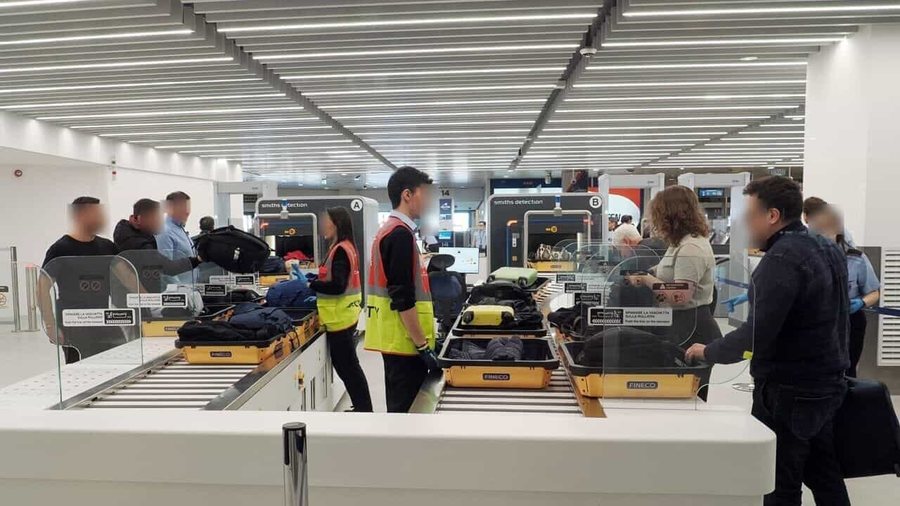
The European Civil Aviation Conference (ECAC) approved on July 25 the possibility of transporting liquids in hand luggage above the limit of 100 milliliters. With the new changes, passengers are allowed up to a maximum of two liters when traveling by plane. This means that perfume, lotions, shampoo, beer, bottles of wine and oil are allowed within this new limit. This rule, however, only applies to airports equipped with state-of-the-art scanners capable of accurately detecting the presence of dangerous materials inside bags and trolleys. However, not all airports enforce it, and there are risks involved in transporting liquids above 100 milliliters.
Scanners at airports
The new rules risk being costly for passengers who decide to carry liquids exceeding 100 milliliters in their hand luggage. The reasons are varied, but they all revolve around the fact that the measure only applies to airports equipped with the latest generation scanners. Next-generation scanners have already been installed at numerous European airports, including Milan (Malpensa and Linate), Rome Fiumicino, Bologna, Turin, Dublin, Belfast, Edinburgh, Paris (Charles de Gaulle and Orly), London (Heathrow, Gatwick, Southend), Birmingham, Madrid, Palma de Mallorca, Düsseldorf, Cologne, Hamburg, Berlin, Frankfurt am Main, Stuttgart, Munich, Prague, Bratislava, Sarajevo and Malta.
What happens if you exceed 100 milliliters?
The problem, however, is that not all airports have decided to implement the new rule for liquids, despite being equipped with next-generation scanners. Therefore, these airports continue to prohibit liquids exceeding 100 milliliters in hand luggage. The consequence of not implementing the rule at all airports is that, if you arrive at the airport with liquids exceeding 100 milliliters in your hand luggage, you will either have to leave them at security or you will have to check them in as checked baggage, paying the additional baggage fee.
The cost of checked baggage purchased at the airport varies from airline to airline, but is still quite high. For example, Ryanair charges between €35.99 and €75 per flight, while Vueling charges between €40 and €75. WizzAir charges €70 and Easyjet €65. With ITA (for economy class tickets), the price starts at €60 for flights within Italy, €70 for European flights and reaches a maximum of €130 for certain destinations such as Japan, the United States, Brazil and Thailand. If you are carrying more than 100 milliliters and are boarding from an airport with state-of-the-art scanners, as not all airports have decided to implement this rule, you will only find out whether your liquids will be allowed or not once you reach the checkpoint.
"Precisely to avoid unforeseen costs for passengers and to overcome the chaotic situation currently developing in the air travel sector, we are asking ENAC today to publish on its website an updated list of airports that allow liquids exceeding 100 milliliters in hand luggage", is requested by the consumer protection associations. If the updated list of airports that have allowed more than 100 milliliters of liquids in the cabin were published, passengers would be informed in advance and would be able to make informed choices, avoiding unpleasant surprises at the airports through which they will depart or transit this summer, explains the association. / Adapted from Today /




Lini një Përgjigje